
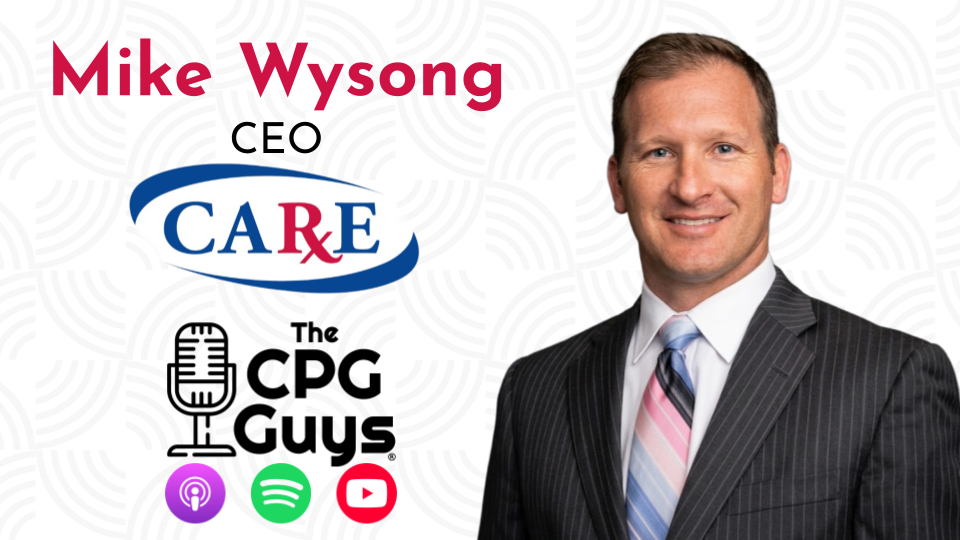
Thriving Independence in Challenging Retail Times with Care Pharmacies' Mike Wysong



 Apple Podcasts Apple Podcasts
  Spotify Spotify
  YouTube YouTube
  Overcast Overcast
  Amazon Music Amazon Music
  Audible Audible
  iHeartRadio iHeartRadio
  Castro Castro
  TuneIn TuneIn
  RSS Feed RSS Feed
  Audacy Audacy
  Castbox Castbox
  Fountain Fountain
  Goodpods Goodpods
  PlayerFM PlayerFM
  PocketCasts PocketCasts
  Podcast Addict Podcast Addict
  Podchaser Podchaser
  Podurama Podurama
  Podverse Podverse
  Podyssey Podyssey
 The CPG Guys are joined in this episode by Mike Wysong, CEO of CARE Pharmacies, Inc., a growing pharmacy network having served communities like your own for more than 64 years.
CARE Pharmacies combines the quality of a trusted local pharmacy with the growth and stability of a national organization. With over 130 pharmacies nationwide and growing, CARE understands its patients, their special needs, prescriptions, local community health concerns, and the importance of personalized CARE - the building blocks to a healthy family and a strong local community.
Follow Mike on LinkedIn at: https://www.linkedin.com/in/michael-wysong-a01626b/
Follow CARE online at: https://www.carepharmacies.com/
Mike answers these questions:
- What is the biggest lesson from those early days carrying the bag that you still lean on today as a CEO?
- What was that first fundamental structural or cultural shift you had to make to change that trajectory?
- How do you get independent owners to genuinely align on shared procurement, brand messages, and technology without stripping away that local entrepreneurship that makes them special?
- How does a cooperative structure create the necessary scale to let local community pharmacies win on price?
- From your seat, how can consumer product groups (CPGs) and OTC manufacturers better bridge those gaps to collaborate with a regional pharmacy layout like CARE?
- What are the top criteria or data-backed insights an emerging brand needs to bring to you today to earn shelf space over a legacy CPG giant?
- For emerging wellness or OTC brands listening to this show, what's your advice on the sales function—should they try to go it alone, or do they need to hire a specialized broker who truly understands regional drug chains?
- How are you helping independent pharmacies roll out complex tech, health informatics, and AI tools without eroding the high-touch, hyper-local intimacy that defines community pharmacy?
- As baby boomers choose to remain in their homes longer, how does the role of the community pharmacy transform from a simple script dispensary into an essential connector of the home health ecosystem?
- How critical is having a real-time view of inventory and fulfillment data to protecting your owners' bottom lines?
- As a board member and past chair of the NACDS, what is the most urgent story the industry needs to keep telling to protect its clinical and commercial relevance?
- What is the single biggest blind spot that corporate CPG executives have when they try to partner with independent, community-based retail networks?
CPG Guys Website: http://CPGguys.com
FMCG Guys Website: http://FMCGguys.com
SheCOMMERCE Website: https://shecommercepodcast.com/
Rhea Raj’s Website: http://rhearaj.com
Lara Raj in Katseye: https://www.katseye.world/
DISCLAIMER: The content in this podcast episode is provided for general informational purposes only. By listening to our episode, you understand that no information contained in this episode should be construed as advice from CPGGUYS, LLC or the individual author, hosts, or guests, nor is it intended to be a substitute for research on any subject matter. Reference to any specific product or entity does not constitute an endorsement or recommendation by CPGGUYS, LLC. The views expressed by guests are their own and their appearance on the program does not imply an endorsement of them or any entity they represent.
CPGGUYS LLC expressly disclaims any and all liability or responsibility for any direct, indirect, incidental, special, consequential or other damages arising out of any individual’s use of, reference to, or inability to use this podcast or the information we presented in this podcast.
Speaker
I'm Mike Wysong. I'm the Chief Executive Officer at Care Pharmacies, and I'm on the CPG Guys Podcast.
Speaker 1
Hello and welcome to the CPG Guys Podcast, set at the intersection of commerce and tech. Your hosts, Sri Raja gopalan and Peter V. S. Bond, explore how brands and retailers engage consumers in a digitally driven world. And now here are the CPG Guys.
Speaker 2
Hello and welcome to this incredibly special episode of the CPG Guys Podcast. I'm Sri your West Coast co-host and also CRO and co-founder at ThinkBlue Consulting, your trusted partner in your Omnichannel journey, where you can get in touch with me at Sri at thinkblueconsulting.co. Please do listen to my older daughter's music at www.rhearaj.com. Younger daughter Lara Raj of the band Katseye was nominated for three AMA Awards out in Vegas. You can follow all of those pursuits on my personal Instagram and TikTok. Joined today by my East Coast co-host and co-founder of PVSP, who also Moonlights as head of industry and client engagement at Flywheel, Commerce Acceleration Division of Omnicom, and lately I've changed his name. I'm calling him the Proud Father of a Future Pro Golfer, Nadia. Peter, so our C-suite lead up to episode 600 continues. It's a special day for us. First tell me what's going on with the golf. Did you get those first lessons with the pro in yet?
Speaker 1
Alright. So yes, we got the first lesson. I booked two more, and I just registered her for her full week of golf camp as soon as she's out of school.
Speaker 2
So yeah, I'm we're This is true love for the sport. But does her community.
Speaker 1
Daddy's not forcing this on his daughter. She came to me and said, Dad, I want to learn how to play golf. That's what I'm saying.
Speaker 2
This is true love for the sport. This has nothing to do with female scholarships in golf, outdo male by nine is to one. Nothing nothing.
Speaker 1
No, but she did say to me, Daddy, I only want to do this as a hobby. You know, I've already decided I'm going to be an artist as a profession. So I'm like, okay.
Speaker 2
Peter, 600 episodes. We're doing a C-suite series. We have very important guests today as part of that. Any thoughts, Peter? Yeah, sure. Why, man, six years.
Speaker 1
It amazes me at how far-reaching our podcast has become, how much a topic of conversation is among so many people, the content we post on LinkedIn, the appearances we make. We've got big activations this summer at Cannes. We are also, again, hosting our executive education program in Omnicommerce up at Cornell this summer. So the great guests that we have leading up to episode 600, it blows my mind, Sri. Some of the real thought leaders of the industry coming to have a conversation on our platform. Great honor, Sri, and I love doing this with you as always.
Speaker 2
Yes, indeed, sir. I want to thank all of you that listen to us on our sponsors. Without you, this podcast doesn't exist. In my wildest dreams, I don't think Peter and I imagine leaving corporate America and doing this. So here we are. Thank you. Make sure you are subscribing to our podcast on your preferred listening platform where you can get our latest episodes, go back and consume some of our 590 plus episodes we've already published. And while you're there on Apple or Spotify, give us a five-star rating. Why? Only because Peter loves the number five, not because I am asking for it. Bottom line, it makes Helpa podcast more findable by industry. Contemporaries are looking to be educated and entertained now for the magic moment or special guest. If you've been paying attention to the retail and healthcare landscape lately, you know that the old way of measuring success is officially moving out the window. Between the explosion of omnichannel behavior, the rise of wellness commerce, the shift towards first-party data ecosystems, brands are finding themselves swimming in a sea of data but striving for actual operational alignment. To help us cut through the noise and find the signal, we thought we should get a true heavy hitter who's essentially building the blueprint for the future of the independent pharmacy networks. I really discussed this one with Peter. We really wanted to get into health and wellness, and we said, let's ask a CEO of a pharmacy network if they'd be willing to come on the podcast for the special series. He obliged. He's the CEO of Care Pharmacies, a board member and Proschev, none other than NACDS, the power player in the health and wellness space. So please do join me in welcoming to the CPG guys, Mike Weissong. Welcome to the show. How are you doing, man?
Speaker
I'm doing awesome. I appreciate both of you having uh me here with you today. So thank you for the honor.
Speaker 2
We can't wait to get started. Thank you for that. In the digital show notes of this episode, we'll have links to your LinkedIn profile, care pharmacies, corporate websites for our listeners to access while we go on with the conversation. So I'm going to jump right into it. And you know, we always troll our guests to dig into their backgrounds. And I realize you actually graduated for the Virginia Military Institute. I actually went to Virginia Tech. So very familiar with VMI. Yep. We had many of those VMI students come over to campus often. So your early tours of duty took you straight to the front line of healthcare sales, I believe, and distributed giants like Cardinal Mary Sosberg. And give us those big lessons from those early days carrying the bag that you still lean on today as a CEO.
Speaker
You know, I have to tell you, I think Virginia Tech actually was the first core of cadets in Virginia, if I'm not mistaken. So I'll have to tip my cap to you on that.
Speaker 2
That is a hundred percent accurate because we would say that often while in school.
Speaker
So I think whether it's Virginia Tech or VMI, I think the foundation uh that those two institutions were built on was really the foundation of trust and the importance of that. That's why the honor code the honor code is so important there, right? You don't lie, you don't cheat, you don't steal, you don't tolerate those who do. Uh so I would say that's kind of the first lesson that you learn from going to a place like that. And then obviously your classmates at VMI would call them brother rats, which sounds terrible, but it's actually a term of endearment. And so the two things that you learn immediately are trust and the importance of the relationships. And as it turns out, those two things are pretty much everything, guys. So I graduated in the early 90s, was hopeful to go into the military desert storm was winding down, so there was really nowhere to go. Uh, so I took the first job I could get, which was in healthcare, uh, and I did what I thought was the right thing to do, and I just kept showing up for all my customers. And when I didn't know what to do next, I showed up again and I followed up, and I realized that was a pretty effective form of uh building trust. Retrospectively, it was transactional trust, but it differentiated me because I thought maybe showing up and following up were low bars, but as it turns out, they weren't. At some point in time, uh I ended up with customers who would ask me questions about, hey, you know, because you've worked at these places, what's the best way for us to proceed? Which was an early indication that they trusted me based on my expertise and competence. And so over a period of time, there was a shared foresight that began to develop. And I realized the importance of being transactionally responsible and also having a shared foresight with your customers. And when I did that, it became indispensable to them. I they would call me for advice on what to do and how to navigate through that. Um, and so looking retrospectively, that's how I've tried to run care pharmacies to make sure that we're doing the right things to demonstrate to our customers that they can trust us, but also at a high level that we can lead them across a pretty dynamic terrain at a pretty uncertain time. So I would say those were probably the biggest lessons that I learned.
Speaker 1
Mike, welcome to the podcast. It's great to have you here. You mentioned about the legacy of trust. Uh, I read last week uh the sad news that after 133 years, the honor code at Princeton, when it comes to exams, was being terminated. They are starting proctoring again. And it's all because of AI. Both students who didn't uh being affected by people who did cheat and the curve working against them and professors being worried about, they both went to the to the board and said, we need to start proctoring exams. So I don't know if that's an indictment of the society we're in, but it's certainly something to consider. And I'm sure it heartbreaks both your heart and sh and Shree as much as it does mine.
Speaker
Well, it does mine because of the importance of that. And I could tell you as a young cadet, we would take all of our exams in our room on our honor, and we'd have to time ourselves, and we didn't think for a second to go past that time.
Speaker 2
So I think those were probably simpler days, but I I gotta tell you guys, I've seen both aspects of the spectrum. Growing up as a younger kid in India before coming to the United States, the rooms were proctored. And then coming to the United States, I was I didn't see any proctoring whatsoever, so I've seen both sides of the fence. I'm a deep believer now that AI is part of life at this stage, and Mike, I'd love to get your opinion on that with that. I think I have a question for you on that later, but regardless, in life in general, isn't the rule adapt to the environment versus forcepitting our views? And I think kids are gonna use AI when they go home anyway. So why not let them just use it? Because they're gonna use it in the real life when they grow up into shoes like yours and mine or Peter's.
Speaker
There's no question, AI is changing everything and the accessibility of the information. I uh there's no question about that. Um I think there is a harmonious balance that exists between refining the new technologies that are coming in and still paying reverence to the foundation of not lying, cheating, or stealing. So finding that will be the art of the science, I think.
Speaker 1
I just keep going back to the question do I want to have heart surgery by someone who got through medical school using using an AI bot? But in any event, Mike, back in 2010, you were a 39-year-old executive inheriting the inheriting a company that was facing, I think, some real profitability headwinds. You completely flipped the script and turned care into a rapidly growing retail co-op powerhouse. From your perspective, what was the first fundamental structural or cultural shift you had to make that really changed the trajectory to put care where it is today and on a path to success?
Speaker
So when uh so when I took over as the CEO in 2010, I could tell you I was so excited to be a CEO before I was 40 years old. It was like a dream of mine to run something. And uh I realized quickly the importance of this thing called cash flow. So, as it turns out, guys, if you have money, you get to make decisions with it. And if you don't, those decisions get made for you. So I was forced to really um get down to some of the problems that were driving that for the organization. And when I was able to sort through that, um, it allowed us to kind of redeploy some of those assets into more forward-basing, proactive programs for our customers. I think looking back, I think the biggest thing that we had to do was really change our mindset. You know, if you look at care, it's unique on so many fronts. It's structured as a drug chain deliberately, but really it was a retail buying group and kind of a loose affiliation of independent pharmacies. I realized quickly that the group is a high-touch provider group because of all the HIV business down in DC. And so I think we had enough foresight to know that we were going to be operating in ways that traditional pharmacy wasn't operating at the time, but likely would in the future, and we did some preparation around that. The other thing we did was we tried to make sure that we had continuity of care. And I thought that making care look like a drug chain would, in the eyes of our partners, be better than just a loose affiliation, which is why we started going to NACDS and participating really at the chain level. I think to your earlier point about balancing AI and some of these more foundational things, that's something we've had to balance our entire time between is care a chain or is it really a group of independent pharmacies? And so we've tried to make sure that we get the benefit of both of those things without the expense of both of those things.
Speaker 2
Well said, but the one thing that comes to mind we where you when you literally say without the expense of those things is you know, Peter and I are aware that independent pharmacies are fiercely, fiercely protective of their independence. One of those two things, which can make driving centralized operational continuity, I'm sure, feel like a little bit of a challenge. But yet, what we notice is you scale care to over 200 locations across 28 states. No joke, huh? How do you get independent owners to genuinely align on like shared procurement, brand messages, technology without stripping away that local entrepreneurship that makes them special? We've seen this in retail over our careers, in like grocery retail. Are you applying the same blueprint? Is something else going on here? Our audience would love to hear your viewpoint.
Speaker
Yeah, it's it's kind of some of the nuance that I talked about earlier. You know, care doesn't own any of its pharmacies. It's a cooperative, and that has its benefits to it, right? You end up with these individual unique providers that are customizing their programs and services based on the communities that they serve. I I love that. I think that is inherently the strength of care. The challenge with that is how do you bring that together into some scope of criticality in terms of scalability, right? And so the bottom line is we can't force that. And so I say the greatest form of leadership is getting people to come together in areas of critical need and then basically mentoring each other across that. It's almost a voluntary leadership type model. And we've been pretty good at figuring out where to standardize without overstandardizing at the expense of the individual provider.
Speaker 2
You know, I've been trying to figure out how to get Peter to volunteer to be mentored. Any suggestions?
Speaker
Well, he has to be the idea that you might say something intelligent to him, Rock.
Speaker 1
Well, that doesn't happen much, Mike, so that's the issue. That's it in a in a in a box free. So, Mike, I know that you were also a founding member of the Buyer Alliance and Roundtable Sourcing to try and aggregate the purchasing power. What's interesting to me, and I this became so evident in the wake of the pandemic, I looked at a lot of the retailers that were facing issues around allocation. And uh, and if you walked into the big box retailer, they had all the inventory and the locals, well, they got what was left over, kind of the you know, the table scrap. So I guess my question is this in an era where retailer, uh, retail is fairly dominated by these big box giants, how does a cooperative structure create the necessary scale to let those community pharmacies win on price, among other things?
Speaker
You know, I have to tell you, my uh roundtable sourcing or the buyer's alliance story is one of my favorite stories, guys. Um, back when we got care kind of flipped around, I had a drug rep that had visited our corporate headquarters and he was lost. And uh I went out to greet him and gave him a cup of coffee. His name was Mario Harris, and I'm sure Mario will probably listen. And uh at the end of it, Mario goes, Hey, I'd like to ask you if you'd like to be on our advisory board. I said, That'd be great. He said, We're gonna have a consulting group come down and talk to you. So they did, and at the end of that, they were like, Will you chair the advisory board? And of course, I was excited at the possibility to do that. And while I was at my meeting, I sat next to one of the the people from this company in Texas that I had never heard of. And I and I asked him, I said, Well, what's Heb? And he goes, Well, this is uh HEB. And I had not heard of HEB. And he goes, you know, we're the largest employer in the state of Texas, um, and you know, one of the largest privately held companies in the country. And he and I became good friends, and so the relationships that were formed in some of those early advisory board meetings are what led to the foundation of that. So it's kind of funny how that works. Um, from a scalability perspective, again, you know, care has in its core this high-touch provision, which is great, but it lacks the scale. So when you're in that situation, uh like a regional chain or some of these hub-based provider models, the relationships that you form become critically important in terms of being able to scale that. Um, one of the benefits for us was that you know, we don't have this huge governance structure. We can make decisions pretty quickly, um, which I think is great. So, you know, we're we're we're very deliberate. Um, we're very quick in terms of of making those decisions. Um so again, I think a lot of the success of care has been around the partners that we've picked and chosen. Uh the HEB and the Buyers Alliance are just one example of many of those.
Speaker 2
Understood pretty well, Mike, on that one. Um But I want to go back into now when you work with independent pharmacies and you work with the industry, the Heb example is a great, great example, right? Like awareness when you're independent of the larger picture might not be that easy. It's probably because people work in their own silos. So let's discuss breaking down those industries, industry silos, which I'm sure in pharma comes with this additional set of complexities given you have to deal with many more middlemen than the grocery industry does, which Peter and I come from. You noted recently that the real growth opportunities lie in the gaps, exactly those middlemen areas. Payers, manufacturers, wholesalers, retail remain siloed. They got their own PLs to worry about, they're all worried about, you know, executing against their own operational plans. From your seat, think of RLife Mike CPGs, and you and I run into a lot of CPG conferences often, right? Like FMI, etc., NACDS. How can consumer product groups and OTC manufacturers better bridge those gaps to collaborate with a regional pharmacy layout like what you're doing as the leader?
Speaker
So I think our industry is so fragmented. You just mentioned a couple of them, the manufacturers, payers, the providers. We're in the middle of great change in terms of the provider models, in terms, you know, looking at historically being more of a reactive dispensary to more of a proactive, comprehensive wellness provider. That is all taking place today. And I think if you're a CPG company or an emerging brand or product, there's a real opportunity to partner with groups like CARE or some of these more regionally based high-touch providers. And I would say the folks that come to us that really are looking at more outcomes-based opportunities and to do that, you know, I mentioned creating this transactional reliability, but com the CPG companies that come to us with kind of that higher thought process in mind to try to make themselves indispensable and helping us close those gaps, those are the ones that we will typically, you know, sign preferred partnerships with or will spend more time trying to figure out how to improve the lives of the people that our stores are servicing.
Speaker 2
Because you're touching so many different stakeholders like the ones I named, you're probably touching others that I don't even we don't have awareness of. This can't be easy to bring them all to the table and figure this out. Like what does your average day look like?
Speaker
Well, I mean, again, it depends on the stores. If you look at care and it's one of the uniquenesses of care, and it's it's it's one of our strengths and our challenges. I hate to tell you, we are like the quintessential paradox theory, which are two things can be absolutely true at the same time. I mean, care comprises retail pharmacy, specialty light, mail order specialty, home infusion, rare orphan drug, long-term care, hospice. So you have all this class as a trade. You have you have to cater to that. So I would tell you the good news is that you have a comprehensive view of all of that. The downside to that is that you have to be very deliberate in catering to the individual needs of that. So I would say, you know, an average day looks like making sure that we're very proactive in our connection with our customers, but also guiding the organization forward around the next models of care and making sure that the stores are properly positioned within it through some of the new technologies that are coming, through new partnerships. The sourcing pieces continue to be a huge portion of this because of the of the dollars involved in that uh and some of the reimbursement challenges that continue to plague the industry. So a lot of it is out on the preferred partner side. And then I'm a super big fan of making sure the stores hear from the CEO occasionally. It's a nice thing.
Speaker 2
Can I can I follow up with one on that, Peter? So when you say you're a super big fan of hearing from the CEO occasionally, do you do that digitally? Do you all get together a couple of times a year? Like, how do you travel? Do you have to head out and meet individual owners? Like, how does that work?
Speaker
I d I do. It was uh so one of my favorite things is getting around and showing up. I think showing up is a direct representation of what you think, you know, what you think of the people that you showed up for. I'm a very big fan of that. The good news for me, you know, we have a lot of responsibility in some of the associations that we're a part of, whether it's NACDS or N CPA, more NASP, you know, just to name a few of those. So, because of the diversity of the membership and the location, I can kill two birds with one stone. I can represent our store. And our industry simultaneously, it kind of goes back to that speed and focus perspective. I have the luxury of that, given the scale and size of care. So just making sure that we have a nice balance of representing the industry and the individual needs of the store as the models continue to change. But I tell people all the time, if you have ADD, man, pharmacy is the best place to be because it changes one minute to the next. No kidding. No kidding.
Speaker 1
So, Mike, in about a little over a decade ago, I ran loyalty and personalization for a certain pharmacy retailer based out of Rhode Island. I think you can put the pieces together. The front of store in a pharmacy has become a major battlefield, especially for consumers who are looking for more holistic health solutions, preventative wellness, and food as medicine in many cases. The thing that I found in my time is most of the attention went to the really big players. They just demanded a large percentage of the attention of the merchandising group. So I guess, you know, from your perspective, if there are challenger brands, ones that are bringing some of these new innovative solutions to the table, what are the top criteria or data-backed insights that one of these emerging brands needs to bring to care to really help earn the shelf space over some of these legacy giants that that are relying on the sheer force of their distribution capabilities?
Speaker
Yeah, and there's a place for the sheer force of distribution and the big retailers. I think there's still going to be a place for those, for those entities. You know, that's all changing here, and and and you guys know that because you see it every day. But I think, you know, from our perspective, you talked about food as medicine, nourishing change. I think those are proclamations that pharmacy is moving from this very reactive model to this more holistic, comprehensive, proactive. How do we, how do we head these things off before they begin, right? I mean, I went back and looked at some of the health, the data trends from a decade ago in terms of the rate of diabetes, body mass index, insured versus uninsured. I mean, a lot of these trends have continued to be unsustainable, which means you're gonna have to take pharmacy at some point and use it for the capability that it's best positioned to serve and do it in a proactive way. So I think if you're an emerging brand trying to figure out how to validate that clinically for a potential customer or patient is a really great way to do that. I think there has to be some differentiation of the product and to do that, you know, in an authentic manner, um, not just in terms of claim, but be able to support that clinically for a group like care pharmacies. And then I always go back to the way I started here, which is we also want partners that are understand the nuances of our business because we are heavily nuanced, and then can help us figure out, hey, you know, here's where you are. You haven't even thought about where this is gonna go. I often say, I know I have a good partner when they start off with, hey, we think we have a terrible idea. Do you want to hear it? You know, I'm all in on that, right? So you go, okay, you're looking at this through a completely different set of lenses, maybe in a way that we haven't, because we're constrained either through our own track record of success or our own way that we move through it. So I would say it's it's it's probably a combination of those things.
Speaker 2
I'm glad you've kind of put that out there. You know, I worked for three decades prior to having my own ventures now in a CPG setting, called on retail three decades for a living, like who's who in retail. The last two years I've had opportunities to work with retail very differently than I did in the past, where it was more about one product where I was a DST. And I've realized retail and CPG actually don't work towards the same objective. We're actually not holding hands to serve the consumer, working towards our either our own brand or meeting our own PL. I'm not even sure we're working towards common community goals. So I'm glad you kind of put that out there. But a reminder to our audience for speaking with Mike Wysong, CEO of Care Pharmacies, as part of a special C-suite series leading up to episode 600 and beyond on June 17th. Mike, the next one, the CPG guys have learned that you're a big racing car guy. And you once told a great story about totaling your race car on your very third race. Tell us more about what that means, racing car guy. You realize that paying for an expert pit crew was worth every single penny for emerging wellness or ODC brands listening to the show. Therefore, what's your advice on the sales functions? Go along, hire a specialized broker who totally understands the drug industry, or let's say the wellness industry.
Speaker
Hire the pit crew. It's an easy one. So I'll tell you what happened because it's a really funny story. So I got into racing and I loved it. Uh and I realized that I loved it because it's the fine line between being in control and out of control, right? You're super fast if you can find that line, and it's just further over for the people that are a little bit faster. So in my early days of racing, I had two great races right out of the gate, and I went, man, I can do this by myself. I don't have to spend the money on a pit crew because I'm never going to run into anything because I'm so good. And on the third race, I ran into something and realized quickly you don't need it until you need it. And I spent the night underneath the race car in the pits and did a terrible job repairing the car and had a subpar performance the next day during the race because I was inadequately prepared. And so it was a really great lesson that you want to make sure that you partner with people that are best positioned to provide the guidance, especially when something goes wrong and help you get back on track so that you can get across the finish line.
Speaker 2
Mike, for the benefit of our listeners, curious, especially the emerging health and wellness brands, which we have plenty of followers doing that. Could you give a could you give a quick overview of when you hire the PQ, the sales force, what can they expect in terms of ROI?
Speaker
Yeah, I mean, they'll tell you how to set the car up faster so that you don't have a lot of wasted motion or a lot of wasted movement. And time is money. And and I would tell you, you know, when I hired the pit crew, they they pointed out a bunch of things in my driving style that would make me much better at it. Um when I had an issue, they were there to solve and fix it. So I think hiring brokers or folks that have been up and down the mountain from point A to point B a hundred times, they're they're Sherpas. They just they'll help you not make a bunch of unnecessary, silly, costly mistakes. And in pharmacy, especially in specialty pharmacy, you can't do that. It's not sustainable. So you're better off surrounding yourself, like I said before, with people that are capable and competent, particularly in places that you're not, which is why I'm still an amateur road racer.
Speaker 2
I I am so sorry. I am I am really curious what race car you're driving these days.
Speaker
Well, I have I have a spec racer Ford, um, and it's still down in Georgia. Um, but I love cars, my personal cars. I love fast things that are bright and sparkly and shiny and too low to the ground.
Speaker 1
All right. Well, well, I'm I'm I'm an I'm uh an amateur uh amateur podcaster. I'm hoping someday to get good at it, Mike. I figure after 600 episodes, it's about time I kind of pulled my own weight here and stop making Shree be the intellectual. But let's let's pivot to an area that I like, which is technology. Uh retail pharmacy really is facing a bit of a revolution right now around technology. Uh I know the care recently overhauled your digital pharmacy marketplace. And when I think about how challenging it is for independent to keep up with very large, massive retailers that can invest, build, and amortize across thousands of stores, right? How are you helping independent pharmacies roll out pretty complex tech, health informatics, and AI tools without eroding the high touch, hyperlocal intimacy that really has defined the community pharmacy that comprise care?
Speaker
It's uh it's a great question. So, my short answer to that is we're trying to be extremely deliberate in how we do that. One of the challenges, we get so many calls a week because there's such going on in the data informatics, the digital health space today, trying to sort through what it is and what it actually accomplishes is a Herculean task for us. And I say all the time, imagine pharmacy is single-handedly keeping the fax machine alive, right? And so when you look at health data and all the refinements that are coming through, we talked about them at the beginning of this show. It's changing the way we serve our customers. The question is, is it is it changing it in a good way? I think that pharmacy is intended to have an intimate interaction with the patient and to be able to spend as much time triaging some of these chronic disease states. I think the challenge and the trap here is that the redeployment aspect of technology could actually take the pharmacy and the provider farther away from the patient. And so, from my perspective, that's what we're trying to do. We're trying to make sure that we're deliberate and whatever technology is rolled out is deliberate and allows our pharmacists to spend more quality time with the patients.
Speaker 2
Very true. We could not agree more with you. I'm going to jump from what we've been discussing so far, the complexity of doing what you do every day, working with so many stakeholders into some macro trends and how it's impacting the industry. So we've heard that you've done some incredibly innovative work with the AARP around, and for the benefit of our listeners, that's a may take an association of retired professionals around aging in place solutions, you know. Suddenly I look at my own age, I may qualify to be an AARP member. I don't think I may I will.
Speaker 1
You do, Sri. You turned 15.
Speaker 2
Can you not age me, please? Can you not age me, please? But as baby boomers choose to remain in their homes longer, how does the role of the community pharmacy transform from a simple script dispensary into an essential connector of the home health ecosystem, which is what you were alluding to, have that relationship?
Speaker
If if you need me to sign you up, the folks at AARP, I'm sure, are happy to have you as part of the crowd. Um so I had a funny thing that happened to me a couple of years ago. I ran into the folks from AARP at an NACDS meeting and we started chatting. And I hate to, I hate to admit this, but I didn't realize the health trends of people that are getting cared for at home. And it dawned on me that that is the epitome of high-touch care providing for folks that want to be cared for but either can't afford it or they're not mobile. Um, and you look at the trend on that, it is overwhelming. It is it is definitely an area of opportunity uh to improve the lives of the people that are that are receiving the care at home. Um I think about pharmacy in its role. I also think about specialty pharmacy as a specialty pharmacy provider. It's just the next version of what I think is specialty pharmacy. Um I think we're trusted connectors and care providers, and that the ability for us to have a suitable solution for those folks, we're a natural fit for that. So I don't think there's anybody better positioned to that. Some of the work that we're doing with AARP, we're we're we're in the process of amplifying that uh in proof of concept with the hope of rolling it out on a more national footprint. But I think that's just indicative of of where these models are going.
Speaker 2
You know, I love that you guys have focused on one of the biggest, I would say, associations that exist for the baby boomers. 50 plus is in this case ARP, because all the conversation in the industry we hear 95% of the time Gen Z Alpha, Gen Z Alpha, Gen Z Alpha, maybe millennial.
Speaker
No, it's it's the the more I get involved in it, the more you know I'm committed to it and the more passionate I am about it. And I think it's it's another one of those areas of opportunity where pharmacy, I think, is best positioned to really meet a growing and unaddressed need.
Speaker 1
Mike, when Sri and I were younger, we would always wonder to ourselves, why are our parents always talking about all of their ailments? You know, it seemed to occupy most of the conversation. And increasingly, that's something Sri and I are talking about, comparing what are you doing? What is what's your issue? How are you dealing with it? So it it is it is beginning to consume the uh the lives of these two Gen Xers uh as I'm on the uh the beginning of the that particular generation.
Speaker
I'm right there with you, and it happens pretty fast. And so I always say you have to be careful about talking about them because it's not too long before you're one of them.
Speaker 1
I am feeling that pain. So uh, Mike, uh on the CPG guys, we focus very much around the intersection of commerce and technology. Um Sheree and I talk a lot about the speed to insights and breaking down data lags in in this highly digital world, especially in independent pharmacy where margins are really razor thin due to intense pharmacy benefit management pressures. I know that also from my time at uh at a company that had a PBM built into it. You know, how critical is having a real-time view of inventory and fulfillment data uh to protecting your member pharmacy's bottom lines?
Speaker
It it it's uh it's not critical. It's it's X and it's existential, right?
Speaker 1
Yeah.
Speaker
So when you look at the cost of the medications, particularly for us, right? These specialty branded drugs, the biosimilars, they're not inexpensive, right? And so if they're sitting on the shelves and you have overstock, that's not good. If you don't have the inventory, that's not good in either direction. And so, like I said, the the cash flow for us, especially as independent pharmacies, so much of that is sitting in these little stacks of money behind the counter. And so managing that in the most operationally efficient way while we're looking at areas of opportunity for more high margin clinical services, is really the art of the science in being able to balance those. So cash flow is still king. You look at the reimbursement challenges, you can't make a lot of silly financial mistakes, and a lot of that's tied to inventory management and being effective in what is and isn't on the shelf.
Speaker 1
Yeah, Mike, and uh I was it's so funny. I was in New York City on Thursday at a conference and I get a phone call. It's from my PBM, you know, and and they're the they're part of the ecosystem, but in many regards, they're your competitor. Why were they calling me? They were trying to convince me to move my prescription from my current provider, my local provider down the street, to having it all delivered via mail via their provider, their own system. I mean, it's a it's a tough world when you're you have to deal with these people, and to some degree they're they're part of this ecosystem that's trying to undercut your ability to service your own customers. It's very challenging, I have to imagine.
Speaker
Well, I think I think it's if we go back to the car analogy and I use the the gas-powered car versus the electric technology, you know, the new electric cars are faster than the gas-powered cars. And watching that technology get ushered in is being held up by the current infrastructure of all of the auto part dealers and the manufacturers and the rest of that stuff. And I think healthcare has got some of the same upside potential, but some of the same structural challenges today that will take some time for all of that to work itself out.
Speaker 1
Is there going to come a day when Sri and I can finally get rid of our fax machines? Is that what you're telling me? Let's hope.
Speaker
Yes, I think there will finally be a day that the two of you can get rid of your fax machines and your beepers. Thank you.
Speaker 1
Oh, not my beepers, no. I need to I need my pager on call. It's right here on my hip. I can reach down for it right now.
Speaker 2
All right, I'm gonna jump into another valuable service you'll provide, which is the advocacy site. You pointed out that retail pharmacy absolutely stepped up, say, the country during the pandemic. We've heard you say that, which is true. We recognize that. The government and peers can have incredibly short memories, of course, which I'm sure happens every day. As a board member and past chair of the NACDS, which is a huge role, what is the most urgent story the industry needs to keep telling to ensure that it actually protects for humans its clinical and commercial relevance?
Speaker
That's a big question, and I can tell you I was certainly honored to have served as the as the past NACDS chair. And I could tell you I learned a lot of things when I was out moving around through my chairmanship. Um, one of the things that I learned is that pharmacy has the capability and the capacity to do the infrastructure of that, right? I think it's one of the most trusted, if not the most trusted healthcare profession, right? So as a coordinator of that, particularly during COVID, all of that was demonstrated. In fact, care pharmacies was named the regional drug chain of the year during COVID. So I think you know, you just saw that in a time of duress, but that infrastructure exists today. Um, and it's in the middle of being refined, like I said, to this more proactive model where it's going to be interoperable at some point in time. It's going to be less fragmented, it's going to have more data analytics that allow the providers that are in that system uh to be more proactive in triaging some of these costly health issues. Those models are on the way. We're just trying to sort through some of the reimbursement and financial challenges that exist today while we're getting to that. But I think you're going to see that model. And I think the most important thing from an advocacy perspective is to continue to remind people that pharmacy stepped up when they needed it the most, and that infrastructure still exists today, and there isn't another profession that has that infrastructure, could take on that responsibility or capacity.
Speaker 1
Well said, Mike. So let me close this out. We want to send our listeners home with some sage advice. Uh you've spent over three decades in healthcare across every imaginable role, sales, distribution, retail. What's the single best blind spot? You know, the single biggest rather blind spot that corporate CPG executives have when they try to partner with independent community-based retail networks. Where are they missing the mark?
Speaker
I think it's easy to assume that all retail is the same and that big box is the same as independent and it isn't. I think when you look at where the new models are going, it's going to be more high-touch, more regional-based. Um, so I think there is a misperception, maybe, that the independent space has less of a promise than what it takes to get to that. Um, and I would tell you there is there is a growing opportunity there for people to partner. Um so I would say that's probably the biggest thing, is it's it's easy to overlook that. Um, and then I would say that there definitely is an entrepreneur attitude within our group of pharmacies that may not exist across a larger platform because the actual operator is the owner. So if you can sort through that and customize your offerings around that entrepreneurship, um, then you're much more likely to find a meaningful partnership as you as you look for areas and ways to grow the business.
Speaker 2
Awesome. What a wonderful conversation. Let me remind our listeners you can find all of our content by simply going to a web browser, typing cpgguys.com as the URL. If you or someone you know is something to contribute to this ongoing discussion on the CPG Guys, please send us an email at reachus at cpgguys.com. That's R E A C H U S. ReachUs at CPGguys.com to our audience. Thank you for the clicks, likes, comments, direct messages, meeting us at trade shows, coming to our events, recording episodes with us and our sponsors. We're always grateful for you. We made a conscious choice, our C suite sweeties, we would not accept. Sponsorships because we wanted to have true conversations, and that's what today was. But the show doesn't exist without all of you. You work with all of us all year. Grateful to have you as an audience with partners from the bottom of Peter in my heart. Thank you, thank you, thank you. Peter, pleasure doing the special C-suite episodes with you. Give us your big takeaway.
Speaker 1
While Mike didn't expressly state this, it was very clear that in his role he has to be a very good servant leader. And what he did emphasize is the fact that what makes his members so special is they really are parts of the community they serve. They are the most trusted part of the healthcare system for the people that shop at their stores. So what he has to do in his role is let them shine at that. That means enabling technology and other capabilities, buying in everything else to make it easier for them to focus on where they matter most, which is engaging the consumer. I think that is laudable, and I commend Mike and what he's doing at care pharmacies.
Speaker 2
Very interestingly, Peter, I think in a rare occasion we have a coincidence of our takeaway. And the servant leader word you used is very important because what does a servant leader do? They recognize the strengths of the team and the people that they work with, and they let the team flex the biceps as required in a given occasion. And I think that's clear with Mike. The one other thing that I can point out is I gotta get in one of those race cars with him at some point. We'll see if we can make that happen. Mike, I want to say thank you for making time for us. I know you have a busy day, a busy week, busy year ahead of you. Thank you for making time to be on the CPG Guys.
Speaker
It was an honor to be with both of you today. Congratulations on a pretty cool run all the way to 600.
Speaker 2
Thank you, Mike. And that's a wrap up this episode of the CPG Guys.