
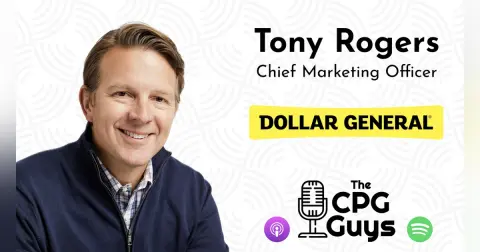
Dollar General CMO Tony Rogers: CPGGUYS SPECIAL EPISODE 600


 Apple Podcasts Apple Podcasts
  Spotify Spotify
  YouTube YouTube
  Overcast Overcast
  Amazon Music Amazon Music
  Audible Audible
  iHeartRadio iHeartRadio
  Castro Castro
  TuneIn TuneIn
  RSS Feed RSS Feed
  Audacy Audacy
  Castbox Castbox
  Fountain Fountain
  Goodpods Goodpods
  PlayerFM PlayerFM
  PocketCasts PocketCasts
  Podcast Addict Podcast Addict
  Podchaser Podchaser
  Podurama Podurama
  Podverse Podverse
  Podyssey Podyssey
 The CPG Guys are joined on its 600th episode by Tony Rogers, CMO of Dollar General which serves as America’s neighborhood general store. Founded in 1939, Dollar General lives its mission of Serving Others every day by providing access to affordable products and services for its customers, career opportunities for its employees, and literacy and education support for its hometown communities. As of May 1, 2026, the Company’s 21,055 Dollar General, DG Market, DGX and pOpshelf stores across the United States and Mi Súper Dollar General stores in Mexico provide everyday essentials including food, health and wellness products, cleaning and laundry supplies, self-care and beauty items, and seasonal décor.
Follow Tony on LinkedIn at: https://www.linkedin.com/in/tonyrogers1
Follow Dollar General online at: https://investor.dollargeneral.com/
Tony answers these questions:
- Dollar General has a very clear value proposition—convenience, everyday low prices, and a store that feels close to home. How would you articulate the brand promise today, and how has it evolved with changing consumer expectations over the last few years?
- Dollar General serves millions of daily shoppers. What consumer insights have most surprised you since you joined, and how do you translate those insights into marketing programs that scale across thousands of stores?
- Data is the backbone of modern marketing. How does Dollar General balance data-driven decision making with the realities of privacy, consent, and a broad shopper base? Can you share an example of a data-enabled campaign that delivered measurable impact?
- How has Dollar General’s approach to e-commerce and omnichannel evolved, especially as more shoppers expect online ordering, curbside pickup, and ship-to-home options? What role does in-store activation play in that mix?
- Private brands has become a strategic driver for many retailers. What’s Dollar General’s approach to product assortment and private brands, and how do you decide which initiatives to invest in?
- With so many channels and touchpoints, how do you measure retail media marketing ROI at Dollar General? What metrics matter most, and how do you tie marketing investments to store traffic, basket size, and long-term loyalty?
- Dollar General has a distinctive presence in local communities. How do you weave community impact and social responsibility into your marketing strategy without compromising value for customers?
- Can you share your philosophy on creative that resonates with Dollar General’s shopper base? Are there any campaigns in the last few years that you’re particularly proud of, and what made them effective?
- Building a high-performing marketing organization in a discount retailer requires special talent and culture. How do you attract and retain top marketing talent, and what changes have you championed to keep the team energized and innovative?
- Looking ahead, what are the big bets for Dollar General in the next 3–5 years? How do you see the role of discount retailers evolving in the broader CPG ecosystem, and what should brands watch for when partnering with DG?
CPG Guys Website: http://CPGguys.com
FMCG Guys Website: http://FMCGguys.com
SheCOMMERCE Website: https://shecommercepodcast.com/
Rhea Raj’s Website: http://rhearaj.com
Lara Raj in Katseye: https://www.katseye.world/
DISCLAIMER: The content in this podcast episode is provided for general informational purposes only. By listening to our episode, you understand that no information contained in this episode should be construed as advice from CPGGUYS, LLC or the individual author, hosts, or guests, nor is it intended to be a substitute for research on any subject matter. Reference to any specific product or entity does not constitute an endorsement or recommendation by CPGGUYS, LLC. The views expressed by guests are their own and their appearance on the program does not imply an endorsement of them or any entity they represent.
CPGGUYS LLC expressly disclaims any and all liability or responsibility for any direct, indirect, incidental, special, consequential or other damages arising out of any individual’s use of, reference to, or inability to use this podcast or the information we presented in this podcast.
William Rogers (00:00)
Hi, I'm Tony Rogers, the Chief Marketing Officer at Dollar General and this is the 600th episode of the CPG Guys Podcast.
Papa Raj (00:09)
Hello and welcome to this incredibly special episode of the CPG Guys Podcast, episode 600. When Peter and I started this back in COVID, we had no idea we'd get this far and we've become one of the leading voices of the industry. We're of course Sri, your West Coast co-host and also CRO and co-founder of Think Blue Consulting, your trusted partner in your omnichannel journey. Where you can get in touch with me at Sri at thinkblueconsulting.co. Please do listen to my older daughter's music at www.rhearaj.com and younger daughter Laura of the band Katseye who were back then nominated for 3 AMAs at the time of the release of this episode. We'll know if they actually won one. Rhea Raj, my older daughter is now officially signed to Republic Records under the Universal Music Umbrella with a partnership with Hive Labels. Of course I'm joined today by my East Coast co-host and co-founder PVSB who also moonlights a set of industry-inclined engagement at Flywheel, the Commerce Acceleration, Division of Omnicom. Peter, I know it's mid-June but at the time of this recording
Mother's Day was around the corner. How did Mother's Day go?
PVSB (01:13)
It was great. Went over to the Madison Beach Hotel, got all dressed up, went to a fancy brunch and celebrated the day. Everybody was happy. I was very excited. know, Sri, I would be remiss if I didn't talk a little bit about 600 episodes. Can you believe we've stayed together that long, Sri? I know we kid about it's just for the kids, but, from my perspective, these 600 episodes, everyone has been a joy.
Papa Raj (01:41)
You like to make that
weird Muppets reference? I don't understand.
PVSB (01:43)
I am not going to refer to Waldorf or Stadler. I'm simply going to say I couldn't imagine anyone else I'd want to be on this journey with. It has been incredible. And to think, we were just killing time. But where are we now 600 episodes later? We are a staple at the CAGNY Conference every year. People turn to us for our summaries and insights on the events. We have a full-scale activation this summer at Cannes.
We are doing our second year of the Cornell Omni-Commerce Executive Ed program, all from a couple of guys just trying to kill time after being cooped up at the beginning of the pandemic. Sri, it's been a great ride. I'm looking forward to the next 600.
Papa Raj (02:27)
Yeah, and something Peter, I didn't want to say Cannes is about a week away and ⁓ our guest company is very much a partner with us. So we got some great activation, great conversations. Look forward to seeing all of you who are live at France or those looking forward deeply to that. I'm surprised you didn't have any to say about the Dodgers. and I'm not going to say anything about the Yankees cause we lost three in a row today, it's still good to be up top of the wild card by seven games.
I want to thank all of you that listened to us on our sponsors, because without you, there is no podcast. my wildest dreams, I did not imagine leaving corporate America and doing this near full time as I am. Thank you, thank you, thank you. Make sure you're subscribing to our podcast on your Preferred Listening platform where you can get our latest episodes and then go back and consume some of the 500 and 999 plus episodes we've already published. And now over to our special guest. We have a phenomenal episode lined up today.
It's none other than Tony Rogers, CMO of Dollar General. Tony joined Dollar General with the track record of building relevance for brands and growth at scale in consumer goods and retail. His role as CMO is led multi-brand marketing strategies, differentiated shopper engagement, bold campaigns that resonate with everyday shoppers across diverse communities. Tony's perspective blends data-driven decision-making so important in today's volume challenge world with a genuine understanding of value-driven consumer needs.
making him the perfect guess for a wide ranging conversation about the status CPG, retail media, growth and scale at Dollar General. Sometimes Peter, feel Dollar General is one of the only three or four retailers that's actually still growing. And we're thrilled to have him on our show for episode 600. Tony Rogers, welcome to the CPG guys for number 600. It's a pleasure to have you.
William Rogers (04:14)
Thank you, Sri. Thank you for having me. It's an honor to be here, especially on your 600.
Papa Raj (04:19)
We look forward to it. So in the digital show notes of this episode, we'll include links to Tony's LinkedIn profile, of course, Dollar General's corporate website for our listeners to access while we go on with our conversation. And I'm gonna jump right in, Tony. Straightforward, Dollar General is a very clear value proposition, convenience, everyday low prices in a store that feels close to home in the communities that we come from.
How would you articulate the brand promise today and how it's evolved with changing consumer expectations, especially post COVID?
William Rogers (04:51)
the first thing I would say is, having worked on a number of different brands in CPG and retail, this is just one of those brands, one of those companies that you just really kind of look for. You really want to work for as a marketer. This thing's 85 years in the making. And really the brand promise hasn't changed in that time. It's the way we articulate it is this brand.
is on a mission to save people time and money every day. having worked in other places in discount retail, there are other people who are also focused on that money saving part of it. But I think what makes this brand and this company unique is the physical footprint. So 21,000 of these stores
80 % of them are in communities where there's less than 20,000 people. And so a lot of times we're the only retailer in that community that's physically there in that community. And so there's a real close relationship between the brand and our core customers. And our head of consumer insights is a really smart lady named Angela Martin. And she always uses this phrase that our customer often has
too much month left for the money. And they're just in this month to month struggle to make ends meet to get to that next paycheck, to get to the end of the month. And we really view ourselves as playing a very important role in helping her do just that. So that's really what the brand's always been about. I think what's changing, how it's evolving is, as we all know,
We're getting to a place now, we're in a place now where it's no longer just about price, you've also got to deliver on convenience.
PVSB (06:46)
Tony, welcome to the CPG Guys podcast. You talked in your last answer about the brand promise not having changed. We were fortunate enough to visit DG's headquarters and your colleague Angela Martin took us on a tour of the Hall of Values and the brand promise permeated in everything she shared with us. we couldn't agree more. Dollar General serves
millions of daily shoppers What consumer insights have most surprised you since you joined you gave us a couple of stats But I'd like to go a little deeper and how do you translate those insights into? Marketing programs that can scale across the 21,000 plus stores
William Rogers (07:33)
I think there are there have been a number of things that have surprised me. know, my ⁓ good friend and and a person that I worked with for more than a decade at a previous stop, Chad Fox was the was the CMO here for many years. And, he and I stayed close over the years and he always had such great things to say about about
about Dollar General and about what they were up to on the marketing side. So I kind of knew what was happening and I kind of knew what I was getting into here. But even with that, there have been a few things that have pleasantly surprised me. I think the first is, it's easy to get your head wrapped around this notion of this core value-driven customer in a smaller community relying on Dollar General.
But one thing that did surprise me is, yes, we have that, but we also have a large number of what we call trade-in customers. Folks that are, maybe don't fit that mold exactly. Maybe they're a little bit higher socioeconomically on that scale, maybe a little bit more suburban, a little bit closer to the larger cities, larger towns. And so that's one for me. I was just kind of surprised how many of these trade-in customers
are in our business and how receptive they are to our marketing when we go out and try to recruit them. ⁓ think the second thing is, would think, especially compared to some of the big box retail, you got these little ⁓ dollar general boxes that are say a 20th the size of one of the bigger boxes. And so I kind of came in thinking, ⁓ loyal customer, they're in there pretty frequently.
They probably know where everything is and don't need to market to them in that sense Not not the case people are such creatures of habit that they come into this little box laser focused on getting the handful of things they're looking for and getting out quickly and so It's a blessing and a curse It you kind of wish they didn't have like our whole Planogram so they would just shop it, themselves but
The blessing is like from a marketing standpoint, they are very responsive to marketing that sort of disrupts that routine and reminds them, hey, you came in for a 12 pack of carbonated soft drinks, but remember there's frozen pizza 20 feet away over in the cooler. And what we have found is marketing to that, whether it's
with our enterprise marketing or through the DG Media Network has been really, really effective. Just takes a little bit. A little bit of marketing goes a long way there to break people out of that cycle. And then I think the third one, I, know, Chad said a lot of this, set a lot of this stuff up, but, very robust ecosystem, very robust set of first party data that we're able to use to fuel
our insights and our enterprise marketing, like I said, but also this DG ecosystem that includes the DG media network. And I'm sure we'll get more into that.
PVSB (10:52)
Tony, when Sri and I were visiting your headquarters, we took a trip over to the local DG market not too far away. And one of the things that we noticed immediately on pulling into the parking lot was something you emphasized, which was we saw a Porsche SUV and a Cadillac Escalade. So if you think of the DG shopper as exclusively someone who
Papa Raj (10:52)
Thank
PVSB (11:19)
who may have a low income, lives very much on a cash flow statement kind of a lifestyle. You're probably missing the boat because everyone wants to save money. Value is in the eye of the beholder. For some people, the value is about the convenience of the store being there and having exactly the assortment they need. So I think you really hit the nail on the head, at least from our perspective.
William Rogers (11:42)
we all see this, but, go back to the pandemic. And here we are in 2026. You've got, five or six years of this, cumulative impact of the year on year inflation. And yes, there has been real wage growth during that time. But it has struggled to keep up, with the pressure of this inflation and especially
in recent months with what's happening with gas prices and things like that. so I think you're exactly right, Peter. Like it's caused all of us to become a little bit more focused on value in our own way. And we see the same thing. You see, you might see some cars in our parking lot that might surprise you, but at the end of the day, if you can deliver on
On value and help people save on the essentials of daily life so they can redeploy that savings into other parts of their life And if you can do it in a convenient time-saving way, you're gonna draw, customers from all different walks of life
Papa Raj (12:43)
No doubt about it, Peter, at the end of the day, the reason why someone goes in is the reason why they will shop at a Dollar General. But I wanna remind our audience, we've had a few other episodes with Dollar General over the course of six years we've been doing this, and I just wanna state what they are so people can listen in. Do a quick search and listen in. A while ago we had Molly Hjelm when she was still at DGMN the original DGMN from years ago, followed by, of course, Austin Leonard's been on the show, he leads DGMN
day. Austin's been a great friend of the show and we've known him quite a bit. Great listening in, one of the best we know in the industry from a media standpoint. Peter mentioned we've had Angela Martin who of course talked about the culture of values for Dollar General and we did a live walking tour of that hall of values at Dollar General's headquarters. Then we went over to the Fresh Market as Peter mentioned where Allen Warch gave us a tour of the stores focused on
Fresh merchandising and food and we covered that live from the store, is quite a great experience for Peter and me to learn a lot of things that Allen mentioned. then while ago, we also had Heather Land senior director of grocery merchandising back then who discussed deeply affordable and accessible groceries strategy for Dollar General. was right at the mix during COVID, which is the right time to have those discussions. the one thing Tony, before I go to the next question that comes to my mind is operating 21,000 plus stores is no joke.
That's a lot of stores and it means you're in every community. The all, I'm sure audience is curious to learn in the CPG way, way we operate is every month, we'd get together and we'd go in depth on what's going on in the country with 21,000 stores. How do you just keep that going week over week?
William Rogers (14:33)
Yeah, it's interesting. I think there are more of these things than there are McDonald's. It's a massive footprint.
Papa Raj (14:43)
How about that Peter? Hard to even
conceive but yeah.
William Rogers (14:48)
it's a massive footprint and it's a lot of fun to get out into these communities. I just got to go down near Augusta, Georgia to we opened up our 21,000 store out there. ⁓ By the way, it was one week after the Masters. So the timing was a little off on that trip to Augusta. But ⁓ really amazing just to get out into these communities and see ⁓
both the stores that have been there for a while, to see these new stores and to see the energy in the community and how excited they are to have us there and to see how excited our employees, our associates are to be there and to be serving the community. And a lot of our employees come from shoppers in those local towns, those local communities. it's, we're very closely connected.
maybe more so than other bigger box retailers, we're very connected to the communities where we operate. to your question, 21,000 stores is a lot. And so it requires a ton of tracking, a ton of measurement. And you're just constantly trying to do, exception reporting and trying to find places where maybe it's not going right. So can go correct those. ⁓ But that's
⁓ This company's gotten pretty good at that.
Papa Raj (16:10)
think of it as discipline, Tony, and one such area where today, for the CPGs that are volume challenge and discipline is required as data, data, of course, is the backbone of modern marketing. How does Dollar General balance data-driven decision making with the realities of privacy, consent, a broad shopper base? Can you then maybe share such an example of a data enabled campaign that delivered measurable impact?
William Rogers (16:35)
Yeah, absolutely. As I said, one of the pleasant surprises for me coming in here was the robustness of the data and the machine that fuels it. I would describe what we have here as an ecosystem, and it basically kind of works like this. We've got a partnership with a company that you're familiar with called Bridge.
And that's where we house all of our one P data. that's largely what we activate on, through the DG media network and all the great stuff Austin's doing. ⁓ But our goal in life is to migrate that hundred million plus people, those hundred million plus people into greater and greater levels of loyalty at Dollar General. And so we have this flywheel that we ⁓ that we talk about and it's
First, getting people into MyDG. And it's our free ⁓ loyalty program. ⁓ We've got about 16 million people in there now. They largely use this loyalty program to plan their grocery trips, to clip coupons, ⁓ and to do all the things we said in the first part of this conversation of just planning out their month so that they can get to the next paycheck. ⁓
It's a really sticky and gamified ecosystem. It's got so many passionate users that it's spawned a whole cottage industry of social media influencers who just make videos and telling people how to stack coupons and get the most out of the program. Two billion coupons clipped in this thing in a given year. It's massive. And so this mighty G is kind of the entry into our ecosystem. And then
In November, we added to that and we launched same day delivery. And so we'll talk more about that ⁓ here in a minute. But we launched our own one piece same day delivery in November. We're nationwide now over 17,000 stores. And so that's an important part of our evolution of truly becoming an Ami Channel retailer from a one piece standpoint. We've said publicly that in the fall we're going to launch
our version of a retail subscription where those deliveries will become free and will be surrounded by some other benefits. And then, know, all of that then fuels what Austin does with the DG Media Network and all of that provides, larger audiences, more opportunities for ⁓ on-site activation. And that's really where we are in the DG MN journey. And so, all of that's working together. And we kind of have a
⁓ We think a little bit of a benefit over some other retailers because we have all of that housed in one department, in my department. So we have marketing, digital and DG Media Network all in one area. And so it allows us to be pretty flexible. If we meet with a supplier who says, I need your website to do XYZ, hey, no problem. Those people work for me. Or if we meet with somebody who says, hey, we're putting together a World Cup activation,
And we can say, well, hey, great. In fact, I'm looking at World Cup too, so I can take some of my enterprise dollars and pair that up with your media network investment and we can make one plus one equals three. So there's a lot of advantages to how we're set up. You asked for an example, Sri, and I'll pick one that we did with Unilever, one of our really most important partners.
But Unilever wanted to build a campaign with us around that launch of Same Day Delivery. And so we built a campaign with them that reached over 6 million of our monthly users through our DG digital touch points. And ⁓ we can build audiences to do different things. In this particular campaign, we went after existing brand buyers, lapsed brand buyers, category shoppers who had never been brand buyers.
And then we also went after high affinity groups and put the right marketing in front of the right audiences in that journey. And in that particular campaign of just getting those Unilever, driving those Unilever brands through DG Delivery, the results ⁓ are massive. So in this particular one, 2X higher, ⁓ incremental ROAS ⁓ relative to our benchmarks.
20 % higher sales growth during that time than people that hadn't invested. 55 % higher growth versus how much the stores grew during that time. ⁓ And a third of the purchasers in the campaign came from new customers to the brand. And again, we have all that data because we got the closed loop and we can see all of this. So that's the kind of campaigns that we build. We build real specific audiences for real specific missions.
and we can just measure them down to the last little detail. So ⁓ that's kind of where we are in terms of our enterprise marketing and also working with folks on the media network.
Papa Raj (21:59)
Peter and I think it's a big deal that you have one piece same day delivery and the about my DG same day delivery. think I mentioned to you when I met you live for me that I'm an avid DG chopper because here in SoCal where I live, I've got access to a couple of DGs within a 10 mile radius. I for one will be one of the early subscribers when you do actually launch in the fall and I will report it back right here on the same day. I'm eagerly looking forward to it.
because it is a game changer, no doubt about it but
So Tony, we got a very simple question for you. 600 episodes in, should Peter and Sri, the CPG guys be relevant on TikTok and Instagram?
William Rogers (22:46)
100%. My favorite way to talk about this is if you've ever heard the old adage of it's better to have somebody else say something good about you than to say something good about yourself. That's been a big part of our journey here in the last year. We really stood up our influencer marketing last year.
about midway through last year, we got serious about influencers. And what we find is ⁓ the engagement rate when we have influencers talking about us is twice as high. The brand sentiment, if you go into the comments and the reverberating chatter that comes after the post, it's 3X what we typically get when we post something ourselves. And so we absolutely love the
the influencer community, the creator communities that we're engaging with, you're going to see us really continue to grow that going forward. And as we talked about for us, that's really a natural evolution from something that was happening organically where these influencers were saying, hey, let me show you how to use all these DG coupons.
Papa Raj (23:59)
Peter that's the push you and I needed it's time to pull up our socks on Instagram and
PVSB (24:04)
I well Sri fortunately
Papa Raj brings a hundred and forty thousand followers on his Instagram account if you add that to mind that's a hundred and forty thousand eight hundred and seventy eight followers on Instagram So we're well on our way Sri. We are we are blazing a trail Tick-tock ⁓ I can contribute nothing there, but you definitely have an audience but Tony I want to
Papa Raj (24:21)
What about TikTok?
William Rogers (24:30)
I don't know about YouTube too.
I gotta, put a little plug in for the YouTube guys.
PVSB (24:35)
We are on YouTube as well.
Papa Raj (24:35)
Peter's been telling me every day
about YouTube. think I've been the drag there because my personal profiles are big on Instagram and Tiktok. But think of Tony Peter. I think it's a three p it's a three pronged strategy. It's Tiktok, Instagram and YouTube. We promise you our audience. We will pull up our socks.
PVSB (24:40)
Yeah.
I know. We're gonna get Suzanne on that Shre.
⁓ All right, so Tony, go ahead.
William Rogers (24:54)
I love it. Hey,
I'll make a video for you
PVSB (25:00)
like it. I like it. So Tony, ⁓ you talked a little bit about this, and I want to now dig deeper on it, which is around last mile delivery and omnichannel. Dollar General's approach to e-commerce and omnichannel has evolved substantially. In talking to Austin, he mentioned the fact when DGMN launched, it was primarily an offsite solution, right? Because there wasn't very much e-commerce activity happening on
dollar general's properties. That is changing ⁓ as more shoppers are expecting online ordering, curbside pickup, and delivery to home options. I'd love to hear from you what role does in-store activation play in that whole mix to truly make it an omnichannel experience? Because I don't think shoppers do one or the other. think they do what they need to do based upon their trip mission, right?
William Rogers (25:57)
I think you're absolutely right. I think it's all about need state. I think our customers decide what brand they want to shop with based on their affinity to the brand, the value they think they're getting from it. And then you're exactly right, Peter. based on whatever need state they're in at that time, they decide if they're going to go in and get it or have it delivered to the front door. And for us,
until last November, we didn't have a one P solution to putting it on your front porch. Now we have a great relationship with DoorDash. about five years running and we've had phenomenal success there with those guys. We just added Uber Eats this past year and we love how that's going. So more experience for us on the three P side of delivery, but really November is when we just got into this nationwide on our stuff.
⁓ It is really interesting when you go do the research with Angela on our team of you what are those needs dates and You find everything from with that trade in customer that we talked about earlier They're looking for convenience And they're willing and they're willing excited to use delivery to deliver that convenience to have it just show up on the front porch ⁓ Just as a pure time saver. We also hear from
folks in different socioeconomic levels who have all kinds of different motivations for wanting to use delivery. Sometimes it's, I'm working two jobs and I don't have time to get to the store today, I need it delivered. Or I've got problems with my transportation and I've got no way to get to the store today, I need it to come to me. And everything in between. And so you're exactly right, Peter. It's just all about need state and delivering what we do.
to a customer when they want it, where they want it, and how they want it. ⁓ so that's been huge for us launching that in November. ⁓ Interestingly, 80 % of the orders that we see on our 1P delivery, we see customers using at least one coupon. And so you can see the Dollar General promise, the Dollar General
a value prop playing out in delivery the same way it does in store. I think that's huge. I think for us, it's a really important time in our marketing team and our digital team because you're seeing the DG app and the DG website really evolve from where it's been most of its life, which was essentially the digital companion to a brick and mortar shopping trip.
I'm going to build my shopping list. I'm going to clip coupons and put them in a digital wallet, know, those kinds of things. Whereas now that we're a true omnichannel retailer, ⁓ things like search become a lot more important and both to our customer, but also to our DGM and advertisers. And so we're having a lot of conversations about taxonomy, about our search and how that works.
and just about how the site functions as an omni-channel site. And so it's a pretty exciting time to be working on that stuff. And you mentioned this earlier, but the way our media network evolved in the beginning, because we weren't an omni-channel retailer, they pretty much had to grow that thing offsite. And they got really good at it. I think they're one of the best in the business at taking audiences and building programs offsite.
But now, there's just so much excitement about adding to that all these onsite platforms. And it's fun to watch the traffic grow and the monthly active users grow. And so we have larger onsite audiences to monetize as well.
Papa Raj (30:04)
Tony, that is indeed awesome. You know, I personally love the in-store audio network that I get to listen to every time I visited TG. I got a simple one for you as the next one. And it has to do with private brands. Peter and I don't say private label. say private brands because today what we observe is that stand on their own merit. And it's not just a price thing, but it's become a strategic driver for many retailers. What's Dollar General's approach to
private brands and how do you decide which initiatives to invest on?
William Rogers (30:37)
like a lot of retailers, private brands is a really important part of the mix here. And, we've been pretty fortunate, had a lot of success with our private brands. We're gaining share if you look at the syndicated data. And interestingly, our baskets are 30 % higher when they include private brands in the basket.
And what that tells us is that the more loyal the more loyal a customer is, the more the deeper our relationship is, the more they rely on our private brands ⁓ to get them from point A to point B to get them to the end of the month, like we talked about. And so we really we leverage private brands, to work ⁓ in concert and, harmoniously with
the national brands and they both play a really important part in the mix. ⁓ We know that our national brands also drive a lot of trips, drive a lot of traffic and our customers rely on us to have those brands at a competitive price too. private brands are an important part of the mix, but just as the national brands are as well. We may talk about this a little bit later, but we've gone through a ⁓
a process called next best action, where we understand what are the things that make it more likely for a customer to become more loyal to us. we've got about a half dozen of them. But one of the most important ones is private brands. And we know that if we can convince our customer of the value and the quality of the private brands, it makes them more loyal to us over the long time. It builds the lifetime value over a long period of time.
Papa Raj (32:35)
No doubt about Tony whatsoever. Let me remind our audience that we're speaking with Tony Rogers, CMO of Dollar General for a special episode 600.
PVSB (32:35)
Yeah.
So Tony, a couple things to unpack before I get to my question. When you talked about trust in private brands, what's going to drive a lot of that is honestly the content that you provide to your shoppers when they're on your own and operated properties, notably in the form of ratings and reviews. It's amazing how much that builds trust, people that you've never met before.
Will sway a shopper's opinion much more than what a brand or a retailer writes about a product on its website so as you build your your your full-scale e-commerce business that Content will start to grow and that will build trust in private brands But my other point about private brands is you mentioned the harmony between a national brand the private brands smart national brands figure out
how their products complement some of the private brands. Recipes are a great example. And if you're smart about it, you'll learn how to live and coexist with those. And ultimately, the consumer, your shopper, gets a satisfied experience. ⁓ My question to you is this. With so many channels and touch points, how are you measuring retail media marketing return on investment at Dollar General?
I'd love to hear from you because you talked about it starting as an offsite and evolving now to where you have 1P delivery and that's going to build your own and operate it. But what metrics matter most and how do you tie marketing investment to store traffic, basket size, and even long-term loyalty as you go to evaluate the performance of your program?
William Rogers (34:25)
you're exactly right, by the way, on the content, your previous point. And it's exciting to think about ⁓ what AI is doing on the search side. I think we're evolving from, hey, me find ⁓ party favors in a keyword search environment. And we're evolving to more of a contextual search of, I'm having a birthday party for a bunch of eight-year-olds. Tell me what I need.
That's an exciting time for national brands and for private brands to show up in that kind of a more contextual search. To your question about just how do we maximize ROI from a marketing standpoint, I'll start with our enterprise marketing. The metaphor that I use a lot here is we're kind of like the, if you're a fan of history, the battle of Bunker Hill and the American Revolution.
where they said, it's so little ammunition. They said, don't shoot until you see the whites of their eyes. Like that's, kind of have that mentality and we say every dollar that we spend is precious and, and, it has to have a, return on investment. That's very clear. And so a couple of things there. One, I use all the same pipes.
and all the same measurement in my enterprise marketing that we use for the DG Media Network. it allows me to sit in front of my key advertisers and have very much a eat what you cook sort of a conversation because everything I'm trying to convince them to invest in it. I'm also invested in completely with my own with my own dollars. I spend the vast majority of my marketing dollars on customer acquisition. My thought is
use the paid dollars I have to bring more customers into the franchise and rely on all the owned impressions that I can deliver through emails and SMSes and in the store. And now we have a huge new in-store radio network growing. know, rely on those more for retention. ⁓ And then also, the DG Media Network. ⁓
plays a huge role, I think, on the retention side. ⁓ When you look at our impressions in the marketplace holistically, the investment that our advertisers make, ⁓ it makes up a sizable chunk of the impressions that a customer would see about Dollar General. So that's sort of the ecosystem that lives in. And so I really spend most of my enterprise dollars on acquisition. And we use a really, ⁓ I think, a pretty sophisticated
CAC based approach, customer acquisition cost. We know exactly what it costs us to acquire a new customer. We know what their lifetime value is. ⁓ so ⁓ that's really, we drive our dollars to places that give us that lower CAC. And I'll tell you, it's been really interesting working with some of the best names, the biggest names in the business, and then also some more obscure ⁓ places where you can go acquire new customers. ⁓
When you show up with that data and you're able to say, hey, know, platform X, not X, like platform A, hey, your CAC is three times as high as your competitor. How can you help me get that down? It's led to some really ⁓ interesting conversations and some really interesting, ⁓ some really impressive progress, in lowering those kind of lowering those kind of numbers. So
Turn on investment driven by a really low customer acquisition cost is really my main focus.
Papa Raj (38:12)
awesome is that Peter? I love that you're focusing a lot of your time on the customer acquisition piece for the enterprise because that's how you reach communities and tell them what the value proposition is of either coming in, getting home delivery, however they prefer convenience of shopping at Dollar General. We've talked about the community quite a bit, but I thought maybe we'll anchor a little deeper in the next question, which is we've said you have a...
deep presence in local communities with 21,000 stores. How do you actually weave community impact and social responsibility into your everyday marketing strategy without compromising value for those very consumers in the communities they come
William Rogers (38:56)
Sri. think, first and foremost, I like the saying that experience is the new marketing. The most important thing we can do in the communities that we serve, especially because we've talked about this close connection, this more intimate connection we have in these smaller communities, the most important thing is just delivering day in, day out, and having great value, and being in stock.
and being convenient and helping folks get what they need at the right value and getting it quickly. That's the most important thing. But there are a couple of other extensions of that to that relationship with the community that are probably worth highlighting. I think the first one is social responsibility. When you have 21,000 stores and you're in all these communities, ⁓ we really feel like we have...
a responsibility to give back to those communities and to create a more sustainable relationship over the long term. A win-win for us and the residents of those communities. And so that's really always been part of who Dollar General is. Interesting story. If you go back to our roots, so our founder, J.L. Turner,
He had to leave school in the third grade to go help support his family. ⁓ And basically through that, life experience, ⁓ he was functionally illiterate. And that experience that he had shaped a deep belief in the power of education. And that's really something that influences our company today. ⁓ More than 30 years ago,
His grandson, Cal Turner Jr., he founded something called the Dollar General Literacy Foundation. And their mission is to support literacy and education in those communities that we serve. And so they provide grants to schools, libraries, nonprofits, but it's all focused within 15 miles of a Dollar General store. So it's really meant to be localized around where those stores are.
And so that's something we take a lot of pride in, something we try to do in that very focused way around the stores. We've got a marketing extension to that, which we call our Yellow Glasses Project. And so every year we run an awareness campaign essentially for our literacy program. A lot of our suppliers participate in it. It's a big DGMN push as well. And so for example, this year, beginning in July, it'll run all the way through early September.
We basically engage our customers to help us do this and support it. And they can buy these yellow sunglasses for $2. And when they buy these yellow sunglasses, all the proceeds go to the Literacy Fund. And so, today, between our contributions and these sunglass projects, we've raised over $6 million for these communities. So that's a big part of what we do. Just on the...
on the community side. I guess the last thing I would just point to is when you talk about investments, it's not just investing in libraries or schools and things like that, but it's also continuing to invest in the stores themselves. We have two initiatives. One's called Renovate and one's called Elevate. Where you're seeing us, if you've watched us over the last few years,
We've actually cut back a little bit on the amount of new stores that we build and we're taking more of our capital and investing it into our existing store base for just that reason. so Elevate, Project Elevate, well I'll start with Renovate. Renovate is kind of your classic full remodel. And so we go into stores that are more mature and we do a comprehensive upgrade, the fixtures, the merchandising, and really like put an upgrade on these stores.
That's project renovate and the project elevate is we go into stores that maybe aren't quite that far into their life cycle, but they're a few years old and we go in and we just give them a little bit of a uplift. ⁓ Maybe 80 % of the store footprint gets touched, but you're talking about new coolers, new physical assets, new paint, things like that. ⁓ And so we really think
between the philanthropy in those communities, but also just the investment in the infrastructure there. That's a really important part of the sustainability of the business model.
PVSB (43:47)
Tony, great marketing almost always involves great creative. Can you share your philosophy around creative that resonates with Dollar General's shopper base ⁓ and any campaigns that you're particularly proud of that you think exemplifies really great creative connecting with consumers?
William Rogers (44:13)
Yeah, I think first of all, just to keep this in context to what we've talked about earlier in this conversation, we really are one of those brands where we put a premium on ROI, on measurability. We really are extremely efficient with every marketing dollar that we have.
whatever creative approach we use, it has to deliver in those metrics and the way we measure things. ⁓ In general, ⁓ one of my favorite lines on marketing is marketing is more effective when you tell somebody something that they didn't know before. And as simple as that sounds, just kind of think about
not all the marketing that you see out there does that. so our goal is for most of what you see from us, we're trying to tell you something maybe that you hadn't heard of from us before, or maybe you didn't know about, whether it's a new promotion we have or a new product that we sell or a new way to go to market, a way to do shop with us, like delivery. And so it's very focused on that. Within that,
Two things, one is, ⁓ two things I'm excited about. The first is going back to the influencer stuff that we talked about earlier. ⁓ It kinda pains me to say this because as much as I would just love to say, I can make a great TV commercial or a great piece of online creative, and I've been doing that for a long time, but I gotta say, guys, these influencers.
are pretty dang good at what they do, these creators. And I think that the way social media has evolved, the way media in general has evolved, our customers telling us that they really like hearing from other shoppers and hearing from these creators. And so right now, what's performing the best out of all of our different types of creative, it is those creators. And so that's why we're gonna keep leaning into that.
I think outside of the creators, think the thing that I'm most excited about is where AI is taking us. So we talked earlier about this opportunity to personalize. I teased this a little bit earlier, but when I think about our retention marketing, for example, we have all these next best actions. So our next best actions are things like
Can I encourage you to download the app? Clip your first coupon. Shop private brands like we talked about. ⁓ Shop a certain amount of times in your first 30 days. Shop a certain amount of categories with us. Use us more like a grocery store and less just like a convenience store. Those are our next best actions. And so we're having a lot of success putting that message.
putting those messages in front of the right person at the right time. And so that's another example of creative working, not because it's ⁓ fancy creative, but just because it's the right message. You're telling me something that I didn't know at that right time. The challenge for us is, ⁓ as I mentioned, we've got 16 million people in MyDG. Most of those people are opted in to receive marketing from us. And so in a perfect world, I really will have
16 million different marketing journeys for 16 million different people, each of them at their own place in the journey. know, Sri, maybe you haven't, ⁓ maybe you've downloaded the app, but you haven't bought private brands from us. I need to put private brand content in front of you. Peter, maybe you've bought private brands from us, but you only shop three categories and I want you to shop five categories. So I got to put those other two categories in front of you. And so, and so there's no way that,
humanly that we're going to be able to create all that content. And so that's where AI just becomes critical for us, ⁓ for us to scale things like next best action and personalization. I've got to be able to leverage AI to do that.
Papa Raj (48:55)
You know, Peter, he tripled, reinforced the need for us own social media strategy, but you know, Tony, as I think about it with the scale that you have, get the penultimate question for today and it's about talent. That large a company operating in so many communities, markets, et cetera, within the United States requires very special talent and a culture of values, which Peter and I of course have the fortune of seeing and covering on a podcast. Or how do you attract and retain top marketing talent?
then what changes have you championed to ensure that the team stays energized, innovative, and delivers for these communities we speak to?
William Rogers (49:34)
Probably my favorite question that you've asked me. I think this is the part where I'm the most passionate about is the people. I don't know if you guys are Myers-Briggs fans. I'm a huge Myers-Briggs geek and my personality type, I'm an ENFP. And so that F makes me very relationship focused and I kind of look at the world through the lens of relationships. And I'm also a fan of the Peter Drucker quote,
culture, you said the word Sreeb, culture eats strategy for breakfast. And ⁓ I really do believe that, that if you can start with the right culture, you can figure everything else out. ⁓ Jim Collins would say, it's about getting the right people on the bus. And so for me, that's the very first thing. It's about getting the right people in the team. And we are, we describe ourselves as a small and mighty team.
⁓ As I've talked before about the Bunker Hill, media strategy. ⁓ We are a small and mighty team. And since culture is really important to us, we're super selective about who we led on to the island, who we led on to the team. And we take that very, very seriously. And it probably frustrates some of our applicants because we have a lot of interviews and we really vet folks. But if you've made it onto our team, like you've really
You know, you've really done something. I think Austin, you mentioned Austin, he's a great example of that, and it took us a year to find Austin, but it was because we were looking for a really specific person who understood how to lead a sales team, understood the Martech side and also was a cultural fit for the team. And it's a bit of a unicorn, but it was worth the wait. And that's really how we...
That's really how we approach things. I also mentioned we have this unique setup where we got marketing and digital and the media network all inside of one team. They get a lot of other companies. Those would be three different SVPs, three different fiefdoms in the company, maybe with some conflict between them and, the natural sort of friction that happens between groups. We don't really have that. We're all on the same team and we really ⁓
we try to have a thick skin. We try to speak the truth and just, so for example, I won't say who the supplier is, but a few months ago we took a trip to one of the biggest, one of our biggest advertisers headquarters and we sat with them for a full day and listened to what they want from us going forward from an omnichannel standpoint.
what features, what bells and whistles they want in our digital experience. I think in a lot of companies, you'd have to come back and sort of, get on one knee and ask the technical team, the digital team, the, to do it. Here, they were just with us on the trip, And so there's, there's, it's a high output, low ego kind of an environment where it's like, we all want to win. We're going to check our egos at the door and we're to do it together.
PVSB (52:47)
All right, Tony, first of all, I'm ENTP, so very close, but slight little, big Myers-Briggs fan. ⁓ Second of all, I've worked at a retailer where it was like turning the Titanic. ⁓ You needed to plan out a year and a half in advance ⁓ for allocation of IT resources to do anything. And if something came up in between, I'm sorry, you were just...
William Rogers (52:51)
okay. ⁓
Papa Raj (52:57)
Thank
PVSB (53:14)
Wait in line and come back to me in a year and a half when you've got your ducks in a row. So it's good to see that you're nimble and that you are able to react and that you listen to your customers. And you understand that it's not the old day where Dollar General just bought product from suppliers or vendors. They are effectively your customers as well because they're investing in your media platform. And so
Treating them like that is critically important for everybody's success. That's how you get joint value creation. So let me close this out for us, ⁓ You've talked a little bit about some of the big bets you have. Clearly, omnichannel is one. ⁓ Obviously, thinking about how commerce is ⁓ transforming, particularly around agentic. But I'd love to hear from you. What are the big bets on a macro level?
that really have your attention looking out three to five years.
William Rogers (54:14)
Yeah, great way to close it out, Peter. think first, we've got to continue to deliver a fantastic experience in our stores. I think a lot of people would expect this answer to go immediately to Omni Channel and I'll get there. But the vast majority of retail is still happening in stores in these communities. And so ⁓ we're still very focused on
delivering that experience on a day-to-day basis. Then I think for us, we are absolutely diving in headfirst to this omnichannel world. And so we, as I said, just launched delivery in November. And so we're very focused on getting that scaled, getting more more people to try that delivery. The majority of our deliveries happen in less than an hour because we're already in this little smaller community where everything's so close.
And so getting more people to use delivery and making it part of their daily routine. then layering on that important subscription piece this fall. I really want to emphasize how important subscription is. You guys, I'm sure you guys feel that in your own life. The subscriptions that you have in retail and your DoorDash and your Uber subscriptions and all the different things you have. ⁓ And so.
And so subscription, we're really excited about the role that that's going to play in terms of continuing to drive people into a deeper level ⁓ of loyalty in our ecosystem. And then for the DG Media Network, and you heard this from Austin, but just so many great things happening there. On the offsite piece, which as we've said, that's been kind of the bread and butter of this media network.
now we're evolving into this world of self-serve, which isn't how we were built. And so how do you ⁓ migrate into self-serve and add those new ways of buying that a lot of our, especially our larger and more sophisticated advertisers want to do it in their agencies. bringing self-serve to the table on the offsite stuff, scaling all of our onsite platforms. ⁓
We got some really exciting things happening in the world of search that I think is going to really help us accelerate that. ⁓ And then Peter, you mentioned this earlier, but we haven't talked much about it here, in-store, ⁓ we just are launching through a partnership with a company called Qsic, ⁓ what will be one of the largest, if not the largest in-store radio networks in the country. ⁓ And so, that's probably...
I wouldn't say it's an area of, it's not untapped opportunity, but there's a lot more green space, I guess, in the in-store piece between what we do in in-store audio, in-store digital, ⁓ and even just good old fashioned in-store signage. So those are kind of the things we're focused on as a team. And, it's an exciting time to be here.
Papa Raj (57:27)
Let me remind our listeners you can find all of our content by simply going to a web browser and typing cpgguys.com is the URL that easy. If you or someone something to contribute to this ongoing discussion on the CPG guys, please drop us an email at reachus at cpgguys.com. Again, that's reachus at cpgguys.com to our audience. I want to thank you for the clicks, likes, comments, direct messages, meeting us at trade shows, coming to our events, recording episodes with us and to our sponsors. We're always grateful for you. The show doesn't exist without all of you.
work with us all year. We're grateful to have you as our audience and partners. Thank you, thank you, thank you for getting us to episode 600. Peter, doing this episode, special episode 600 with you. What's your big takeaway from Tony's conversation with us?
PVSB (58:10)
All right, Sri when I will think back about the choice of Tony to be on episode 600, I will metaphorically think of Indiana Jones in The Last Crusade when he's going at the end of the movie to save his father and he reaches for the inconspicuous cup, which turns out to be the Holy Grail on the Knight of the Templar says to him, you chose wisely. I think we absolutely did.
Sri, Tony told us a great story, a great story about how marketing is connecting with consumers in the community and connecting with them wherever they are on their journey and with the values that they hold, how they define value that's right for them and that marketing is about creating that community with consumers. It was a really great tapestry of a story.
that I heard from Tony today couldn't think of a better way to deliver episode 600 to our audience tree.
Papa Raj (59:17)
Very well said indeed, Peter. I can't wait for their subscription platform to launch. I'm looking forward to that one. I've already mentioned they installed your network. Every time I walk in to a store, I actually get to enjoy something listening to it. Talent, you Tony described in detail what the important part is in Aston Man, you're in Unicorn. We knew that from day one we met you. What a power packed episode 600.
It's about the industry, it's about community, it's about value. So many things in this episode. Couldn't have loved it. Tony, thank you for making time to record episode 600 with us. It's a pleasure to have hosted you on this episode.
William Rogers (1:00:00)
It was a pleasure guys. I'll talk to you guys anytime.
Papa Raj (1:00:04)
That's wrap of this episode of The CPG Guys episode 600.