
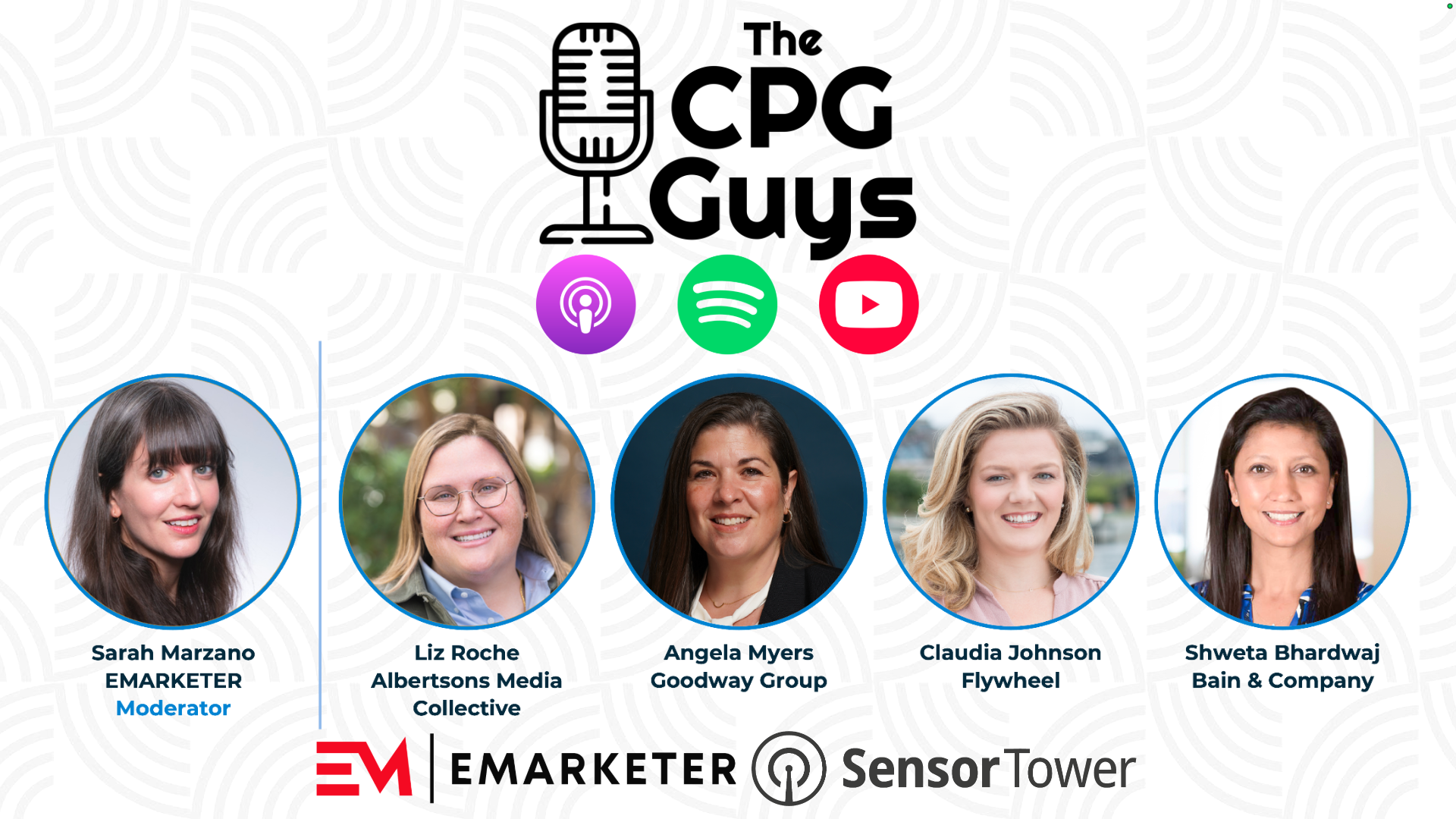
Albertsons' Liz Roche, Omnicom's Claudia Johnson, EMarketer's Sarah Marzano, Goodway Group's Angela Myers & Bain & Co's Shweta Bhardwaj - How Retail Media Becomes a Growth Engine


 Apple Podcasts Apple Podcasts
  Spotify Spotify
  YouTube YouTube
  Overcast Overcast
  Amazon Music Amazon Music
  Audible Audible
  iHeartRadio iHeartRadio
  Castro Castro
  TuneIn TuneIn
  RSS Feed RSS Feed
  Audacy Audacy
  Castbox Castbox
  Fountain Fountain
  Goodpods Goodpods
  PlayerFM PlayerFM
  PocketCasts PocketCasts
  Podcast Addict Podcast Addict
  Podchaser Podchaser
  Podurama Podurama
  Podverse Podverse
  Podyssey Podyssey
 This episode was recorded in France at the 2026 Cannes Lions International Festival of Creativity and features a panel called “How Retail Media Becomes a Growth Engine” which was produced by EMarketer and sponsored by Sensor Tower, featuring Albertsons Media Collectives' Liz Roche, Omnicom's Claudia Johnson, EMarketer's Sarah Marzano, Goodway Group's Angela Myers & Bain & Co's Shweta Bhardwaj.
Following Liz Roche on LinkedIn at: https://www.linkedin.com/in/eroche1
Follow Sarah Marzano on LinkedIn at: https://www.linkedin.com/in/sarahzmarzano
Follow Claudia Johnson on LinkedIn at: https://www.linkedin.com/in/claudia-johnson-b133436
Follow Angela Myers on LinkedIn at: https://www.linkedin.com/in/angela-myers-2257aa1
Follow Shweta Bhardwaj on LinkedIn at: https://www.linkedin.com/in/bhardwajshweta
Follow EMarketer online at: http://emarketer.com
CPG Guys Website: http://CPGguys.com
FMCG Guys Website: http://FMCGguys.com
SheCOMMERCE Website: https://shecommercepodcast.com/
Rhea Raj’s Website: http://rhearaj.com
Lara Raj in Katseye: https://www.katseye.world/
DISCLAIMER: The content in this podcast episode is provided for general informational purposes only. By listening to our episode, you understand that no information contained in this episode should be construed as advice from CPGGUYS, LLC or the individual author, hosts, or guests, nor is it intended to be a substitute for research on any subject matter. Reference to any specific product or entity does not constitute an endorsement or recommendation by CPGGUYS, LLC. The views expressed by guests are their own and their appearance on the program does not imply an endorsement of them or any entity they represent.
CPGGUYS LLC expressly disclaims any and all liability or responsibility for any direct, indirect, incidental, special, consequential or other damages arising out of any individual’s use of, reference to, or inability to use this podcast or the information we presented in this podcast.
PVSB
Hello and welcome to the CPG Guys Podcast, set at the intersection of commerce and tech. Your hosts, Shri Raja Gopelin and Peter V. S. Bond, explore how brands and retailers engage consumers in a digitally driven world. And now, here are the CPG guys. Hello and welcome again to the CPG Guys Podcast. I'm your co-host, PBSB, who also moonlights, is head of industry and client engagement at Flywheel, the Commerce Acceleration Division of Omnicom. My co-host is the co-founder of Think Blue Consulting, the father of Popstars Rhea Raj and Cat's Eyes Lara Raj. Their fans, of course, call him Papa Raj, but to me he's my BFF Shree. Last month, Shree and I attended the Cann Lyons International Festival of Creativity. Today's episode is the recording of a conversation that took place at La Residence, our home on the Riviera. More on that in a moment. To our audience, if you're getting value from these conversations, we have three quick asks. First, subscribe to the CPG guys on whatever platform you're listening on right now, whether that's Spotify, Apple, Amazon Music, or anywhere else you get your podcast, hit that subscriber follow button so you never miss an episode. Second, please leave us a rating. It takes 30 seconds and it makes an enormous difference in helping other CPG and retail professionals find us. We've built this community one listener at a time, and a five-star rating is the single best way you can help us keep growing it. And third, follow us on LinkedIn. Between episodes, we're publishing thought leadership, industry analysis, and content you won't find anywhere else, all built for the CPG and retail media community. You're already a part of. Search CPG Guys on LinkedIn and hit follow or click the link in the digital show notes of this episode. Subscribe, rate, follow. These simple actions help us bring you more of the conversations that matter. Today's episode came from an activation with we hosted with eMarketer. This panel is called Beyond the Campaign: How Retail Media Becomes a Growth Engine. It features moderator Sarah Marzano, VP and Principal Analyst for Retail and Commerce Media at eMarketer. Sarah is joined by Liz Roach, Vice President Media and Measurement at Albertson's Media Collective, Claudia Johnson, Chief Technical Advisor to the CEO of Flywheel, Angela Myers, EVP and GM, Brandon Commerce at Goodway Group, and Shueta Bardwatch, partner at Bain Company. Now let's get to the conversation.
SPEAKER_05
Liz, I'm so excited to have you here because I think uh Albertsons is one of the Media Networks that's doing such a great job furthering the entire industry, right? So much good work that you guys are doing. Lately, it's been particularly around measurement and accountability. I think as you think about the future of retail media, if I can ask you to look beyond measurement, what do you think the industry needs to get right over the next five years?
SPEAKER_01
I think it's going to be a combination of bringing the media and the merch tactics together to show overall growth. Media in the retail space has lived in a weird little silo. It doesn't need to, though. And I think more and more we're finding that integrated strategy is actually where our clients are winning. But that also means stepping outside of the campaign viewpoint and getting less myopic and actually thinking about how these strategies work together to drive actual category growth. At the end of the day, as a retailer, you know, we're charged with moving units. And that's good for our shoppers, it's good for our brands, and of course, it's good for us. So bringing all these strategies together and figuring out where there are places of arbitrage, that's what's next for us.
SPEAKER_05
Yeah. I talk about this at Nauseum, but I grew up in retail and merchandising. And so it was this music to my ears. Can you tell us a little bit about what getting your merchandising organization on board has looked like? Were there any challenges that surprised you? And where do things stand today?
SPEAKER_01
What's been really interesting is actually as we've rolled out our digital in a store network, that has become an interesting common language between us and merch. The screens live right at the shelf edge, which gets really blurry when you think about who owns what, right? So being able to bring that common space and start orchestrating strategy in the store, as analog as that sounds, it's been one of the big places for innovation for driving this type of integration. Uh it's been a journey. I think uh, you know, training people on different languages. We're learning merch language, they are learning media language, but and again, coming coming together with common language has been really important. And that at the end of the day, centers around category growth. It doesn't center around ROAS. So just changing that orientation toward growth, but also, you know, using the store as an initial format to really get on the same page.
SPEAKER_05
Yeah. No, I think it it sort of speaks to the fact that change management, while it's a very difficult thing to accomplish, is becoming increasingly necessary.
SPEAKER_02
And just to brag on them for a second, because I've always been impressed with your team from day one when their retail media network launched, they've always had that point of view that it should be joined up. And so I do think that plays into it as well. Like that was never a question for them. They started as they meant to go and they continue down that path.
SPEAKER_05
No, I think that's absolutely right. And I think I have a prediction that more retailers are going to follow suit. And I think you're going to feel the benefits of being an early leader in that space because it's not something you can do overnight, right?
SPEAKER_01
It's also a super complex space. In media, we have the luxury of having a lot of one-to-one touch points. And the feedback loop is really tight in most places. I mean, there are some exceptions. But you have a little bit of a different playbook in merch. Um, and especially because we have so many different banners. We're operating 2,200 stores across the US. Every store has its own local flavor. There are a lot of variables. So how do you how do you actually standardize those variables and start measuring them? It's it's complex, but I think it's the job to be done.
SPEAKER_05
Absolutely. Um I think that that segues really nice to the next question, which is just about the fact that we've got a lot of different stakeholders that are involved in retail media decisions, right? And and the thing is that retailers, brands, agencies, and then retail media teams often use the same words, but mean really different things, right? Growth, loyalty, penetration, incrementality can all be defined and measured differently depending on who's at the table. Everyone can get on this, but I want to start with Angela. I wonder if you can share where you see some of the clearest examples of teams working toward the same objective, but not using the same vocabulary. And what do you think needs to happen in order to create a more shared framework?
SPEAKER_03
Uh, one of the things I think is super interesting is in every single incrementality conversation that I've had with a brand or at a roundtable with brands and retailers, they they can get pretty alive quickly on the not just the definition of incrementality, but how important it is. But in every single conversation, the brand always comes back to, yeah, but I didn't grow share. And so the way that they're measuring market share is critically important. But the way they measure market share is not the same way that Albert measures market share, right? Because there's different trade areas, there's different definitions of categories and things like that. So I do think there's an opportunity for some of those things that have long been standardized to actually take another look and rethink about the definitions so that they could come to the table and actually help enable this conversation to have that more shared language.
SPEAKER_05
Great. Yeah, Claudia, I wonder like, it's pretty clear that the industry is not going to solve this overnight, especially considering how long we've been talking about it. What would you kind of advise individual brands or individual retailers or RMNs to do now to better align on this?
SPEAKER_02
So, first of all, I do want to challenge the question because I actually think there's common language and not common understanding. And my new analogy I've latched on too, which some of you might roll your eyes, is you know, in The Little Mermaid, she's got her gizmets and whatchets we call it. So one of them is a fork and she uses it to brush her hair. The fork to me is commerce. Like the media teams, the creative agencies are like, yes, we know commerce. They're brushing their hair with the fork. The actual retail team is over at eating steak with it. We both know what a fork is. We both believe in the fork, but we have very different understandings of what the fork should be doing. So I know that's weird that it resonates among weird little brains, so hopefully some of you. It was vivid. Um forgetting. So sorry. Um, but I think one way to cut through that is to go back to what really matters, and I think you mentioned it a bit as well. But that is the shopper, the consumer. Like the the main goal for most companies is household penetration because they want to grow sales, they want to grow share. The way to do that is to win with the consumer. So that should be our central driving force. And you know, I work at an agency and sometimes we do get caught up in our own stuff of, oh, well, did we improve margin or we do this? Like at the end of the day, did you impact sales and share? Because if you didn't, like end of story. Liz, I don't know if it's cruel to not let you weigh in on this.
SPEAKER_01
I I was trying to think of ways to keep riffing on the fork analogy. Uh we plastered up this argument there, silver forks. No, uh that was really rough, but uh so I I I have to agree, I think it at a very micro stance, uh, we we've done a lot of work talking about iROAS. Um, and at Albertson's, we partnered with Ovativ and Kellogg to unpack iROAS and what it really means. And although we're all kind of going into the same meeting, saying IROAS, depending on how it's calculated, depending on match rates, depending on the factor of, um, depending on how control groups are developed, can change ROAS from positive to negative. So you're looking at a lot of variation in that, although we're all bringing those same letters to the meeting. Sure. Um, I think it's it is on us as retailers to take that complexity on and explain what that methodology looks like and what it should mean at Albertson's. And these are not portable numbers. You can't just grab all the Albertsons numbers and walk them down to the next retailer. Um, they really are specific to how we do business, how our shoppers shop. And, you know, we try to get as close to the truth as possible. Because to your point, it's it's really fun to have a report that says I did great, but did I actually move units? And at the end of the day, that's what we're all, that's what we're all here to do.
SPEAKER_05
I think you you all sort of got at a at an important uh theme in all of this is that no one has bad intentions, right? When we're defining things differently, hopefully they don't, right? But there's this uh crucial component of transparency that has to accompany because no matter what, there's gonna be nuances that sit behind the way we arrive at certain metrics. Um, I think something that that sort of occurs to me pretty often is that there's a practical challenge, right? Even if we align on the way we're defining things and get really transparent, the fact is that most organizations are incentivized on short-term outcomes, right? Retail media teams are measured on revenue, advertisers on performance, sales teams on near-term results. But many of retail media's biggest opportunities require a much longer time horizon, right? So, Schweta, I want to go to you. You work with a lot of advertisers uh over at Bain. How are you thinking about resolving that tension between the fact that everyone's really being held to urgent short-term incentives, right? But in order for this industry to grow and to get the most out of it, we have to start thinking long term.
SPEAKER_04
Yeah, I feel and many people in this room likely know this, but that what that is what creates so much tension within advertisers is you have two teams who often are working with two separate agencies who have two entirely different goals. And so that that is generally speaking, and and that has resulted in brand teams being incredibly suspicious of retail media because what's happening to them is they're getting asked to spend more and more on retail media, basically start at the top of the funnel, such that sales teams can be, you know, their next day goals, their conversion-oriented goals. I think the good news of is what I'm observing, and many advertisers who I'm working with is there's an operating model evolution that has started, which is it does not make sense for media to reside in multiple places within an organization. And many large and some of the most sophisticated advertisers are starting to say we need to pull this together with one group of media specialists, common sets of agencies with specialization, but we need to come together to look at the full funnel. And I think that opens the aperture a little bit, but it also comes with some responsibility of retail media networks to educate. And the reason for that is because, again, brands have a lot of suspicion around retail media because of the dynamic that has unfolded. And so I think at, you know, it's so refreshing to have this conversation and to hear, gosh, retail media networks really want to sell something, not just sell something, want to sell an ad unit that really differentially performs. And I think that brand teams need to hear that kind of more clearly. And then they need to see it. Yeah. You know, they've been promised an evolution of measurement frameworks for a long time. But now, you know, I feel like that evolution is here and now, and there's a lot of appetite for collaboration to get insure.
SPEAKER_05
Yeah, it's exciting to think about all the opportunity that opens up if brand side is restructuring too to make a more holistic, sort of unified experience. But it sounds like to your point, there's a level of trust that needs to be either earned or re-earned on the part of the retailers. Liz, I wonder if that's something that you have uh noticed among your advertising partners, depending on the different state that they might be in in terms of uniting their own teams and how you navigate that as you think through how to tell.
SPEAKER_01
Honestly, everyone is going through a very I not everyone, but I'd say broadly there is kind of a collapsing happening where teams are starting to work together. And I think a lot of we're seeing the benefit of integrating media and merchandising that extends to our CPG partners who are seeing the benefit of their e-commerce teams, their retail media teams, and their sales teams coming together. So I think we're gonna continue to see that. I think what becomes really interesting is you know, taking all of these data points, for example, in measurement and moving them from retrospective to translated insight that can be applied in the move forward plan. And how do you apply that to a move forward plan that extends beyond just media, that extends into that merch framework as well and what's happening in store? Um, but we're seeing a lot of that transition happen. I think a lot of it's happening in conjunction with trying to move to more unified frameworks that help push the ball forward.
SPEAKER_05
Great. Yeah. Um, okay, we're gonna stick on measurement, but move to consumer behavior a bit. Um, consumer behavior when it comes to shopping and and across categories is often shaped by deeply ingrained habits. Angela, you and I were talking about grocery because I mean, you grew up in that industry. And Claudia, I think you had mentioned the beauty category as being a really unique one as well, right? There's deep habits and loyalties, which makes changing behavior really difficult, right? Retail media is often discussed as a way to capture demand, but some of the biggest long-term growth opportunities might actually come from helping consumers discover, reconsider, and ultimately change their behaviors over time, uh, which is pretty complex to measure, right? Um, so Claudia and Angela, I want to start with you. Both of you work alongside a wide range of retailers and brands. Um, given the metrics the industry prioritizes today, what do you think we're missing? And where would you like to see a conversation evolve over the next few years?
SPEAKER_03
I think what's interesting is that I don't see a lot of retailers measuring actual behavior change, actual perception change alongside all of the effort that they're putting into retail media. I think the other interesting thing is discovery, the path to discovery is changing like literally right now as we speak. There's shit we don't even know that's going on, right? And so the ability to measure that and the impact that that will have, especially in the in the grocery space, which is not the same as the beauty space, which is not the same as the home improvement space, right? Where people spend an inordinate amount of time thinking about, pondering about, whereas we're so habit-ingrained in our CPG everyday life. So I think there has to be some sort of route to discovery. And I think CBG retailers in particular have to spend a lot of time thinking about how do I have that presence online as well as in-store? And I know that's why we have so much in-store activity going on, is to inspire differently, but to actually capture the attention and get to the actual conversion. I think we're going to see a lot of change happen. I'm sure you're already doing some of that. I actually know you are because I read some of the recent announcements.
SPEAKER_02
Yeah, I so the easy one is lifetime value, which a couple of retailers do have, and that's been helpful because then it allows the brands to uh look at an actual data point instead of trusting the vibes and feelings of the team that owns retail medium. But vibes. But it is, it is hard to be an oak tree and like trust that it's going to come to fruition, even if you're staring at data because people's reputations and quite frankly, their livelihoods and promotions are on the line within the organizations. I think the other part that hasn't been solved for, which you started to allude to, is getting a view of that total consumer journey. I really do, and I see it in the data. There's starting to be this shift with certain categories, beauty being one of them, where the discovery and the decision making is happening outside of retail. And so by the time they make it to a Walmart or an Albertsons, they're literally there to fulfill an order. Like you can serve them an on-site ad and you are not going to change their mind because they just sat with a TikTok video and wrote down a very specific SKU that they want to go find and purchase. And that is upending how we think about paid search, for instance. Uh, but you have to be able to identify when that behavior is happening. We can see it in the search data because we see we're not converting on those compusting ads, and that starts a hypothesis and then we go figure it out. Um, but there isn't really good connectivity right now between those. So to me, that would be the interesting one.
SPEAKER_05
I want to pivot to the different sort of channels that exist within retail media. I think something that's very interesting is that the most retailers still have room to optimize their owned and operated uh on-site environments, right? There's there's growth to be had there that is some of the most margin-rich revenue you can get in retail media. So there's a very good reason to keep working on that. But from for most retailers, also, there's a mismatch between the size of their e-commerce business and the size of their customer base and their data assets, right? So if retail media is going to become larger and more durable growth engine, the growth can't come from on-site alone. Angela, I want to start with you because there's something that we were discussing, we were getting ready for this, which is that retailer data is widely viewed as valuable, but premium pricing can sometimes limit adoption, especially in off-site environments. So I want to hear from you how the industry should think about balance protecting the value of that data with making it easier or perhaps more palatable for advertisers to adopt.
SPEAKER_03
Yeah, when we build, when we build plans for brands, I think it is really challenging to determine whether or not we're going to use a retailer's off-site data because of that premium. And so we look at that value construct based on what we think it will also deliver. And oftentimes it doesn't make the cut. But having been monetizing retail data for a very long time, I think there is a significant opportunity for a different monetization structure when it comes to readily available data, let's say, from at Albertsons online. Because some of the data you've you've got households that are spending $10,000 plus dollars a year, right? They're so valuable. You know so much about them. And you're able to extrapolate so much from those households. That is highly valuable. That's worth the premium. But you also have 60% of your households, maybe, that chop you very irregularly or randomly. And that's not as valuable, even when you extrapolate, but it's still good audience and good signal. But it is not worth the same. But what we don't see is a lot of the pricing construct of audience reflecting the value of that data. And as somebody that's going to run media for a brand, that's the type of thing that would make me put that in the plan. Like this is very premium. I'm going to spend some on this because it's so worth it. And vice versa, I need to maybe spend a little bit more over here, but I know that it's not, I don't have to pay as much for it.
SPEAKER_05
So maybe like a sort of a segmentation of jumps or a tiering approach. I love that. Chueta, again, wanting to hear from you around the advertiser perspective, right? Retailers are pushing hard beyond off-site to drive future growth. I wonder how you're seeing advertiser attitude towards investing in retail media, whether that's off-site or in-store evolve and change. Is the demand growing or are there still a certain amount of convincing that needs to happen in order to get that adoption? Yeah.
SPEAKER_04
I mean, just like we survey um RMN's in conjunction with um eMarketer, we also survey advertisers and there's still apprehension associated, as I'm sure everyone is aware of in terms of on both in-store and off-platform ad units. And I think the reason for that is everything that we've talked about. This notion, it's it's you know, a little bit of the historical narrative of these ad units are really expensive, the audiences we are going to target are overly narrow, and you know, the measurement solutions are generally weak. And I love the notion of starting to think about both the evolution of the measurement solutions to be thinking about things like LTV and repeat purchase, things that RMNs can uniquely measure and other media platforms simply cannot, as with, you know, as the data that you share. And also thinking about segmentation. I also think, you know, like any any marketer, there's a question of, you know, we've been operating it a little bit in a world of like these walled gardens, right? And retail media plays a role in in a sale or a role in repeat purchase behavior, a role in LTV, but it's not 100% of it, right? It certainly can't be the case. And that's where I think core brand marketers push back and say, how can I believe in this? And so I think there also needs to be a bit of those kind of walls coming down and starting to say, absolutely, retail media is contributing. Like what is the role of retail media alongside other media platforms as we think about that shopper journey. Liz, I've heard you talk about that a lot, kind of the old school days of uh multi-touch attribution, right? How do we actually get into that in this world where we're operating with a bunch of different RMNs and consumer shopping different chat?
SPEAKER_02
Yeah, I think that goes back to one of the earlier questions of, you know, people are using different language or they're using the same like different meanings. Like I was just in a workshop with a brand, all of the agency partners from PR, social, creative, at like the whole commerce. And they were talking about this creative idea. It was the point of the workshop is to kind of pressure test the creative idea. It was a great idea, but the shopper barrier for that product was that Gen Zs and Millennials, which is who they were going after, were terrified of a category. They don't shop the category. What category? I don't I don't want to name it because you don't know what kind it is. It's not also cleaning, I'll say that. So they're scared of the category. And even though the creative was great, it didn't do a good job of convincing people this wasn't terrifying. And so I was like, that doesn't help me. You're going to send this demand that you've just spent money generating to commerce and it's going to fall flat because you haven't addressed the shopper barrier. But I think innately, and I'm sure great marketers think this way, but like a lot of marketers don't think about the shopper barrier because it lived in the silo that the customer teams thought about. And unless the customer team is elevating that concern, those dots aren't getting connected. And that goes back to my fork analogy. They're like, we've done what we're supposed to do. I'm not going to let it go. It's a good analogy.
SPEAKER_04
By the way, I love that. And you know, we talked earlier about retail media growing categories, not just individual brands. And I think that's a really interesting place for innovation. How does a retail media work with a handful of CPGs to really drive growth of the category in a world where every CPG is imperative right now is volume-driven, which has been kind of elusive post-pandemic. And so I think about categories like serial, the category that's unnamed. Um, you're on the category, like this fundamentally defining categories. And, you know, while there's one perspective of they can't be safe. There's another perspective of actually maybe we can galvanize around category growth. And we've got some willing market participants and RMNs who want to kind of take that challenge quick.
SPEAKER_05
Yeah. No, I love that. And I think, and it tees me up well to Liz. The next thing I sort of wanted to mention is it sort of occurs to me that one of the challenges with moving off-site and in-store and retail media is that we've sort of gotten spoiled in terms of the precise measurement we're able to get from on-site ads, right? And so this is your full job, right? How do you balance the pressure to kind of expand? No pressure, it's your whole job, Liz. Sorry.
SPEAKER_01
You said that because every time we prep something, I say, don't worry, it's my whole job. Yeah, that's true.
SPEAKER_05
That's true. I got that from you. I learned it from you. Um, but how do you think about balancing the urgency to expand with the fact that it's it's quite difficult and we have to develop new ways to get to that measurement that we're used to getting, or maybe we have to accept getting different measurement than we're used to getting.
SPEAKER_01
Yeah, we have gotten very spoiled in the one-to-one world. And frankly, that is the value prop of retail media, being able to close the loop, right? And also uh Albertsons, for example, we do have such a big loyalty base that we can get down to that one-to-one in most places. But we know, to your point, on Shopper Journey, like there's this is very complex. It's not just I went to the Albertsons app and then I went directly to the store. I did a whole bunch of other stuff. Right. And um, for those reasons, I think we need to kind of we can't let good be the enemy of perfect or perfect be the enemy of good. Yeah, there's the one. Yeah, because again, when we talk about measurement, like a lot of this is it's all retrospective. The value of measurement comes from translating it into an actual insight. Right. That is the value of measurement. It's not just you put it on the fridge and get a gold star, it's actually changing your behavior moving forward based on an informed piece of research that you've been able to conduct. So I think as as we kind of blend into new mediums, as we move into store, uh digital out of home, I think is coming way back. Audio also, I've had so many conversations about audio. As these mediums come into play, they aren't going to be one-to-one mediums. We need to design campaigns with the intent of learning something. I think being just waiting for the waiting for the report is is probably not the way to go. But saying to yourself, hey, if these two channels work together, do you think I can get a better result? Or do I think I can drive shopper behavior in my movable middles, if I combine these channels and this message, if you can go into it with those learnings and or with those objectives and actually get some directional learnings, you can apply those and move the ball forward without having that perfect one-to-one. Um, so so I think there's going to be a balance. You're gonna have those really, really, really clean studies, and then you're gonna have some directional stuff. And if that moves the ball forward, you got to go with that.
SPEAKER_05
When I think back to my days in retail, the thing I always remember is the so what now what, right? You can understand your sales from the past week, you can analyze them every which way and tell a story about them. But if you don't have the action that your buyers get to yell at you. Um but you really have to.
SPEAKER_02
We have a similar trauma.
unknown
We should talk.
SPEAKER_05
All right. Um, we're we're running out of time. I want to close with a quick lightning round for everyone. Um, we've all been talking about sort of what needs to happen in order to move the industry forward and fulfill its potential. I want you each to mention something the industry um should absolutely stop doing. Um, Schwatz, I'm gonna have you go first and we'll go down this line. Um, absolutely.
SPEAKER_04
I think um traditional ROAS is is dead in the era of retail media, and so we have to stop thinking about measurement solutions as kind of ROAS, core traditional ROAS based public.
SPEAKER_03
I think we have to stop thinking that media itself is the growth engine here and that it integrated with all of the other elements of retail and brand is is the actual true growth engine.
SPEAKER_02
Love that. I don't know if it's a cheater answer, but um stop ignoring the need for organizational change, change management, training. Like to me, the technology and the retailers is not the problem. The people is the I'm gonna say opportunity, so that's the same thing.
SPEAKER_05
The people is the opportunity. That's not a cheat answer you saw in my presentation. Yeah, so I'm I'm grading everyone, so group it.
SPEAKER_01
Um we've talked about this, but we need to stop talking about the consolidation of retail media where we all shop at the same, you know, brandless box and buy the brandless items. As for as long as stores exist and people are going to them, those retail media uh networks are also going to exist. Like I think that that kind of fear factor of like we're all moving into uh, you know, we're gonna wear uniforms and drink protein shakes for every single one. I didn't say if you did, but I I think we should just I think we should stop that. I think you should instead talk about the benefits of working with multiple multiple retailers, understanding that every retailer is serving a shopper's purpose in a given moment.
SPEAKER_05
Yeah, I think that's a fantastic note to end on. This has been a really fun conversation. Thanks, everybody.
PVSB
To our listeners and the over 46,000 followers on LinkedIn, thank you for doing what you do every day. Whether you're building brands, driving retail partnerships, deploying technology, or shaping the future of commerce, you are the industry we cover, and this podcast exists because of you. If today's conversation sparks something for you, a new idea, a fresh perspective, just a reminder of what this industry is worth showing up for every day, share it, tag us, tell a colleague. The more voices we bring into this community, the sharper all of us get. Until next time, keep pushing the conversation forward. I'm P V SB on behalf of my co host Papa Raj. This has been the CPG Guys.