
Instacart's Ali Miller and Tim Castelli - Live from Cannes Lions 2026


 Apple Podcasts Apple Podcasts
  Spotify Spotify
  YouTube YouTube
  Overcast Overcast
  Amazon Music Amazon Music
  Audible Audible
  iHeartRadio iHeartRadio
  Castro Castro
  TuneIn TuneIn
  RSS Feed RSS Feed
  Audacy Audacy
  Castbox Castbox
  Fountain Fountain
  Goodpods Goodpods
  PlayerFM PlayerFM
  PocketCasts PocketCasts
  Podcast Addict Podcast Addict
  Podchaser Podchaser
  Podurama Podurama
  Podverse Podverse
  Podyssey Podyssey
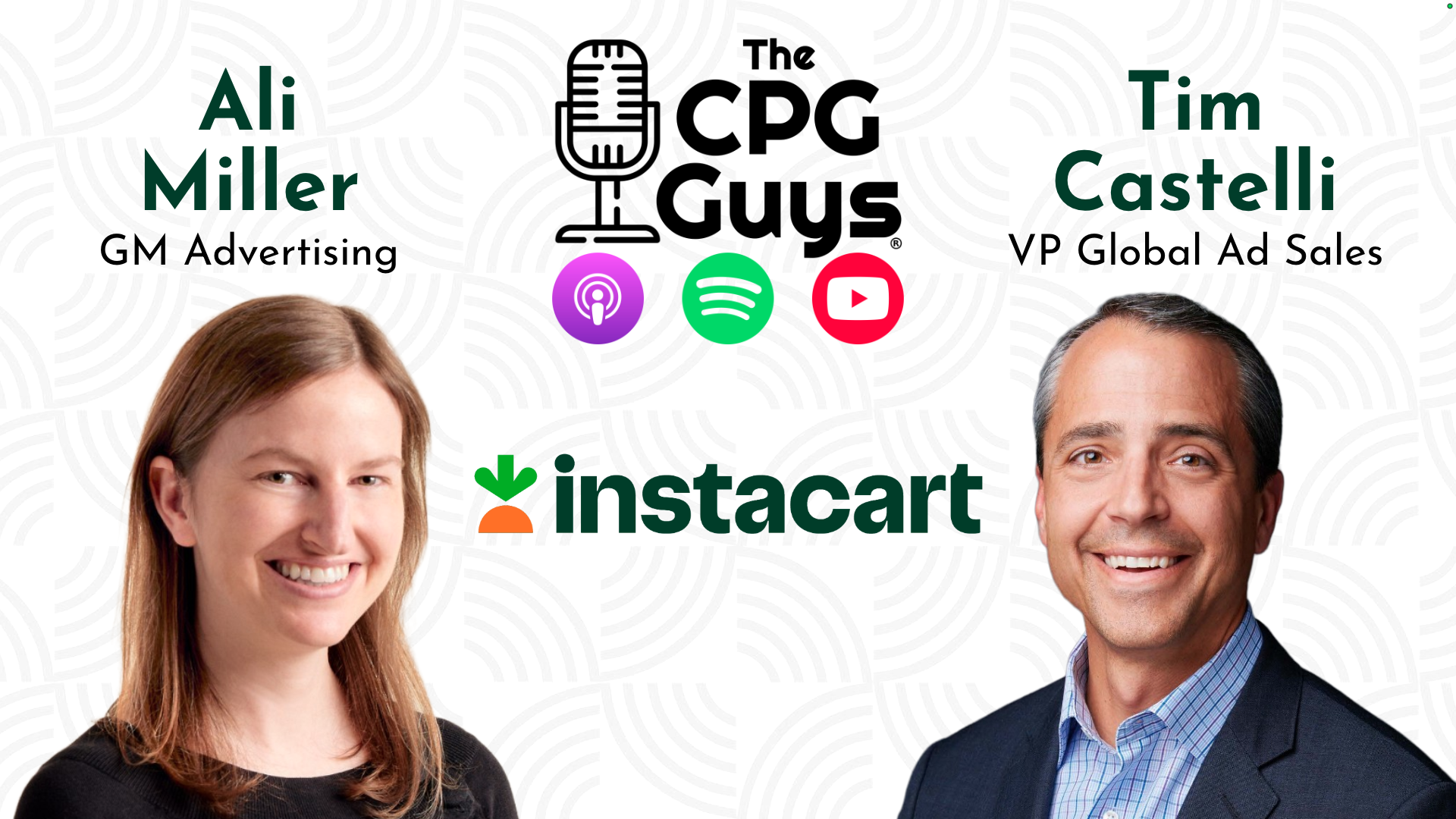
 The CPG Guys are joined in this episode by Ali Miller, GM of Advertising and Tim Castelli, VP Global Ad Sales at Instacart.
This episode was recorded in France at the 2026 Cannes Lions International Festival of Creativity.
Follow Ali on LinkedIn at: https://www.linkedin.com/in/about-ali-miller/
Follow Tim on LinkedIn at: https://www.linkedin.com/in/timcastelli/
Follow Instacart Ads online at: https://company.instacart.com/ads
Ali & Tim answer these questions:
- So Ali, let’s kick it off with you on a massive macro trend. We just read Nik Modi's latest RBC Capital report, Modi’s Musings Volume 4, and theme number one is that Cultural Relevance > Brand Equity—meaning scale alone doesn’t protect you anymore; you have to turn online platforms into an active "economic substrate" for identity and transaction flow. How is Instacart evolving its ad tech stack to let legacy CPG giants quickly move at the speed of a viral TikTok trend or cultural moment, turning immediate social media inspiration into a converted grocery basket?
- That speed to conversion is everything. Tim, let’s talk about some news you announced at Cannes this week. Let’s start with your AI Shopping assistant. What makes Instacart’s AI assistant different?
- As consumers look to collapse choice complexity because of low mental energy and rising anxiety, the visible shelf is shrinking from 50+ items down to 1 or 2 AI-curated recommendations. How does this radically compressed digital real estate change your ad business strategy and Joint Business Plans with brands? You mentioned you're intentionally not running ads in AI experiences yet. Walk us through how you’re thinking about that.
- Jumping back to the news…Immersive Feed feels like a direct response to how consumers are already discovering food on social media. How do you make sure that experience feels additive and not just like another ad unit? Does this foreshadow more to come with media publishers and creators?
- And for Ads Studio – is that essentially opening up Instacart's own marketing engine to brand partners? What made you confident enough in that internal capability to turn it into a commercial offering?
- Tim, let’s pivot to New Revenue Streams and Business Models. CPG brands are desperately trying to evolve from old-school, unit-driven transactional models toward ecosystem-based monetization. With Instacart Caper Carts rolling out smart screens right into the physical brick-and-mortar aisles, you guys have built a literal physical-digital loop. How should brands rethink co-created, real-time physical store experiences using your connected hardware?
- Connected hardware in the physical aisle is the ultimate frontier. Ali, we can't talk about Cannes Lions without talking about Closed-Loop Measurement. Marketers are completely burnt out on self-attributed platform metrics. Instacart’s entire value proposition is anchored on receipt-level, purchase-verified deterministic truth. For the brand marketers listening who are caught in the "Validation Trap," what does mathematically clean, independent attribution look like over the next three years, and how does Instacart enforce it?
- If it doesn't move actual volume off the shelf, it’s just noise. Tim, looking at your front-row seat to enterprise sales, what separates the North Star CPG brands—the progressive companies that are aggressively growing their volume share on Instacart right now—from the legacy laggards who are still trying to run 20-year-old, static, distribution-only playbooks? What core corporate competency or operational rhythm allows them to win?
- Incredible, provocative insights. Now, before we pack up the mics and head out onto the Croisette for a glass of rosé, we have to save a special final question. Cannes Lions is famously the birthplace of massive, landscape-shifting partnership announcements and enterprise platform reveals. Ali, Tim... what do you guys have cooking up under the hood for Instacart that you can uniquely share with the CPG Guys community live today?
CPG Guys Website: http://CPGguys.com
FMCG Guys Website: http://FMCGguys.com
SheCOMMERCE Website: https://shecommercepodcast.com/
Rhea Raj’s Website: http://rhearaj.com
Lara Raj in Katseye: https://www.katseye.world/
DISCLAIMER: The content in this podcast episode is provided for general informational purposes only. By listening to our episode, you understand that no information contained in this episode should be construed as advice from CPGGUYS, LLC or the individual author, hosts, or guests, nor is it intended to be a substitute for research on any subject matter. Reference to any specific product or entity does not constitute an endorsement or recommendation by CPGGUYS, LLC. The views expressed by guests are their own and their appearance on the program does not imply an endorsement of them or any entity they represent.
CPGGUYS LLC expressly disclaims any and all liability or responsibility for any direct, indirect, incidental, special, consequential or other damages arising out of any individual’s use of, reference to, or inability to use this podcast or the information we presented in this podcast.
Ali (07:13)
Hello from Cannes! I'm Ali Miller, the general manager of advertising at Instacart.
Tim (07:17)
And I'm Tim Castelli, VP of Global Advertising, and we're with the CPG guys.
Pap Raj (07:22)
Hello, and welcome to this episode of the CPG Guys Podcast. I'm of course Sri, your West Coast co-host, and also CR own co-founder at ThinkBlue Consulting, your trusted partner on your Omnichannel Journey, where you can get in touch with me at Sri at thinkblueconsulting.co. Please do listen to my younger daughter, Lara Raj of the band Katseye who have now announced a full tour in the fall of Europe and US, this time it's Arenas. So hope you're able to get a ticket indeed. And I'm joined today by my East Coast co-host and co-founder, Mr. PVSB who also moonlights his head of industry and
client engagement at Flywheel, the Commerce Acceleration Division of Omnicom, Peter, here in France, we're hosting breakfast, lunch, dinners, happy hours, panels, so much more parties, whatnot. But this is a fun one we're getting ready to do here. And it's in AC.
PVSB (08:07)
I like the the climate control condition. I'm a little upset because you talk about this concert tour and and I can't get a ticket Sri. Like w what good are you to me if I can't even
Pap Raj (08:17)
Live nation.
PVSB (08:19)
no fun. I am having a good time. Sri. I got here yesterday. You put me right to work. I was like stalking the wonderful Coleman snap and go coolers that they sent us to display at the CPG Guys La Residence. and we host it. We host an event. We get tomorrow tonight we've got a happy hour. Tomorrow we've got a whole slew of schedules coming together. It finishes off. We're gonna do a little happy hour with the women in commerce media, one of our favorite groups
but all's good here. It's great to be in Cannes for our, I think this is our fourth time together, Sri.
Pap Raj (08:49)
Indeed.
So let me thank all our listeners and our sponsors. Without you this podcast doesn't exist, of course. Thank you. Make sure you're subscribing to our podcast on your preferred listening platform where you can get our latest episodes and even go back and consume some of the hundred plus episodes.
PVSB (09:02)
Six hundred episodes
Pap Raj (09:06)
of course was Tony Rogers, the CMO of Dollar General. We get a full C-suite lineup to it, including 599, which is the CEO of Newell Brands, Chris Peterson himself with a f fabulous conversation on AI. So we jump into our conversation with our guests, Ali and Tim. I don't know who they are, so we're gonna get introduced. But let me say something.
Ali (09:25)
you Sri.
Pap Raj (09:27)
the dynamic executive engine of Instacart live at their beachfront studio at the Le Maj how do I say Peter Majestic Le Majestic. You got that right? Cannes Lions is an absolute blockbuster event, Peter. Pull up a deck chair, fire up your analytical brain.
Tim (09:39)
Yeah. Yeah, we've heard it a few times.
PVSB (09:47)
We have a below deck. Are we are we doing are we doing some Bravo TV here together?
Pap Raj (09:51)
You know what? Next year we should shoot for that. Instacart! We should make a move like not off that will go
Tim (09:53)
We should.
Full below deck episode.
PVSB (10:01)
think we need to bring that whole flavor to Cornell the summer, Sri. I think that might be I think it would. Up in upstate New York the whole flavor.
Pap Raj (10:08)
So no pulling up your deck chair. But you can fire up your analytical brain though. Because today we're looking at how a platform went from a digital picker app to the economic substrate of modern omnichannel grocery commerce. How about you like my English Peter?
PVSB (10:24)
the grammar today, Sri. I'm proud of you. Quite Grandiloquent! I mean it's
Pap Raj (10:27)
Instagram.
There's a massive transformation happening right now where retail media, programmatic personalization, immediate fulfillment are colliding into a single unified loop. Marketers here can are just trying to figure out how to buy ad impressions or cheap reach. They're trying to figure out how to anchor the entire brand strategy in a dynamic marketplace that's moving at the speed of the shopper with all the volatility we have in the industry. But to help us cut through the noise and find the true commercial signal, we're joined live at the La Residence.
Of instacart by two absolute heavy hitters who are actively are
PVSB (11:02)
Apologize to the audience for Sri
Tim (11:04)
Butchering of the language.
Pap Raj (11:05)
Francesca is in reality, yes. So
PVSB (11:09)
Sri, I think
Pap Raj (11:15)
But in French you would say in Instacart.
Ali (11:18)
Instagram.
Tim (11:18)
Yeah. Let's go.
PVSB (11:20)
Okay.
Pap Raj (11:21)
So help us cut through the noise and find the true commercial signal. We're joined live by two heavy hitters who are actively architecting future retail media and advertising in general. She's the general manager of advertising at Instacard, Ali Miller, second time on the show. Yes. And he's the vice president of global advertising sales. Finally we got Mr. Castelli himself. Welcome to the CPG guys. Live here at Cannes! How you both doing?
PVSB (11:48)
Two two in the bag, three more. You get the jacket. Yeah.
Ali (11:46)
Doing great. Thanks for having us back. hey, I cannot wait.
PVSB (11:52)
We so yesterday we were doing an event with EMarketer and Sarah Marzano who'd been on our podcast earlier this year, came on. She goes, by the way, I'm doing four panels today. That gets me my jacket.
Tim (12:03)
Yeah.
Pap Raj (12:05)
That's the
Ali (12:05)
Although the last thing we need.
PVSB (12:06)
No
what actually Sarah was very explicit. She's the first person came to us and said, I like it, but I want my varsity jacket in satin. She's she's insisted when the jacket goes to her, she wants
Tim (12:16)
I like so.
I do
have to say though this is my second time as well. We did this one record together.
PVSB (12:23)
We had one RMN leader who came on and she said, where's my jacket? And I said, Well you've only been on twice before. She go, Well no, I had the three people from my my company on as well. I'm like, No, no, no, That doesn't count. You don't get to count.
Pap Raj (12:34)
thank you for making time live here in a what's arguably a busy busy schedule for all of us. I think so. Before we jump into the hardening strategy, a quick reminder to audience, check out the digital show notes of this episode. If you've dropped the LinkedIn hyperlinks for Ali and Tim along with Instacart's corporate platform links so you can multitask while you listen. And by the way, while you're there on Apple or Spotify, Peter insists that you must hit the five-star
PVSB (12:39)
Yeah.
Tim (12:39)
Yeah.
Ali (12:57)
That's the screen.
PVSB (12:58)
five Smash the Five. Smash the Five.
What's wrong with five? I like that number. Five for fighting. I like five.
Pap Raj (13:05)
Smash the five quote unquote Tim.
Tim (13:08)
It's fun.
Pap Raj (13:10)
So Ali, we're gonna kick it off with you. Massive macro trends. That's what I'm gonna go straight out. We read Nik Modi from the latest RBC Capital Report and Modi's Musings volume four.
Modi's musings volume four's theme number one, cultural relevance, is what's gonna help develop brand equity.
Meaning scale alone doesn't protect you anymore. You gotta turn online platforms into an active economic substrate from identity, transaction flow. How is Instacart evolving its ad tech stack to let legacy CPT giants quickly move at the speed of a viral TikTok trend or cultural moment, turning immediate social media inspiration into a converted grocery basket?
Ali (13:47)
It's something we talk about a lot that the consumer journey of course is no longer this linear path. It's a completely collapsed funnel where inspiration and friends spider web. creepy. where yeah, any friendly neighborhood spider web. Yeah. A arachnophobic, so we'll we'll roll with it though.
PVSB (13:55)
Spider web.
Friendly neighborhoods.
Pap Raj (14:05)
Rolling
in English language words, ara arachnophobic, love that.
Ali (14:09)
but you know, inspiration, purchase, discovery, all these things are kind of happening all at the same time in in a spider web, non-creepy. And it's something that we've really embraced too. So from the very beginning, we were really focused on building out the foundations of our platform. And that includes, of course, all the foundations of online grocery itself over fourteen years of doing this and this business that Instacart's been around. And you know, so that's building a strong data foundation. That's building the ability to understand what's happening across what are now twenty two hundred.
Retailers on our marketplace. So understanding that breadth and depth of selection, catalog hierarchies, everything that needs to come together in terms of shaping the purchase journey and shaping the groceries that are actually delivered to your door, that requires a lot of data fidelity and strong data foundations. And that supported the rise of our initial on-platform ads business. So we needed to make sure we were building those foundations, but now, especially looking at what's happened with e-commerce, it's no longer all about on platform, right? It's about
Supporting the use of that powerful first party data that we have, digital first, representing 2200 retailers, representing this incredible breadth and depth of selection across everyone from your local favorite grocer to some of the largest national and regional grocers, and allowing that to be more of a capability that CPGs can take with them and use to target, to drive purchase, and to drive closed loop measurement, importantly, really across any surface. So that includes TikTok, as you mentioned.
It includes, you know, YouTube, Meta, the Trade Desk, Roku, NBC Universal, so many other places. And what I love about this is that I like to refer to kind of taking this e-commerce data out of its own little corner. It's no longer about just on platform advertising, one specific stakeholder, one type of person who needs to care about retail media. This is now a layer or a capability that can inform all types of advertising and make that experience much more relevant and targeted to the consumer. Give them a chance to buy that item, get it delivered to their door.
get that product in their hands within an hour and it allows the CPG and agency to close the loop and understand the downstream impact of purchase. So I think we're really at this moment where commerce and discovery is really converging and retail media data is making that possible.
PVSB (16:19)
Absolutely. you can't come to Cannes without a press release in your hand. So Tim, let's talk about some news you at Instacart have announced at Cannes Lions this week. Let's start with your AI shopping assistant. Yes. What makes Instacart's AI assistant different than the rest?
Tim (16:24)
Yeah.
You're right. You you have to come to Cannes with a press release or several press releases.
PVSB (16:40)
I just come I just come with the father of pop stars.
Yeah, yeah.
Tim (16:47)
Yeah. Yeah.
So it's funny. I think last can like A was kind of a buzzword. AI was kind of a buzzword. It's still a buzzword, but I think there's real there's real substance this year. I think that's the what's changed. It's like people have actually built real things you know, using AI to d add real value to the whole ecosystem, which is what we've built and we've been working on in and outs, right? So so look that's interesting. I don't know about your house, but a common conversation in my household like every day is what's for dinner, what are we making, what's going on. In fact there's
This recent Harris poll, right? three out of four Americans are more stressed about what's for dinner and more difficult deciding what's for dinner than actual making dinner, right? So that friction is what I think we can really solve uniquely, right? So we this year we've been working on it for a long time, but we announced Instacart's AI assistant, right? And I think what makes it different is it's not just a surface-level search agent to a what's for dinner, but it's the it's the depth of the machine learning infrastructure and the data behind this. I mean, we've been at this for four.
Years, 1.6 billion transactions over a hundred thousand storefronts, and that level of data and infrastructure, feeding that tool. I mean, it's inventory aware, based on your local retailers, it has all your preferences and his history, it knows what the household and how it shops. So it's that level of detail that I think makes us different, and it learns every transaction, every shopping experience, what they like, what they don't like, what they reject, what they buy. It refines it's constantly learning and constantly making a customer experience.
experience, which leads to bigger baskets, which leads to better brand experiences. So that's where I think it's the un what's underneath these AI tools that feeds it, that makes it different. I think makes us different.
PVSB (18:28)
So speaking as the only member of the household who cooks and the primary member of the household grocery shops, I know that while I'm here in Cannes, Instacart is a primary driver of feeding the family.
Ali (18:39)
Thank you for your business.
PVSB (18:44)
There's I I just what what are you doing? I'm ordering it. Exactly.
Ali (18:47)
Yeah.
Tim (18:48)
Exactly right.
Ali (18:49)
As Tim said, I think one of the things too that's really helpful about this background and the data and the online grocery capabilities that we have is for brands this means it's not a blank slate. It's based on everything that's already driving discovery on Instacart. It's based on our own individual purchase behavior that's shaping recommendations, and it's helping to support these more complex needs and these true underlying needs of consumers to be able to express hey, I need to figure out a recipe for four that only takes 25 minutes to cook and satisfies all the dietary.
And then
PVSB (19:19)
Everyone's got
their own their own lifestyle. what they need.
Tim (19:22)
Yeah,
Ali (19:23)
It could be a real game
too.
Tim (19:24)
and being able to being able to do that in a much more, you know, in an easier, more intelligent and seamless way, it's just it's a game changer.
PVSB (19:30)
Yeah, yeah.
So yeah.
Pap Raj (19:32)
You what?
Ev now you guys are making me think 'cause every person we meet in our corporate work life, they always tell us the same thing when we food and cooking comes up. They always say Instacart is if they're two working spouses or partners, they always say Instacart is my answer to get in grocery home.
Ali (19:51)
Absolutely.
Tim (19:51)
it is, you know, and that's the whole thing. It saves you time so you can like spend time on the other things that are more important in life. It's such a convenience such a
Pap Raj (19:58)
with
your pet, especially if you have a dog.
Ali (20:01)
I agree. Yes. Who also needs to eat?
PVSB (20:03)
Also,
Pap Raj (20:04)
No debate. So
another announcement you you just made is the vertical video feeds. Yeah. Tell us all about the vertical video feeds at
PVSB (20:11)
Yes.
Tim (20:11)
Ali you want to cover this?
Ali (20:12)
I can take that one. So you mentioned up top the you know the speed of TikTok trends, right? So we're all in our in our lives when we're not actively grocery shopping, we're browsing and enjoying content in but not for food and resume.
PVSB (20:24)
the term is doom scrolling.
Pap Raj (20:29)
It's
got twenty-three.
PVSB (20:30)
I was talking about when they're not doing that. They're on other social media actually.
Ali (20:34)
This is what we call cleansing the feet.
Pap Raj (20:36)
Vertical video Feed.
Ali (20:37)
Vertical
video feed. So yes, when you when you need to take a break from the Doom Scrolling and you want to consume amazing inspirational recipe and grocery related content, what form does that tend to take? Vertical video. And so that idea of kind of inspirational, snackable video can now appear on Instacart. So we have this beautiful immersive feed that is really building on some of the more inspiration forward formats that we've launched over the last year or so. So sponsored recipes, sponsored occasions. Now you can create that inspirational shoppable content to kind
Of inspire outside of the aisle and kind of shape that intent of what folks might be interested in discovering and buying. And now you can pair that with vertical video.
PVSB (21:16)
look to engage with brands on that mechanism, do you want them to come to you with a fully baked plan, they you're at a product and just do this? Or are you actually looking to them and say, no, come to us with what your problem is, and let's figure out how we solve that together.
Ali (21:31)
All of the above, I would say. I we we definitely want to be flexible in terms of what brands want to come in the door with. We're very excited about collaborating on big moments. So you could maybe share more about that. but if there is already a vision, if there is already fantastic discovery-oriented content, content that that brands are collaborating on with creators, we think that this is an awesome opportunity to bring that to life in a way that's gonna resonate with consumers on our platform. But beyond that, we're also so excited and you know being here and celebrating a lot of.
the the marketing and advertising work behind what you know this this entire place, we're also very excited to bring that to life for and in partnership with brands,
Tim (22:08)
can I say one more thing just about the immersive feed? I think what's great about the vertical video in the short form and bringing that you know inspiration into the platform. And right and we've been we've been slowly releasing more inspiration ad formats for shop with video and then recipes and occasions and you know cross-on merchandising, but the video, if we can start tying inspiration into commerce, inspiration led commerce. I mean because what's so unique about our platform is it's a contextually relevant platform. People come there not only for the content, but they're already in the mindset.
of looking for food, looking for inspiration, looking for shopping. So the more you can inspire on this platform, it's gonna lead to more purchasing for more brands. So I think that's that's like just the next level of tying that into our platform, which brands are super excited about.
Pap Raj (22:52)
I'm gonna go back to you actually, this is for both of you. As consumers look to collapse choice complexity because of low mental energy, rising anxiety, pricing, the visible shelf is shrinking from 50 plus items down to one or two AI curated recommendations, and Tim was already going there. How does this radically compress digital real estate change how you're thinking about the ad business strategy and joint business plans that you have with brands year over year? And then you mentioned you're intentionally not running ads in A.
experiences yet walk us through how you're thinking about in product yeah walk us through your everyday conversations with brands so maybe we'll kick it off with you first
Ali (23:30)
So
absolutely. So we talked about obviously so much excitement about AI. We're very much investing. We're all in, you know, internally in terms of tools and capabilities we're building for brands and other partners to make it easier for them to activate with Instacart behind the scenes to improve ranking and relevance and personalization on top of what we already do with machine learning, which remains very powerful and interesting even in the in the age of generative AI. but then we get to of course chatbots, chat based interfaces, conversational commerce.
All kinds of names for it for this experience. And we're so excited to be bringing this to life as Tim mentioned, you know, leveraging that 14 plus years of grocery experience and all of the data and personalization behind that. So there's so much potential here, but we're also really early in terms of how this is taking off in the online grocery space in particular with consumers at scale. So what I'm excited about is consumers have this ability to come to us with more complex needs, with the need behind the grocery list. Like I need to figure out what to make for dinner, I need to figure out which
Personal care products are right for me, whatever it may be. And we have a really powerful way to help drive that kind of research and discovery recipe, occasion basket building. But we still need to figure out what's really resonating at scale with consumers. And having been in ads for a long time, both of us, it's how do you make sure that ads are resonating with consumers? Well, you build them on top of a consumer experience that you understand. And so this early stage of rolling out and expanding our card assistant or our AI, our AI assistant on.
Instacart to millions of consumers, we're going to be getting so much fantastic feedback. So feedback at scale on what consumers are actually asking, when they come back, when they don't come back, what are they, what are they finding value in, in addition to qualitative feedback that we hear. And so that's going to really set the foundation for ads experiences that feel natural, that feel useful, that feel additive, and will actually add value to consumers and brands alike. And so that's really what we're looking forward to is you know.
Towards the second half of this year, we'll be building experimentation, we'll be looking at what resonates, and we'll be using that to kind of develop our ad strategy in these new surfaces. So I know we will get there, and and you know, we're already building these inspirational ad formats. We have sponsored recipes, we have great basket building content, we have promotions and deals that that brands are leaning into. These are things that I expect will resonate with consumers in a sponsored context when they're using our our
car our AI assistant, but we want to make sure that it's really ready, ready to start rolling that out. So that's really how we're thinking about it.
Tim (26:03)
Ali said it well, like we we're if anybody has sitting here and we were podcasting they've got this figured out on the the ad experience, I think they're they're lying, right? So so let's re 'cause look we we the the the worst is optimistic. Well I'm sorry, optimistic, yeah. Maybe a little naive, right? Yeah. so the
the you know one of the things I love about working here is it's a very consumer led company, right? It's always has been. Even from the way we look at the marketplace, we don't where care where our consumers shop as long as they're buying our brands in whatever channel they're buying, right? And the consumer has to lead the way. That's how you build a durable platform, a durable company, a durable proposition. If you just jump to assumptions that the advertising is going to interact and consumers are gonna interact with ads in the same way the way we've been doing it, that may not be the right assumption. So we're gonna
We're gonna learn, we're gonna just along the way, we'll let consumer lead the way. What is the right experience and then integrate an organic you know brand experience into that because that's gonna be good for all things. So so brands accept that. They don't want us to jump too far, they're patient with us, and we'll bring them along for the journey with us as well, which will be great.
Ali (27:06)
That test and learn mentality is gonna be really key for literally everybody working in this ecosystem right now.
PVSB (27:11)
let's double click on the immersive feed component. It it it feels like to some degree it's been of a a bit of a direct response to how people are actually engaging in social media, right? Yeah. So I guess my question is this, how do make sure that the experience feels additive and not just another ad unit? And does this foreshadow more to come with media publishers and creators from your
Tim (27:35)
Yeah, I mean I look like I think I'll check and then we'll you know add on to it. So I think you know consumers are used to scrolling or getting inspiration from different plays in their feeds and video, etc. All we're doing is trying to again try to compress that from inspiration to transaction and make that easier and seamless. So I think we're gonna learn here as well. So we're piloting it right now. You know, can we make that in inspiration make it you know in a contextually relevant place and it's shoppable and it's instantly measured.
measurable way. I'm excited to work with brands to see okay which content is actually driving the behavior that they think it's driving. Which one are they is purchasing? Which one is then adding to lifetime value. We're we're guessing a lot a lot of that by trying to connect different platforms. Here in one place if you can you know look at that different content and follow it all the way through I think we're gonna learn a lot with brands along the way.
Ali (28:26)
Absolutely. And I'd say, you know, in the context of just making sure we're not adding just another ad unit, I think a lot of this comes into the type of content that we're promoting, the what we think will resonate with each individual as a consumer based on past purchases or interest in different categories. And we really, you know, with every single thing we launch on Instacart, we make sure that we run lots of A-B tests, we understand the impact on the consumer experience, on the brand experience, and really kind of tying it together with the approach we just talked about with our AI assistant, we're really trying
Trying to build in the direction of value. And what we see is, of course, vertical video content, especially when you think of recipes and when you think of demonstrations of how to use products, it's so natural and it's so resonant to a consumer. So the ability to just have that information in context and quickly add those items to your cart is going to be really, really simple. And then when you further look out at you know where we're doing these integrations with platforms like TikTok and Meta, it helps to really bring that whole story together. Like this is exactly the behavior that we can help to drive when you are in a more kind of discussion.
oriented inspiration forward platform which can also benefit from tying to that purchase and giving the consumer that choice to add something to their cart on Instacart. And now we're kind of bringing that full circle, bringing it back on the platform.
PVSB (29:38)
You know though, I I absolutely think that the contextual aspect of it is going to dramatically improve the shopping experience. Yeah. I've always said n one of the reasons I had historically avoided shopping online for events like Fourth of July was it was spear fishing.
spirit fishing I just want to say listen I'm throwing a party for my friends in the backyard and I want the I want the the platform to come back to me and tell me maybe ask me a couple questions in return. Yeah you got any gluten-free people coming to get me bubble and then boom here's what here's your how many people here's what you need and the right quantity
Tim (30:12)
That's
right. And again, it's it's that contextual relevance and it's that mindset of the consumer and the mode they're in while they're there, right? Right. And what they're looking for. And if you can start using AI to think like you're thinking in holistically, I just need that, or inspire using contextually relevant content, you know, whether the brain's bringing it, whether we eventually get to create our content and start tying that, all of that just makes it a richer experience and more relevant.
PVSB (30:35)
Ali,
Ali (30:45)
We've definitely seen some of that and this, you know, even dates back to some of the conversational search and generative AI enhanced search that we we were piloting over the last couple years. So, you know, we've been at this for for a little while, like learning what's resonating with consumers and definitely I mean we've been all trained to have very specific search terms, very narrow search terms that will help us get exactly what we're looking for. But yes, as people get more used to working in conversational interfaces, we're demanding a little bit more of our search engines.
And I think as you see that kind of popping up across the industry, in grocery or not, or beyond e-commerce, a lot of that can be reflected on our platform. And just to give a shout out too to all the the non food CPGs, I think one of the things I love about this sort of occasion-based shopping is hey, I'm doing a summer grow. What do I need in addition to the meat and the condiments and the buns and everything? You need your bug spray, you need your lighter fluid, you you know, sunscreen, exactly. So it's really helpful to kind of tie together this idea of truly authentic.
authentically useful basket building that that helps to kind of touch every part of the
PVSB (31:47)
Yeah, my daughter came to me the other day and she was from the northeast when it was sunny outside and she walked up with a tube of sunscreen and said, Daddy, would you schmear me?
Ali (31:55)
We're
Tim (31:55)
Jesus. That's really cool. Give me a schmear. Yeah, yeah.
Ali (32:00)
Ha
ha ha ha.
Pap Raj (32:00)
On that account can this
one's for you and it's ad studio.
Tim (32:04)
Yes.
Ali (32:06)
Yeah, there we go.
PVSB (32:07)
I've said
Pap Raj (32:07)
Essentially
the way we see it, you're opening up Instacart's own marketing engine and brand partners. Yes. What made you confident enough that that internal capability of yours, you're actually to turn it into a commercial offering?
Tim (32:21)
Yeah, so so we've been at this for a little bit, right? In fact, Laura Jones, our CMO, is fantastic. She's built an incredible marketing team, an incredible marketing machine. And in fact, our in house agency, Local Produce, just won AdAge number one in house agency of the year. Right. So best in class. Unbelievable, right? so and we've been so we thought hey look, we should be tapping into this creative engine and all of the knowledge we have of our consumers and all we have knowledge of our brands to like work together to
To elevate and and accomplish some marketing goals as well. So we've and we've already been starting doing this. There's about 200 brands, we've done probably about 400 different campaigns, and we see we see great results. So when brands integrate into our moments, our seasonal moments, we're seeing like 80-90% new to brand impressions bringing into the fold. So the biggest probably the biggest example of this was two years ago at Super Bowl, where we had all of our brands delivering the groceries as part of our Super Bowl commercials. We leaned hard.
Into a lot of it ancillary content with that. So I think it's it's bringing that expertise to help brands, and whether it's we're leaning into our seasonal moments or things we're doing, or we're actually creating bespoke creative campaigns, offering that capability, that's what our brands are looking for. So it's really using us for not just the performance, yes, but the full funnel capabilities and how we can add value. And the great thing too is then all of this is underpinned by this rich first party data to help inform the full funnel based on what's online, what's off.
platform and all closed loop measurement to drive performance. So it really is from a marketer standpoint, in if if the brands that are really getting us are starting to look at us that way, I think we could be much more than just a lower fellow.
Pap Raj (34:03)
debate but let me remind our audience we're speaking with Ali Miller and Tim Castelli from Instacart and we're live at Cannes in France. Over to you Peter.
PVSB (34:13)
Let's talk about new revenue streams and business models. Yes. CPG brands, Tim, are desperately trying to evolve from old school unit-driven transaction models towards ecosystem-based monetization. With Instacard Caper Carts rolling out, smart screens right into the physical brick and mortar aisles, you guys have built a literal physical digital loop. Yes. Right? How should brands rethink co-created real-time physical store experiences using your connected hardware?
Tim (34:41)
we're super excited about what's going on in store with Caper. So first of all, and you guys know this, like in stores will continue to be is a massive opportunity, right? It's where most of the transactions are as fast as e-commerce is
PVSB (34:52)
Even
if people are cutting their cables and maybe not watching cable TV the way they used to, they're still they're still
Tim (34:58)
Interesting and and most people are omnichannel, right? So there's a lot of so so you know having a strong offering or finding a way to tie these two worlds together in store and online is really the beauty of Caper. So we bought this company, invested in Caper Cart, and it's it's on fire right now. We have like three X deployments, we're in a hundred cities across 15 states and growing. And your ability to you know develop a relationship, say, you know, bring everything you love about the digital space into that personalization, the physical space, no
where that shopper is in store and be delivering an ad or an offering. We're seeing people who use capers at build bigger baskets, spend more time in stores. Now the retailers like it, the consumers love it. So it's it's really been a unique part of our our our our offering. And brands love it too because now they're starting to look at it. How can you tie physical and online together? And that's just opening up a whole new area of conversations and opportunities.
Ali (35:51)
And importantly, it's one of the only in store touch points where you can fully close the loop on the individual transaction basket because you're you're building a cart.
As Tim said, it really is bringing the best of e-commerce kind of back to to where it all started in the aisle.
Tim (36:05)
already happens. Like so circana tells us even if you're exposed to an ad on Instacart but didn't buy, you're showing up 15 to 20% increase of buying those per those those products in store just from the exposure. So these things are already happening. It's just how can we get more and more signals the time together and more touch points for consumers?
PVSB (36:24)
Yeah. Multi-such attribution you have to understand it's part of the it's part of the experience.
Tim (36:28)
Back
to what you said, it's like consumers look at it holistically. You know, we just look at it in silos and and budgets and those types of things.
Ali (36:34)
It's
almost like we can break down those silos together.
Tim (36:37)
Look at those. Look at those.
Pap Raj (36:39)
So I guess we're starting to deeper dive into the physical aisle, which we would call is the ultimate frontier. Ali we can't be here at Cannes Lions without talking about our favorite word, closed loop measurement.
PVSB (36:50)
That
was three words. Maybe one was hyphenated.
Ali (36:52)
And it's
Tim (36:53)
That's right.
Pap Raj (36:56)
We took too much credit way too early for good English. Marketers are completely burned out on self-attributed platform metrics. yeah. Instacart's value proposition is anchored on receipt level purchase verified deterministic truth. So for the brand marketers listening who are caught in the validation trap, what does mathematically clean independent attribution look like over the next few years and then how do you actually invest it?
PVSB (36:58)
Sorry, buddy.
Yeah.
Ali (37:19)
This is so huge for us. And we we were talking about kind of the incredible rise, of course, of e-commerce and online grocery. And with that came this incredible number of retail media networks and this fragmentation of the space, where, to your point, many different attribution methodologies, many different buying interfaces, varying degrees of kind of quality and trust around what those metrics are showing. And so kind of going back to the roots of what Instacart does uniquely well is everything is digital.
By nature. So not only do we have the receipt, we have the actual basket building details. We have how did a consumer actually build the basket? We have substitution preferences that they might be expressing to us if a product may not be in stock. They have you know all kinds of you know true competitive sets that they're essentially inferring to us based on what they're searching and what they're choosing from. So the level of fidelity that we have on this data is pretty incredible, and so that leads to a really strong measurement foundation, but of course.
It's not enough for us to say it. We have really leaned into third party partnerships and validation and verification. And we were really proud to be one of the first retail media networks that was accredited by the MRC. And so that's a very, very, very, very, very detailed auditing process to make sure that you know our core metrics are validated and trustworthy. And then, as Tim was talking about, you know, we worked with Circana and others to really prove out impact as well. And then the thing that I'm really excited about is that.
As part of our model of offering our ads technology to other to retailers or other e-commerce players in the space, we can take that strong foundation of measurement, that optimization that's powered by it, that accreditation and that trust, and we can offer that technology to retailers so they don't need to invest in what it takes to kind of bring all of this online at a level of fidelity and trust and expertise that obviously takes a lot of time and energy and money to build. And you know, grocers may not want to.
Invest in all of that end-to-end, but by working with us through our Caratads partnerships, they can gain access to all of that technology ready to go. And at the same time, we can help to then defragment and kind of simplify this retail media ecosystem by making it easier for brands and agencies to buy through Instacart ads, show up across the 2200 retailers on our marketplace and the over 310 partners that are using our Carrot Ad solutions.
PVSB (39:31)
Thank you.
We've talked
about all these great innovative capabilities, but at the end of the day, Tim, I know you understand this. If it's not moving volume off the shelf, physical or digital, it's just noise. So my question to you is what's separating the brands that are actually moving the numbers from those that are running the same twenty year old playbook? Yeah.
Tim (39:57)
we've I think we've talked about this before, right? And it's like, you know, so I it's a couple things. and I've always, you know, when I when I I'm relatively new, I've been here for about three years and I was I was surprised by the silos and the level of the silos that exist in this part and traditionally in the retail space about budgets here and channel hip shapes here and partners here versus market. Yeah, we're no family.
Pap Raj (40:21)
He's dead.
Tim (40:22)
And the marketing side was always about an audience, right? Versus and you know, and and like we're an audience first, consumer first platform, right? We didn't exist fourteen years ago. we look at it that way. We don't look at it in silos. It doesn't matter where he or she buys, it's that she buys. So I think the best in class where I see move where organizations are breaking down those silos and looking at it more holistically, it's one dollar trying to drive an outcome. So being in the meetings with not only the chief commercial officer but with the CMO as well, looking at holistically and
And you get enterprise commitment that e-commerce is important. So that's really best in class. So look across holistically, prioritize it as a priority channel for growth, right? And then this mindset of being willing to test and learn and try the new things. Not everything's gonna work, but you have to have that mindset because we haven't all figured this all out, like we were talking about in the AI space. So be curious and see what works and then try and scale it from there. And I think that's where you get best in class in this marketplace right now.
Pap Raj (41:21)
what are we gonna do, man? We can no longer call you the media guy. You've entered the details yourself. Welcome, welcome. So let me let me wrap this one up. Conversation for both of you. So thank you for the provocative insights, getting into measurement in a pretty deep way and what you're building on the platform. Before we back up and head out back onto a beautiful sunny walk on the crossette.
PVSB (41:25)
Yeah.
Tim (41:27)
Proud proud car feel good to be here.
Pap Raj (41:46)
Let's do this final one. So this place especially is very notoriously famous for the birthplace of massive landscape shifting partnership announcements. Enterprise platform reveals. So this means what do you guys have cooking up under the hood for Instacart? You can uniquely share with the CPG guys community live today.
PVSB (42:03)
Yes.
Ali (42:08)
Yeah, let's share that confidential
I mean I would say you know what I'm looking forward to a couple things we talked a lot about being sort of early innings, early days on conversational commerce. And so it is no secret, yet we you know still have a lot to figure out in terms of what the ad experiences are gonna be here. And so for me, when I look ahead to the next six months, understanding what's working for consumers, understanding how to meet brands in terms of what they need, that to me is gonna be a really exciting next step that we're doing.
to test and learn together. And then similarly as we continue to expand this ecosystem approach that we're taking, really looking forward to simplifying the fragmented landscape of retail media. We are not done there. There's definitely going to be more news on the horizon. And so I'm really excited about continuing to expand.
Tim (42:53)
Yeah, and you
know, I like Ali said, I think you'll they continue to play that role to simplify this complicated marketplace. we're gonna continue to test and learn in the AI space together with brands. and then you'll continue to see us act more like a omnichannel full funnel partner to the CPGs that really get it, really lean in and look at not look at us not only just performance, but mid and full funnel using our data to wrap it all together in a closed loop measurement way. So I think that's that's the path you'll continue to see us on.
Pap Raj (43:19)
Let
me remind the listeners you can find all of our content by simply going to a web browser typing cpg guys.com as the URL. If you or someone you know something to contribute to this ongoing discussion of the CPG guys, please reach out to us. Pretty straightforward. Drop us an email at reach us at cpg guys.com. That's R-E-C-H-U-S at CPG guys.com to our audience. I want to say thank you for the likes, clicks, comments, direct messages, meeting us at trade shows, coming to our events.
PVSB (43:44)
sliding into our DMs. We like that.
Tim (43:46)
Yes.
Pap Raj (43:46)
MySpace
DMs, that's what I feel. He's still addicted to MySpace. Thank you for recording episodes with us like we've done today and to our sponsors. Always grateful to you. The show doesn't exist without all of you. You work with us all year. We're grateful to have you as your audience, partners. Thank you, thank you, thank you. Peter, it's been a pleasure doing this with you. Give me the big takeaway today.
Ali (43:49)
What do I say to you?
PVSB (44:07)
That they're building
out a platform that enhances and complements customer experiences, plain and simple. Right. They are they are drafting, adapting they see how consumers are behaving and they are building a platform that that makes it very intuitive and very natural for brands to be able to engage consumers.
Pap Raj (44:24)
My big takeaway, Tim has plunged into the VK where
PVSB (44:28)
Please join the darkness.
Tim (44:30)
Right.
Pap Raj (44:30)
he's in. Thank you, Peter. History in the making, guys. Lots of great announcements right here at Cannes. Looking forward to the next few months playing out as well and what you have cooking under the factory. Thank you both, Ali and Tim, for taking time out of your hyper busy Cannes schedule to drop this masterclass with us live here and to our audience. Check out the digital show notes, click the hyperlinks, follow Instacart's ongoing ad product rollouts. Thank you guys.
Tim (44:54)
Thank so much.
PVSB (44:57)
Yeah.
Pap Raj (44:57)
Yeah, here we go. That's all we have for you today. See you soon in another episode of the CPG guys.