
WK Kellogg Chief Growth Officer Doug VandeVelde On Transforming From Breakfast to Functional Wellness Focus



 Apple Podcasts Apple Podcasts
  Spotify Spotify
  YouTube YouTube
  Overcast Overcast
  Amazon Music Amazon Music
  Audible Audible
  iHeartRadio iHeartRadio
  Castro Castro
  TuneIn TuneIn
  RSS Feed RSS Feed
  Audacy Audacy
  Castbox Castbox
  Fountain Fountain
  Goodpods Goodpods
  PlayerFM PlayerFM
  PocketCasts PocketCasts
  Podcast Addict Podcast Addict
  Podchaser Podchaser
  Podurama Podurama
  Podverse Podverse
  Podyssey Podyssey
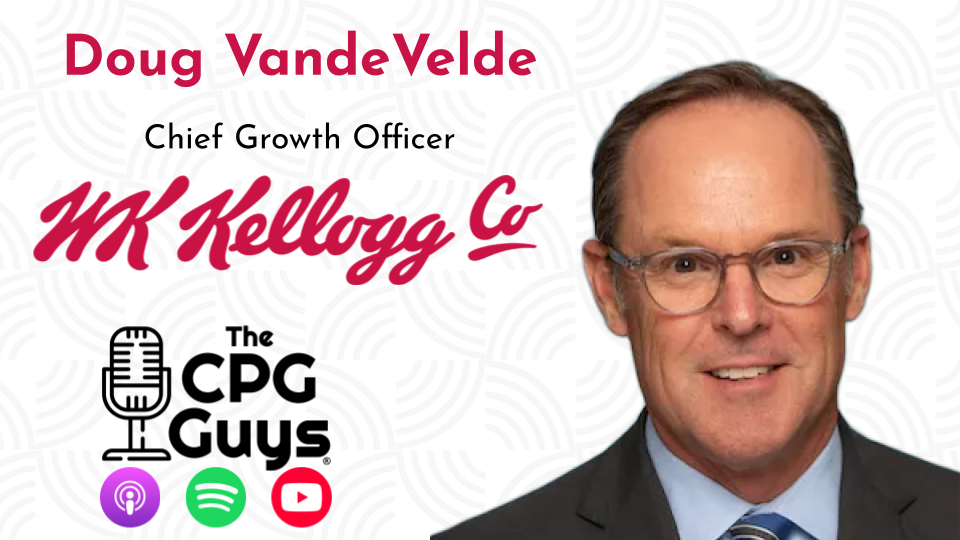
 The CPG Guys are joined in this episode by Doug VandeVelde, Chief Growth Officer at WK Kellogg Co, manufacturer of an iconic brand portfolio including Kellogg's Frosted Flakes®, Rice Krispies®, Froot Loops®, Kashi®, Special K®, Kellogg's Raisin Bran®, and Bear Naked®.
Follow Doug on LinkedIn at: https://www.linkedin.com/in/doug-vandevelde
Follow WK Kellogg Co online at: https://www.wkkellogg.com/
Doug answered these questions:
- 95% of Americans are missing their daily fiber, but nobody goes to a Super Bowl party looking for a "health lecture." Why was 2026 the specific moment you decided to use the world's loudest stage to talk about the "Fiber Gap"?
- Fiber has historically been marketed as a functional necessity for the "older" demographic. How are you using this campaign to pivot the narrative from a "health trend" to a "tasty daily routine" for everyone from Gen Z to Boomers?
- You partnered with Gary Vaynerchuk’s team to bring humor and high-profile talent to a topic as "unsexy" as gut health. How do you, as a 25-year CPG veteran, balance the "legacy brand guardrails" of Kellogg’s with the fast-paced, "attention-first" creative style of VaynerMedia?
- You chose a regional and streaming-first buy for the Big Game rather than a traditional national spot. As Chief Growth Officer, how did you justify the "reach vs. precision" trade-off to your board?
- Gut health can be clinical and boring. Talk to me about the decision-making process behind using humor. Does "funny" actually move units of Raisin Bran and Mini-Wheats, or is it just about winning the "Ad Meter" rankings?
- With a streaming-first approach, you have more data than a traditional TV buy. How is WK Kellogg using real-time signals from this campaign to adjust shelf-level execution in the weeks following the game?
- You’ve been in this game for over 25 years. What is the one "old school" CPG rule you had to break to make this 2026 Super Bowl campaign a reality?
- When you go big on a Super Bowl scale, the pressure on the supply chain is immense. How did the $500M modernization of your plants allow you to "lean in" to this demand spike in a way you couldn't have three years ago?
- Before the campaign went live, did you use AI-driven "attention analytics" or "predictive creative" tools to ensure the humor would land across different demographics, or was this a "gut-feel" (pun intended) decision?
- If this "Fiber Gap" campaign succeeds, you aren't just selling boxes of cereal—you're changing a category's trajectory. Is the future of WK Kellogg less about "Breakfast" and more about "Functional Wellness"?
CPG Guys Website: http://CPGguys.com
FMCG Guys Website: http://FMCGguys.com
SheCOMMERCE Website: https://shecommercepodcast.com/
Rhea Raj’s Website: http://rhearaj.com
Lara Raj in Katseye: https://www.katseye.world/
DISCLAIMER: The content in this podcast episode is provided for general informational purposes only. By listening to our episode, you understand that no information contained in this episode should be construed as advice from CPGGUYS, LLC or the individual author, hosts, or guests, nor is it intended to be a substitute for research on any subject matter. Reference to any specific product or entity does not constitute an endorsement or recommendation by CPGGUYS, LLC. The views expressed by guests are their own and their appearance on the program does not imply an endorsement of them or any entity they represent.
CPGGUYS LLC expressly disclaims any and all liability or responsibility for any direct, indirect, incidental, special, consequential or other damages arising out of any individual’s use of, reference to, or inability to use this podcast or the information we presented in this podcast.
Doug (00:00)
Hi, I'm Doug VandeVelde, Chief Growth Officer at WK Kellogg, and you're listening to the CPG Guys podcast.
Sri (00:07)
Hello and welcome to the special episode of the CPG Guys Podcast. this is our lead up to episode 600 and our C-suite series. I'm Sri, your West Coast co-host and also CRO and co-founder of ThinkBlue Consulting, your trusted partner in your Omnichannel Journey, where you can get in touch with me at Sri @ thinkblueconsulting.co. Pleased to listen to my younger daughter, Lara Raj's band Katseye whose music is now globally famous and now the proud winner of three American Music AMA Awards this year with a clean sweep.
Just this past Sunday in Vegas. Of course, Papa Raj was there to see it live right from up front. I'm joined today by my East Coast co host and co founder, PVSB who also moonlights as head of industry and climate engagement at Flywheel, The Commerce Acceleration Division of Omnicom, Peter, how you doing, man, Cannes less than a month away. What's cooking up there for the CPG guys?
PVSB (00:55)
I'll tell you in a second, but first of all, congratulations to the whole Raj family on the success at the AMAs. Not only three awards. Wow, what a big win. But let's not forget just the whole K pop sensation, right? I remember that ⁓ the K pop Demon Hunters won four awards. I think BTS won an award. That's a lot around the whole music genre. So very exciting to be a part of that, Sri.
But as for Cannes well, we've got a big activation. The CPG guys in partnership with our European partners, the FMCG guys. Well, we've established La Residence, which is a wonderful platform. We're hosting right downtown, across the street from Amazon Port, in the piazza there. We've got sessions involving Dollar General. We've got sessions involving eMarketer. We've got sessions involving ⁓
Flywheel, there is a whole bunch of activities going on. We're really excited about this. and that's gonna take place the week of ⁓ June 22nd through the 25th in Cannes, France during the the Cannes Lions Festival, Sri. So if you're gonna be there, please, please ping us and let us know. There's lots of activity, happy hours. ⁓ I forgot to mention we're doing a happy hour with
the ⁓ the women in commerce media. So lots of activities going on Sri.
Sri (02:17)
But I wanna know is the French coffee gonna be any good?
PVSB (02:20)
since I don't drink coffee, I don't think I am a good judge of character for that particular question. But there will be some croissants and some yeah, there'll there'll be lots of macarons.
Sri (02:26)
You're not gonna be good judges, Rose either.
Petit D.
I
learned those two words for you. Exactly. All right. Let me thank all of you that listen to us and our sponsors. Without you, this podcast doesn't exist. Thank you, thank you, thank you. Make sure you're subscribing to a podcast on your preferred listening platform where you can get our latest episodes and go back and consume some of the five hundred and ninety five plus episodes we've already published. Now let's get to our special guest. This is one I've waited for a couple of years. So here we go.
PVSB (02:41)
Wait, there we go.
Sri (03:03)
We have a phenomenal episode lined up today. If you've been paying attention to the grocery aisles lately, you know that the old way of driving commercial growth is officially moving out the window. Between the intense shift towards predictive demand science, the evolution of omnichannel shopping behavior, the need for brand distinction, consumer brands can no longer just rely on legacy playbooks to protect their volume. Question isn't about mass reach anymore, it's about agility, commercial transformation, and uncovering real world behavior to win the shelf.
To help us cut through that very noise, find the signal that matters for the brand, we're joined live by an absolute titan of the industry who's leading commercial strategy for what I would call some of the most iconic names in breakfast history. He's a seasoned business leader with an incredible decades long track record of steering powerhouse portfolios, driving brand relevance, and modernizing consumer engagement. And he currently serves as a chief growth officer at WK Kellogg Company.
Where he is spearheading the commercial growth and transformation for legendary brands, some examples of frosted flakes, fruit loops, and special K. Please welcome to the CPG guys, Doug VandeVelde. Doug, welcome to the show. How you doing?
Doug (04:11)
Great, great guys. How are you guys doing? Really great to be with you here today.
Sri (04:16)
Awesome. In the digital show notes of this episode, we'll of course include links to Doug's LinkedIn profile, WK Kellogg's corporate website for our listeners to access while we go on with our conversation. I'm gonna jump right in, Doug, and the first question I have for you is 95% of Americans, we believe, based on publicly available data, miss their daily fiber. But nobody goes to a Super Bowl party exactly looking for like a health lecture on fiber. What was specific about 2026?
What was that moment you decided to use the world's loudest stage to talk about the fiber gap during Super Bowl as an event?
Doug (04:53)
I think the big picture here is that we're doing a lot these days to re-engage consumers on the benefits of cereal. I think we feel like cereal has become a little misunderstood. And so we're doing a lot these days to drive reappraisal. So in that context, we we've seen in our research that fiber is really trending. Okay. More people are trying to get more fiber in their diet. and the last year we saw just as many people trying to get more fiber.
as they were trying to get more protein. And we know protein's been been trending for a long time now. The thing is, when you want to get more protein in your diet, it's it's obvious. It's easy. There's a million choices. But when consumers want to get more fiber in their diet, it's not as obvious. And it's not as easy to see where to go to get that fiber. And that's where our portfolio comes in. we have a great portfolio of tasty brands, starting with Raisin brand, that make it easy for consumers to get that fiber. So
When you have a problem that ninety-five percent of people don't get the fiber they need, and you want to reach those people, there's only one way to do that in the world today, and that's to go to the Super Bowl. So we wanted to make a big splash. We knew we had to reach a lot of people. ⁓ and so that's where the Super Bowl comes in. And then, as we went along, we discovered a very interesting insight, which is that gut health is really in the spotlight in Super Bowl, but in the negative way. Many people overeat, overindulge,
in the in the Super Bowl parties, eat too much food that's not great for them. And we always say you you wake up Monday feeling bad and bloated and you're backed up till Wednesday and you need to do something about it, So that's where that's where the the Super Bowl really plays. So we decided that now's the time to shine a light on gut health through the lens of one of our most iconic brands, which is Raisin Brand.
PVSB (06:37)
Doug, welcome to the podcast. We're quite honored to have you join us today. ⁓ I think back to ⁓ spending summers with my grandparents in New Jersey, and my grandfather pulling out his glass of water and some powder mix from a little canister and spooning it in. it doesn't doesn't connote for me. it's vivid memory, but I just couldn't imagine consuming that.
And as such, fiber has kind of been historically marketed as a functional s necessity for an older demographic. How are you using this campaign to pivot the narrative from a health trend to a tasty daily routine for everyone, from Gen Z all the way up to boomers?
Doug (07:21)
that's a lot of what we're seeing in our in our consumer research is that people are really starting to understand the benefits of good gut health on a daily basis. it helps them feel lighter, be less bloated, have more energy, be more like themselves. So it's less of a corrective thing, like your grandfather experienced, and more like something that people want to do every day. They want to have good gut health every day because it affects, their overall wellness.
from our campaign, the the idea, the the line is high fiber, happy gut, and that's what people want. they want their their gut health to be happy because that overall infect affects their the energy and their mood. And honestly, that's even more true of, millennials and Gen Z than it is than it even is of boomers. So we see a multi generational appeal here and obviously we'll talk about it, but that was our approach to to the Super Bowl and to our entire fiber initiative is to make it multi generational.
Sri (08:17)
One thing, Doug, I would love for you to share with the audience is when you chose that Super Bowl as this kind of marquee moment for you, what kind of results did you get from that week that you actually highlighted fiber as one of the most important food sources? Did you see did you see volume or did you actually get, more important than volume was actually getting the message across that
Fiber is important for gut health, exactly as you stated, the Super Bowl traditionally is associated with some negative bit. I don't know if the right word is negative, but I'll say it. eating unhealthily versus eating healthily.
Doug (08:50)
Yeah. Yeah. I mean the insight just rings so true. we did a lot of work obviously leading up to ⁓ launching the campaign and and the insight just leads ⁓ it's just so true. And so the other thing on the flip side of it is is that the benefits of eating fiber every day are real and you feel them, I mean, if you eat a bowl of raisin bran every day for two weeks, I guarantee you you will feel the difference, It's got wheat bran that works very quickly to move things through.
And that gives you more energy, it gives you less bloating and you just feel better about yourself. So so that's the other thing we had working for us here is that the benefit of the product is tangible and people can can really can really feel it. So, the Super Bowl these days is not just the game. Okay. From a marketing perspective, it's a it can it's an ecosystem that goes on for weeks, It it certainly starts a few weeks before, ⁓ and then there's the game, and then we even had continued activation after.
So we saw, as as you guys know, a tremendous uptick when we launched this idea before the Super Bowl, maybe ten days before the Super Bowl. The whole idea of high fiber, happy gut, William Shatner, which we can talk more about, was a fantastic partner. one one of my favorite things that we saw early on in the social engagement and what people were saying is they're like, Hey, William Shatner and Raisin Brand, these are national treasures.
These are national treasures, and it's just like it's so true. I mean, William Shatner's ninety-five years old, Raisin Brand's a hundred years old, they've been around for a long time and they're just legendary, each of them, in their own respect. So yeah, so we saw a really great uptick. We saw sentiment change. post the Super Bowl, we've seen the business improve. So, it's been a very positive experience for us overall.
Sri (10:34)
I gotta tell you, Doug, after every Super Bowl, Peter and I do an episode, meticulous details about every ad that was featured from kickoff to ⁓ the final whistle. And we gotta agree with you that the William Shatner ad that y'all featured was on our top five. No debate about that. And I gotta tell me one more time, man. Maybe it's the gut fiber that y'all are delivering for him that makes him look nothing like makes him look and talk nothing like ninety five.
Doug (11:03)
As incredible, incredible. We're all saying if if I get to look like that when I'm ninety five, I'm eating brazen brand three times a day, not just one.
Sri (11:10)
Heck yeah, let's just pass that message on to the world, man. You wanna When you're ninety five, please do that. So yeah, he's let me Peter and I are fanboys of Gary Vaynerchuk and the media team. We've been following him for quite a bit. I've shared the stage with him in previous corporate lives, for Johnson and Johnson. We know you partner with Gary Vaynerchuk's team to bring humor and high profile talent to a topic as, if I may say so, Peter, unsexy as God Health.
Doug (11:13)
Exactly.
Ha ha
Sri (11:39)
How do you as a twenty five year CPG veteran balance existing, maybe older brand guardrails of Kellogg's with the fast paced attention attention first kind of creative style of Gary and the team at Vayner Media?
Doug (11:54)
we have been working with them for a few years now, and just it is a perfect marriage, honestly, because you have the iconic equity of our brands, the the brand equity, the trust that already exists from consumers, the un undeniable product truths. And then you combine that with Vayner Media, who understand culture and creativity and agility, and they just know how to get ideas.
⁓ to be relevant with consumers. And so it's a perfect marriage. It really was. And and the Super Bowl, I think, really, really played that out. they they are big on cultural and how we take an idea and we make it something that the culture embraces and amplifies and and really and really drives forward. So we ⁓ I couldn't have been a better fit, couldn't have been a better marriage in terms of this partnership.
And we really respect the things that they do and they respect the brands that we have and that's why it works so well.
PVSB (12:49)
Doug, how was this extended ⁓ beyond just television into particularly social media platforms to give a three sixty surround effect to drive consumer awareness and engagement?
Doug (13:02)
So again, we we look at the Super Bowl these days as like an ecosystem of screens. It's an ecosystem of platforms. And it's not just the ad on the game. So, we launched into social media about 10 days before the game, a lot of teasers about William Shatner. And I I don't know if you guys saw some of these, but it was just like William Shatner sitting in his car eating a bowl of raisin bran. And and again, the internet went wild. It's like, what's happening here? Why is he doing that?
And then again, with the help of Vayner, we just continue to build on that, amplify that throughout the 10 days before the Super Bowl. And the social media response was amazing. that and that also went into paid and some earned and some great media coverage, I mean, some fantastic ⁓ clips that I could ⁓ that I'm sure you saw ⁓ on some of the today show ⁓ segments. And so that all that all went fantastic and that really sets the stage. And you there's you there's a built-up
⁓ awareness already and there's a built-up excitement for the the day itself. So we we had our spot, on the on the game. It was great. But really, honestly, in our mind, guys, the Super Bowl was the launch to a year long communication about the benefits of fiber. So for some brands, the game is the end, the game is the end. For us, the game was the start, and we have been ⁓ communicating fiber across
linear T V, C T V, all the platforms, ⁓ YouTube, everybody, and in social since then, and so we're gonna continue that on for the entire year. So it was it was a great launching off point for what has turned into and will be a year long campaign.
PVSB (14:37)
So getting back to the actual big game advertisement, you actually chose a regional and streaming first buy for the Super Bowl rather than a traditional national spot that went out over broadcast. So as chief growth officer, how do you consider and justify reach versus precision as you're advocating to
the rest of the C suite and your board on this is the direction we should be going.
Doug (15:06)
We spent a lot of time on this, obviously. I think it was a very intentional, very purposeful, and a very efficient kind of media decision. I mean, we we haven't been in the Super Bowl in Kellogg's serial for 15 years. Okay. So this is like getting back into the game. And we're getting back into it in a very, again, targeted and efficient way. So we we bought the streaming. streaming is is the new platform. It's this was the most streamed Super Bowl ever.
You can do good targeting within streaming. So that made a lot of sense. Then we bought some big local markets to go with that, and so we tried to drive reach, but we did it in an efficient way through the streaming and through the regional markets. And then the goal was to really read that, see what we get from that and be able to optimize from there. So yeah, it was it was purposeful, it was efficient, but the streaming side of it, the addition of the of the growth of streaming really does add a lot of flexibility to people like us.
to be able to be targeted, to be efficient, and to really drive the messaging in the way we want.
PVSB (16:07)
And I've got to imagine with the streaming, you also get the added benefit of a more closed loop measurement and some working with clean rooms and being able to connect that to actual consumption data. That gives you an added level of confidence that the advertising that you are ⁓ you are producing is having downstream conversion effect.
Doug (16:31)
A hundred percent. And you that's the drill. When you're when you're spending this much money, you want to know that you're getting the result for it. Okay. So you've got to make it measurable. you've got to have the, as you say, the data infrastructure to make it to make your ⁓ to do the evaluation of your decisions and make sure that it really was it really paid out. In our case, it definitely did. But you're right. That's a big advantage of having the streaming platform.
Sri (16:53)
So needless needless to say, gut health, clinical, we've kind of said that multiple times at this point. To some it could be seen as, my gosh, boring, I gotta comply. Since Peter and I weren't a fly on the wall when you were presenting this concept to your leadership team, including which you're very much a part of, but to your bored, because this is a Super Bowl ad at the end of the day, it better be good.
the decision making process, how you convince them, I'm gonna bring humor to this. And getting will William Shatner is no joke. So and getting to cooperate with how the story needs to come out for gut health and fiber, I'm sure that wasn't easy either. But take us behind the scenes. How did all this come together? And then at the end of the day, did funny and humor actually move units of Raisin Bran and Mini Wheats? Or was it more about getting the impressions?
Updating myself within impressions, sorry.
Doug (17:48)
I feel like you were in the room for all the discussions because those are all all the things that we were talking about. So I think first of all, I think humor makes the topic approachable. Okay. It isn't like gut health is for a small number of people. It's for everybody. But it's just one of those topics that, you don't talk about it that often. If you don't if you feel bloated, you feel sluggish, that isn't always something that comes up in conversation. So we're like, okay, it we we need to take kind of an awkward truth and we need to flip it on its head and make it an empowering conversation.
Well, a way to do that is to bring humor to it because humor makes it approachable. You're trying to give people like an aha moment that put a smile on their face, certainly not not give them a lecture. I think the other thing is that, in the Super Bowl, you have to earn people's attention. just because you're in the Super Bowl doesn't mean everybody's gonna pay attention to what you're doing. So you've got to earn people's attention. And to earn it, you've got to do things that are bold and interesting and funny in a lot of cases, So
we said, hey, we we've gotta not just be in the Super Bowl, we've gotta be in the top five or the top two in the Super Bowl, and we've gotta earn people's attention to make it to make it really worthwhile. So so that's where kind of humor really, really came in. and at the end of the day, what we're trying to do is we're trying to really shift people's behavior. So in order to do that, they've got to really internalize what we're saying. And again, the emotional connection that people have with humor helps them internalize the message.
And that gives you a better chance of actually changing behavior and making our fiber brands kind of everyday solutions. So I think, it was quite universal that once we got to that, all that learning that this would be the right approach to really make our brands win in the Super Bowl. And, you to your last question there, we have definitely seen an uptick in our in market consumption from the fiber brand, not only Raisin brand, but the other fiber brands ⁓ that are associated with the messaging from the Super Bowl.
Sri (19:42)
Bingo indeed Doug. Let me remind our audience that we're speaking with Doug VandeVelde, Chief Growth Officer at WK Kellogg Company, as part of a C suite series leading up to episode six hundred.
PVSB (19:55)
So, Doug, I made reference to the closed loop measurement capabilities around streaming. with a stream first approach, you obviously have more data than a traditional TV buy. How is WK Kellogg using real-time signals from the campaign to actually adjust shelf execution in the weeks following the game? And shelf execution being important because as we s know.
Most groceries, food and beverage are still being purchased dramat ⁓ overwhelmingly so in physical brick and mortar. So how is this translating into the actual shelf execution?
Doug (20:32)
So probably three things there. The first thing is that when you go to brick and mortar retailers, of which we have great partnerships with all of our retailers, and you tell them, hey, we're bringing the fiber message to the Super Bowl, they're like, hey, this is going to be great for our category. We want to make sure your brands are visible to the consumer. And so you get more in store merchandising, which is a big driver, obviously, of our volume. The second thing that you do is in the short term is you adjust your digital shelf. Okay. So,
⁓ e-commerce is a fast growing part of our business. It's a fast growing part of center store food. And you can adjust your digital shelf, ⁓ immediately. So that's another thing we did. Once we saw the assets and the work that was coming out of the William Shatner fiber campaign, we immediately pushed that to our digital shelf. And the digital shelf helped drive more e-commerce sales in the short term. And then ultimately in the midterm,
When these brands that were in the Super Bowl get more velocity and they start to sell more, then we can go back and get brick and mortar shelf presence to be greater, get the merchandising to be greater, and that supply wheel that all just kind of starts to feed itself. So all three of those things really worked in our favor in this case.
Sri (21:46)
So part of what Peter and I do is every Tuesday we talk talk about earnings reports. We've been following your the other big competitor in the CDL space pretty closely and it appears, when I circle back about a few years, y'all went through a strike, it impacted distribution, it impacted self execution. Here you are a few years later actually doing a Super Bowl ad and you seem to be thriving.
And ⁓ your competitors looks like at least publicly reported data is struggling. And ⁓ Peter and I kind of follow what rules exist, who's still trying to stay in the old way without bringing change forward. And we suddenly now look at it and say, maybe the other big serial player is struggling, not breaking those old school CPG rules. So if if if I were to ask you, as a veteran in the industry like Peter and me.
What are some old school CPG rules you clearly had to change or break to actually do a twenty twenty six Super Bowl campaign, making it a reality, that you would also advise, pass on as advice to the industry? Hey, think before you leap.
Doug (22:55)
in CPG, the reputation is these are slow moving companies with big iconic brands that don't do, much different each year. And so we've really tried to break that paradigm and be more agile and more more in culture. But the big thing I think, the big rule in my own mind, and again, I've I've been doing this for a long time, is there's always a lot of focus on media, CPMs, cost per impression.
And short term ROI. Okay. A lot of focus on that. And so if you're really trying to change the trajectory of an iconic category like serial that still has 94% household penetration, you've got to take big swings. Okay. You got to do big things that are going to reach a lot of people and have a lot of impact. And those things cost money. And in the short term, we'll see ⁓ what the short term CPMs and ROIs might be. But in the midterm and the long term,
you've got to do those things if you really want to have a big impact. And you just think back to the history of consumer packaged goods and you can point to the five or six big inflection points that were big things that people have executed. And so that I kind of threw out the the marketing math a little bit in the beginning and said we need to we need a big swing here. we need a big swing. We need to do something that will really have impact and can turn the trajectory and have have lasting impact. ⁓ and I think that's that's the thing here. I
I'm sure you guys have seen have seen, we're doing multiple things there. I mean, we just now have toys back in the cereal box. we put toys back into our cereal boxes in our partnership with Disney on the Toy Story movie that's out now, and that has also got tremendous response. I mean, the nostalgia of people remembering growing up as a kid, I always say elbow deep in my apple jacks trying to grab that trying to grab that toy out of it. I mean, this just
So much latent equity and those kind of things. So again, big swing, put toys back in the box, but again, something that will have lasting impact.
PVSB (24:48)
Doug at the CPG guys, we're famous for when we hear really great quotes, putting them on t shirts that we like to wear for future episodes. So I'm pretty sure ⁓ you gotta take a big swing to get a big impact is going to find its way onto one of our t shirts. So don't be surprised.
Sri (25:06)
That
the C P G guy's wearing that a cagma next year.
PVSB (25:09)
Yeah, I think that's
Doug (25:10)
That'd be great. That'd be great.
PVSB (25:12)
All right. ⁓ when you go big on a Super Bowl scale, the pressure on the supply chain can be pretty immense. How did the ⁓ half billion dollar modernization of your plants allow you to lean in to this demand spike in a way you could not have possibly done two, three years ago?
Doug (25:32)
as you guys know, we announced a big modernization of our supply chain a couple of years ago, putting a lot of capital in to make our supply chain more resilient, more capable, more flexible, and able to deal with, demand shifts up and down. And so ⁓ the fact that we've been doing the modernization allows us to say, hey, we're going to the Super Bowl with Raisin Brand and we're gonna need more mini weeds and
this is gonna have an upside that we hadn't originally been planning and we need to be able to supply this. And so the supply chain leaned in here tremendously well. And again, we would not have been able to do it if we didn't have the capabilities that we've been adding. So you're right. Super Bowl puts a lot of pressure on supply chain and we have one that really rose to the occasion here.
PVSB (26:18)
Doug, do you do you see this as an opportunity to really, ⁓ in addition to obviously building your own brand equity through exactly what you're doing, do you foresee this as being an opportunity for other brand collaborations outside your category and and elsewhere to really play out the the gut health opportunity that this brings?
Doug (26:39)
Yeah, definitely, definitely. I mean, we think fiber is having its moment. I mean, William Shatner said it's fiber time. I think he's right. Yeah. So we think gut health is here to stay and people are gonna more and more realize the benefits of good gut health. People are more and more there's going to be more and more science that comes out about the overall well being benefits of gut health. So I think we think it's here to stay. And we're doing a lot of innovation in that area. We'll be doing more partnerships in that area, something we're definitely committed to.
Sri (27:08)
Awesome. ⁓ no conversation with a senior leader in our industry can end without bringing up artificial intelligence or the famous two-letter word in our industry today, AI. So I'm I'm tempted to ask you, Doug, before the campaign went live, did you actually use AI-driven, let's say, attention analytics, predictive, creative? Did you partner with Vayner on, hey, let's do, the old ways of A-B testing, let's create a bunch of creatives.
Do some maybe testing with it through AI. Or ⁓ know, you needed to ensure the humor and you needed to make sure it would land across demographics. So did you go through the process with AI or was this more about you guys are leaders in the category, you have been, you're certainly thriving, and was it a gut feel? Gut feel. Unintended. ⁓
Doug (27:56)
I like it. I like it. I like it.
obviously there's a lot going on ⁓ with AI in our company and there's a lot of things we're using AI to make us better ⁓ at. I think in this case though, ⁓ we had been doing some work with Boehner on the whole area of fiber in social media, a lot of organic, ⁓ and then some paid. And so we're getting a lot of good early indications of the kind of stickiness of the fiber message. So we do that, we optimize that, we we optimize the paid based on the organic. There's some AI involved in that.
But honestly, when we saw the William Shatner spot, it was just one of those things where you go, This is gonna work. it's I think to your question, I think is gut instinct. I think you just look at that and you go, that is great. it's gonna work. It's got pure, it's true to the brand's equity and the product truth. It's got the multi-generational appeal of William Shatner. It's funny, it's gonna break through. And so I remember the first meeting. I mean, Boehner showed us the idea. I mean, I literally laughed out loud.
I looked at, my team there and I'm like, this is gonna work. This is brilliant. And then of course we continued to make it better and built out the whole ecosystem from there. But ⁓ but yeah, no, I think it was just one of those things lightning in a bottle a little bit that you see it and you know it's gonna work.
PVSB (29:11)
Absolutely, Doug. I get to ask the last question of our conversation here. It's pretty clear the the fiber gap campaign is on the road to success. And that gets measured not just in terms of selling boxes of cereal, but changing the trajectory of the entire category, which excites your retail customers, I have to imagine. Is the future of WK Kellogg less about breakfast and more about
Functional wellness.
Doug (29:43)
we're definitely trying to change the trajectory of this category. It's something the consumer wants and it's something that the retailer wants for sure. But we've done a lot of work in the last couple of years and we feel like we're in the business of joy. We're joy and connection for families. We're in the business of joy. That's what cereal brings. It brings joy through taste and fun and the emotional benefits of eating around the table in the morning, of the nostalgia.
Everybody has a story, everybody remembers. So that brings joy. The other thing that brings joy is feeling like you're doing the right things for your health in a simple, accessible, tasty way. And that that's where the fiber campaign and other things that we're doing really come into play. And I think those make people feel good about what they're doing, and that brings joy as well. I'm sure you saw, or maybe you will, our press release this morning, we're bringing an evidence-based framework.
around the benefits of cereal, make it easy for people to understand the benefits of cereal called spoons. And it's an acronym and and it has a thing associated with each letter. Super smart way, memorable way for people to just re-engage in the benefits of cereal. So we are definitely trying to change the trajectory of the category. I think as you said, we've got some early green shoots that a lot of what we're doing here is working. And I think, what we ultimately want to be is a a is a brand that brings joy to people and to families.
Sri (31:07)
I gotta say, Doug, the whole family emphasis that you said, bringing the joy back of sitting on a table together and having breakfast together on a weekend, perhaps, is is a pretty cool factor that we've all kind of moved away from in the past couple of decades. And maybe the other thing I think of is when you when you all made the press release this morning about spoons, the first thought that went to my head is it's not just a WK Kellogg's proprietary framework. You're kinda going to help.
the entire retail ecosystem to ⁓ really lean in and now anchor on re energizing cereal as an as as the option, not an option for breakfast. Correct. Which is gonna energize the whole category and just probably change how the future of ⁓ functional wellness and breakfast continues to develop over the course of time.
So let me remind the listeners, you can find all our content by simply going to a web browser and you can type cpg guys.com as the URL. If you or someone you know has something to contribute to this ongoing discussion on the CPG guys, please drop us an email at reach us. That's R-E-A-C-H-U-S reach us at cpgguys dot com. To our audience, I can't thank you enough for the clicks, likes, comments, direct messages, meeting us at trade shows, coming to our events.
recording episodes with us and our sponsors. We're always grateful for you. The show doesn't exist without all of you. You work with us all year. We're grateful to have you as your audience and partners. Thank you. Thank you. Peter, a pleasure doing this live with you.
PVSB (32:38)
No, together in fact. That's great.
Sri (32:40)
I mean, talk to us about your big takeaways from this conversation with Doug. ⁓
PVSB (32:45)
well obviously the t shirt moment of you gotta take big swings to have a big impact. ⁓
Sri (32:51)
I'm
just saying Peter, that's gonna show up at Gagney next year on a
PVSB (32:54)
I
it absolutely will. But for me it it's the other the other thing that I think of from my nostalgia, and I made mention my grandfather, is this is not my grandfather's Oldsmobile, right? WK Kellogg is positioning itself not as a manufacturer of cereal, but as a promoter of health and wellness, right? And that is functionally important because
It transforms the nature of their relationship with their retail customers. And the more they are helping retailers advocate for health and wellness, the more they are a part of the conversation that they're having with the end consumer. So I think this is ⁓ this is setting WK Kellogg up well for ⁓ for growth. And I I encourage them in this direction. What do you think, Sri?
Sri (33:45)
Since you've covered the functional benefits of CDL already as your big takeaway, I'm gonna go in a completely different direction, Peter. So as we were talking to Doug today about we all we did was we talked about one campaign. Yeah. But he did a master class and I'm gonna kinda talk about the kind of things that came out in this episode. We talked supply chain. Yeah. I had to drop AI in there. Yeah. We talked e commerce. We talked social media, social presence. Close closed loop streaming.
How some legacy measurement metrics in media may not be the best way to measure, but one of the most important things he talked about as a senior leader is having the guts. Having the guts. Guts. No one intention. Go with a gut feeling. He said something very important. Yeah. When I was sitting in that room with my team and we were looking at the choice of ads, I knew it was gonna work and boy has it worked or what. So this is a master class about
the entire ecosystem of a brand operating in the retail world with a retail partner and all the functional aspects that it takes from manufacturing all the way to distribution and consumption. That's what today was. Doug, I want to thank you for joining us this morning and actually bringing that masterclass to the CPG guys.
Doug (35:04)
thank you guys. Fantastic discussion. Really enjoyed it. Appreciate ⁓ all the time.
Sri (35:09)
That's what we have for you today, folks, in our C suite series leading up to episode six hundred. We look forward to you joining us on the next episode of the CPG Guys.