
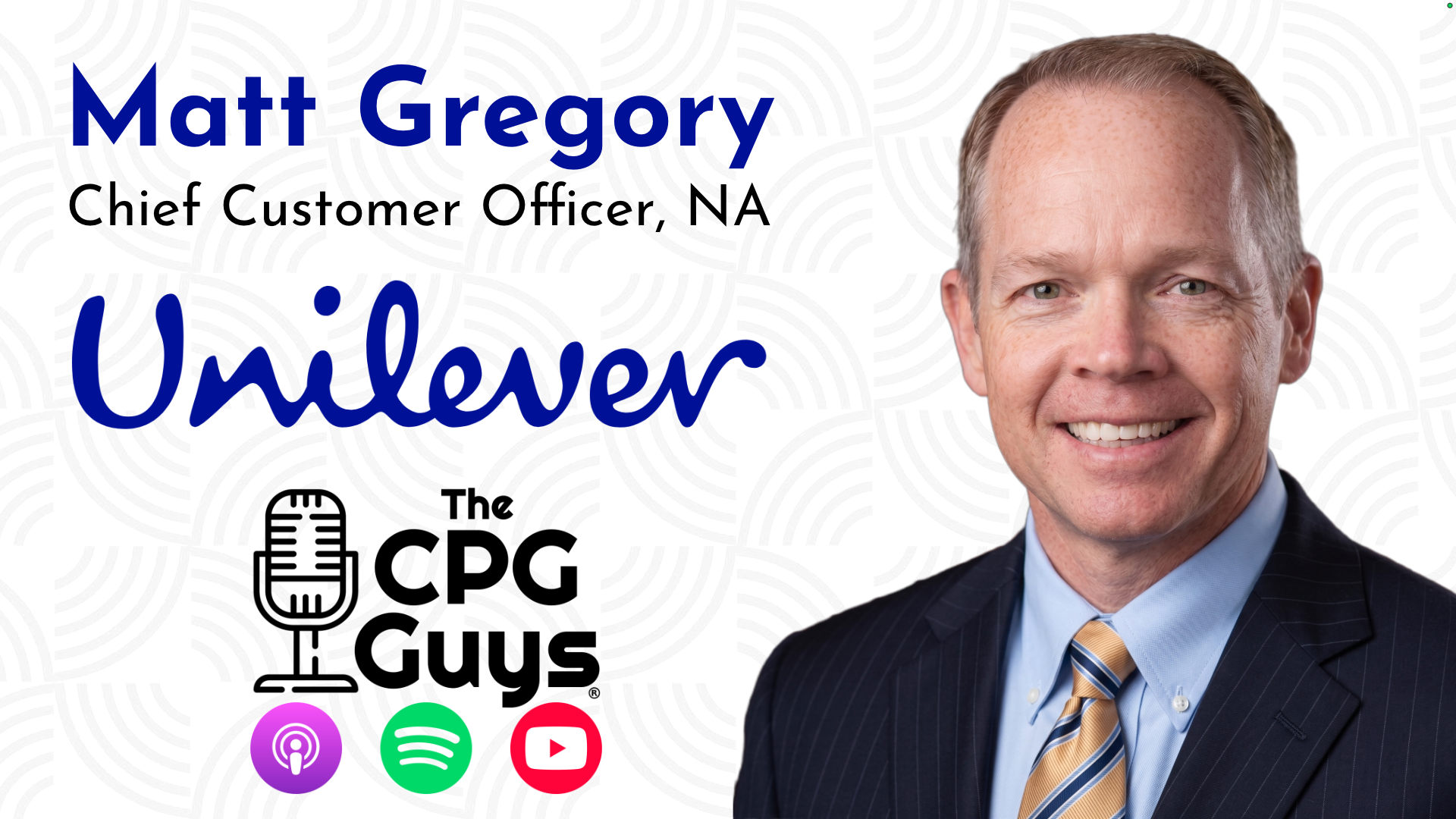
Unilever CCO Matt Gregory: Omnichannel Customer Growth Strategy



 Apple Podcasts Apple Podcasts
  Spotify Spotify
  YouTube YouTube
  Overcast Overcast
  Amazon Music Amazon Music
  Audible Audible
  iHeartRadio iHeartRadio
  Castro Castro
  TuneIn TuneIn
  RSS Feed RSS Feed
  Audacy Audacy
  Castbox Castbox
  Fountain Fountain
  Goodpods Goodpods
  PlayerFM PlayerFM
  PocketCasts PocketCasts
  Podcast Addict Podcast Addict
  Podchaser Podchaser
  Podurama Podurama
  Podverse Podverse
  Podyssey Podyssey
 The CPG Guys are joined in this episode by Matt Gregory, EVP & Chief Customer Officer North America at Unilever.
Follow Matt on LinkedIn at: https://www.linkedin.com/in/matt-gregory-b702567
Follow Unilever online at: http://unilever.com
Matt answers these questions:
- As Chief Customer Officer, what are your top priorities for Unilever's customer partnerships this year, and how have those priorities evolved from your previous roles?
- Unilever spans many categories and channels. How do you balance a single, coherent customer strategy with the diverse needs of retailers, wholesalers, and direct-to-consumer partners?
- What makes for a truly effective retailer collaboration from a customer-first perspective? Can you share thoughts on what constitutes a partnership that delivered measurable value for both a CPG brand and retailer?
- How has Unilever adapted its customer strategy to omnichannel realities—store visits, digital marketplaces, and social commerce? What role do retailers play in orchestrating that journey?
- In times of supply chain disruption, what are the key lessons for maintaining strong customer relationships, and how do you collaborate with retailers to mitigate risk for both sides?
- When a brand is already as big and established as Dove, growth typically gets harder—not easier. Yet, Dove is experiencing approximately double-digit growth in the U.S. over the last year. What’s the unlock that allows brands like Dove to continue deepening relevance and sustaining that level of momentum?
- What competencies and capabilities do you prioritize when building and leading a high-performance customer organization? How do you foster cross-functional collaboration with sales, marketing, and supply chain?
- Looking ahead 3–5 years, what are the biggest shifts you anticipate in retailer-CPG partnerships, and where should brands and retailers collaborate most closely to win in the evolving landscape?
- You’ve had a career that spans GM roles and commercially focused leadership positions. What have you learned in your personal and professional history that you find yourself using most in your role today?
- What’s something the industry is still doing today that you think we’ll look back on in five years and wonder, “why were we doing it that way?”
- What excites you most about agentic AI and how it could reshape the shopping experience? And what, if anything, gives you pause?
- If you could make one singular change to positively impact the CPG industry, what would it be and why?
CPG Guys Website: http://CPGguys.com
FMCG Guys Website: http://FMCGguys.com
SheCOMMERCE Website: https://shecommercepodcast.com/
Rhea Raj’s Website: http://rhearaj.com
Lara Raj in Katseye: https://www.katseye.world/
DISCLAIMER: The content in this podcast episode is provided for general informational purposes only. By listening to our episode, you understand that no information contained in this episode should be construed as advice from CPGGUYS, LLC or the individual author, hosts, or guests, nor is it intended to be a substitute for research on any subject matter. Reference to any specific product or entity does not constitute an endorsement or recommendation by CPGGUYS, LLC. The views expressed by guests are their own and their appearance on the program does not imply an endorsement of them or any entity they represent.
CPGGUYS LLC expressly disclaims any and all liability or responsibility for any direct, indirect, incidental, special, consequential or other damages arising out of any individual’s use of, reference to, or inability to use this podcast or the information we presented in this podcast.
Speaker 2
I'm Matt Gregory, Chief Customer Officer of Unilever, and you're listening to the CPG Guys Podcast.
PVSB
Hello, and welcome to the CPG Guys Podcast, set at the intersection of commerce and tech. Your hosts, Sri Raja gopalann and Peter V. S. Bond, explore how brands and retailers engage consumers in a digitally driven world. And now, here are the CPG guys.
Speaker 1
Hello, and welcome to this incredibly special episode of the CPG Guys Podcast. I'm, of course, Sri, your West Coast co-host and also CRO and co-founder of Thinkblue Consulting, your trusted partner on your Omnichannel journey, where you can get in touch with me, then email at Sri at thinkblueconsulting.co. Please do listen to my older daughter's music at www.rearaj.com and a younger daughter, Lara Raja the Band Katseye, who was nominated for three AMA awards just about a week ago. You can follow all of those pursuits on my personal Instagram and TikTok, of course. I'm joined today by my East Coast co-host and co-founder, PVSB, who moonlights us out of industry and client engagement at Flywheel and the Proud Father, Future Pro Golfer, Nadia. How are those golf exploits going? We've got lessons in. What's next?
PVSB
Golf camp in a couple of weeks. Yeah, seven and a half years old, though. I think the pro is the real problem here. Nadia said to me the other day, I just want to do it as a hobby. She wants to be an artist. She's already decided. She said to me Sri yesterday, most kids decide at 12 what they're going to do for a career, but at seven and a half, I've decided that I want to be an artist.
Speaker 1
Peter, I want to reset your expectations. My kids told me at age four and six, we're going to sing as a hobby dad if you get us music lessons. I didn't know if that's going to work out for them, sure.
Speaker
We're all over the world now. 27 City World Tours. So I don't know. Better listen to her carefully is what I would say. I agree, Sri.
Speaker 1
Of course, Peter, this is a special C-suite lead up to episode 600. And uh and it continues after that. And it's a special month-long programming for that. Take a minute, reflect on that, man. Six years.
PVSB
Hard to believe, Shri. We're closing in on episode 600. The fact that we consistently produce so much content. It is, it is, we try to make it sound easy so that our listeners enjoy they're educated and they're entertained, but we spend a lot of time sweating the details, the questions we ask, the people we invite, the topics we pursue. And the great thing about it is we do it from a practitioner standpoint. We get to ask questions that we really want answered, things that interest us. And so to have the opportunity to talk to so many luminaries in the industry, particularly leading up to episode 600, it's just a real treat, Sri. I know you agree.
Speaker 1
No debate, Peter Vang, that practitioner lens is very important. But let me thank all of you that listen to us and our sponsors. Without you, this podcast doesn't exist. In our wireless streams, Peter and I did not realize we would scale to a point where we lead corporate America and between this near coal time. So here we are. Thank you, thank you, thank you. Make sure subscribing to your podcast on your preferred listening platform. We can get all our latest episodes. Go back and consume the 590 plus episodes we've already published. And then while you're there on Apple and Spotify, give us a five-star rating. Why? Because Peter loves that number magically is whatever. No. It's because it helps make our podcast more findable by industry contemporaries who are looking to be in the edutainment space, both education and entertainment. Now I'm gonna jump over to our special guest. If you've been paying attention to the retail landscape lately, you know that the old way of driving commercial growth is officially moving out the window. Between the explosion of omnichannel behavior, the rise of collaborative commerce, the desperate need for genuine retail partnerships, brands can no longer just go in and walk in and assume they'll get mass volume through distribution. The question isn't about reach, it's about distinction, execution, driving trips and larger baskets at retail. And of course, brand equity development to help us cut through that noise, find the signal, we're joined alive by what I would say. It's a true heavy hitter that I've known for quite a bit in the industry. I think once upon a time we actually had sharing walls at FMI Midwinter. He's leading the commercial charge for a massive brand portfolio. He's a seasoned consumer products executive with over 28 years of industry pedigree, spanning leadership roles at Clorox, Burt's Bees, Kingsford Charcoal, and now, as we've said, the CCO, Chief Custom Officer for Customer Business Development at Unilever, driving strategic customer partnerships for legendary brands, TRESemmé, Vaseline, etc. Please join us in welcoming to the CPG guys, Matt Gregory. Matt, how are you doing, man? Welcome to the show.
Speaker 2
I'm doing great. Congratulations on almost 600 podcasts. I think I've listened to maybe four to five hundred of those, so I only have a little bit of catch-up to do. But uh congratulations to you both. Just the impact you've had on helping share different points of view across the industry has been really remarkable.
PVSB
Matt, you're gonna have to play us on double speed. That way you can catch up and make it to the 600. So that's right.
Speaker 2
I'll do that. But of course, Peter, five stars. Don't worry.
Speaker 1
Matt, in our generation, you could also play it backwards and create the Led Zeppelin story of Stairway to Heaven being played backwards if you want. But you have to be from our generation to know what that means. But in the digital show line out, this episode will include links to your LinkedIn profile, Unilever's corporate website for listeners to access where we go on with our conversation. I'm gonna jump right into it, Peter, and I'll start Matt right here, you know, with the role that you have as chief customer officer. Talk to us about your top priorities for Unilever's customer partnerships at retail this year and how those priorities evolve from previous, you know, your previous role.
Speaker 2
Yep, I think it's probably one of the more dynamic roles in the industry today. And that's really because it's broader than it's ever been before, because consumers, of course, are engaging in so many retail ecosystems and marketplaces and social commerce and digital platforms, and the number of ways that we can interact with consumers and they can interact with us is literally it's mind-blowing the number of things. And, you know, when I talk to my teams and what our collective mission is with our customer organization, is we simply want to be the first person or the first company that our retailer partners call when they need category growth, when they want to talk about partnerships or innovation, is that we're the first place they call for real true category leadership. And, you know, I think if you roll this back to the 30 years that I've been in in the industry, I think at one point that retailers uh viewed brands as a means to an end. And maybe some brands also viewed retailers as a means to an end toward a greater goal. And I think the biggest shift that we've seen is that, aside from previous roles, is that customer partnerships today are far more connected and far more demand-led. And that really, you know, makes a difference. And I will tell you, because of the consumers, they're the ones that have really created this as they move seamlessly across the physical, the digital, the social shelves, and across all the platforms, including AI. And it really makes our job to be one that's connecting demand generation and retail execution and supply and uh how we come across in physical and digital shelves. That is what our jobs become. And the better we do that, the more likely it is that we'll be the first person they call. And we'll be at the top of the list when they really do need to make that phone call for what does extraordinary category leadership look like? And that's how we respond at Unilever and across our teams.
PVSB
Uh I think we're going to get into this later, uh, Matt, but I couldn't agree more, particularly in the era where, for the better part of 75 years, retailers were writing checks and it was very much a one-sided conversation. In the era of where retailers become publishers and there's media involved, and to your point, consumer data is at the center of the decisions that are being made. It does require a level of partnership and complexity that was just unheard of before the last 10 years in particular. But uh what I want to what I want to tap into is obviously Unilever spans many categories and channels. Obviously, there's we won't go into this, but I know there are a lot of changes taking place in terms of the portfolio and how it's structured at Unilever. But how do you as the the steward of a uh of a large portfolio of brands, right? Balance a single coherent customer strategy with the diverse needs of all your retailer customers, the wholesalers, direct consumer partners. How does that kind of like all happen? It seems like you've got to be the jack of all trades to bring that together.
Speaker 2
It does. And I'll tell you that I think we've complicated this question over time. And the really the key is we've got to follow the shopper. And the reality is that their expectations are unique across customers and different channels. And I think the key to our success and the way that we look at it is that we have to have a consumer-first strategy while still recognizing that execution has to flex by retailer and channel and shopping mission, and whether that's in the drug channel or at uh in mass or e-commerce or digital. Um we have to create category growth and convert demand seamlessly uh across all of those channels in a way. Of course, we have to take our customer strategies and then we have to put that into a customer first, customer-forward model, and then with the consumer at the center. And you just brought it up uh just a minute ago, so I don't mind going into it just a little bit deeper. And as a company, we have also been championing greater focus. And last year we did separate our ice cream business uh uh into really try to focus on the core of our portfolio. And you no doubt have seen in the news that we're considering another process with our foods business. But following that separation, our portfolio in the U.S. will be 95% of beauty, well-being, um, personal care, business. And that focus really creates one where we can be the fastest growing and most relevant company in the spaces in which we can feed. And I think one of the special things we've learned throughout these two events is that it allows us to move with it in greater speed with innovation, with an extreme category focus where someone really knows their craft and knows their categories. And of course, I'll tell you, you can't do that without having brands that matter. And I would say that's the largest condition of being successful in this endeavor, is that you have to have a brand portfolio that drives desire for consumers. And if you think about Dr. Squatch and TRESemmé and Vaseline and Gruns and Liquid IV, and there's many more, they really are a set of brands that are perfectly aligned to this forward-looking mission of how we connect to shoppers and our retailers. And of course, you know, we pledge very consistently, MA in the US space, focused on these categories. And I believe that's just as part of much of our success as any other. But looking at each retailer about how we will execute and how we will partner with them on and how we will integrate with them really drives the end goal. But of course, all these other standards have to be met at the same time.
PVSB
You know, you mentioned Liquid IV. I'll, I'll, I'll make note of the fact that my other Avatar at Flywheel, we were so honored to partner with the Liquid IV team and showcase uh a case study at Amazon Unboxed last year on the great work we've done to help build out that brand. Yeah, it it's so absolutely fascinating when we talk about trying to trying to work with so many different retail partners, marketplaces, big chains, independence, co-ops. It's just there's a lot of complexity, and trying to to navigate that can be a very challenging effort. I'll also say this, Mike. Sri and I went to the CAGNY conference this past February down in down in Florida. And the one presentation that we regarded as being just top-notch was actually Unilever. And it was because your CEO talked about the fact that changes were made, um, not only obviously leading up to the divestiture of the ice cream, and at that point, the announcement I don't think had been made yet on the on on the food business, but the fact that there were also changes made to the board and to leadership, right? Because doing exactly that enabled you with the right people to fuel the growth of the business. That is fundamentally important. I think uh I think Unilever needs to be commended on on recognizing that it's not just I need to remix my portfolio. There are things that need to take place to uh to actually uh to actually succeed and and position yourself for success and growth.
Speaker 2
Yeah. Peter, thanks for mentioning that. We're really proud of that. And I think you know, it's as much of an inside-out transformation as outside in. And balancing those two has been really important. And you're right. We have built a lot of capability. We've made a lot of investments across the portfolio and our infrastructure. And frankly, it's about putting people in the right, uh, the right people in the right jobs that uh will truly fuel our ambitions of where we want to go.
Speaker 1
So, Matt, what makes for a truly effective retailer collaboration from a customer-first perspective? You know, can you share thoughts on what constitutes a partnership that actually delivers measurable value for both the CPG brand and retailer in these volume challenge times in the industry?
Speaker 2
Yeah. You know, Sri, I think this is probably the largest change I've seen in 30 years. And, you know, ultimately the strongest collaborations are ones where both the retailer and the manufacturer, the brand, they're focused on building the category together, not simply negotiating transactions. And I think that's been one of the things that kind of uh marred maybe a couple of the decades that we've been through together. And focusing on what matters is really how we create measurable value for both of us. And, you know, I think we have to be really tightly aligned on the ambition of mutual growth uh with retailers and brands and in the consumer and truly the metrics that matter. It used to be when we walked into a meeting, it was like the first thing out of the chute was supply chain metrics. And at one point, you know, we talked a little bit about unit growth, but that was about the measure of success. And today, when we walk into those same conversations, it's about growth, it's about digital penetration, household penetration, and have we together, both the brand and the retailer, have we created this demand generation ecosystem that is consistently providing conversion and growth? And I would say a big part of that that we've seen is that behaviors matter, integration also matters, and heck, you got to spend time with each other. You got to understand the objectives. And I think for for both companies, you have to advocate for integration. And that's hard. That is not a natural thing for us to do. But at the end of the day, the the common thread is that our best collaborations and collaborative relationships always start with the consumer and what they're looking for next. Not just what we want to sell or what we want to be sold, uh, it's both when the retailer and the brand are aligned. And of course, industry partnerships are much broader than products. Uh, but I'll just I'll give you a couple of examples where I think the collaborative nature of our relationship led to really great outcomes. And there's a couple of products that I'll put into mind. One is Dove and Crumbl, uh, that we executed with a retailer, and one's Bridgerton activations that we did during this last season's uh launch. We've also done things with Devil Wears Prada, and there's a host of others. But when we find the right cultural relevance and with the right product that can engage younger consumers, and both of these executions that I just mentioned, they drove new to brand, new to category, new to retailer. Like all of these metrics really matter into building the category that we want when we connect culture all the way through to commerce. It is, you cannot have one without the other. And I think this is a powerful way to reach consumers in this new world. And of course, you know, we have to have strong alignment that that is what our objective is is serving the consumer, however, they may be changing at every point.
Speaker 1
Matt, you said something very profound, Matt. Number one, the world has moved quite a bit from those days when you and I would sit across the table from retail and there'd be that 200-page binder. And they'd find page 47 and four rows on it, specifically a supply chain thing. I remember those days. The second thing, probably the more profound part of what you said is if we put the consumer at the center of every discussion, most of these problems look very micro in nature, and it's about solving it. You know, I'm a big fan of moving away from JBP's joint business planning to joint value creation with the consumer. So, you know, could not have hit it more home. Peter, over to you.
PVSB
All right, Matt, when I uh back to Cagny, when Sri and I were down there, we were uh we were presented with some samples of the Dove Bridgerton body wash. I brought that home to my uh to my family. I'm proud to say now that all of the bathrooms in my household are stocked with that that very product. So it certainly was uh quite timely and appreciated in a few years.
Speaker 2
Well, we'd like for you Well Peter, we'd like for you to empty those bottles and then go back and buy more uh for our next collection.
PVSB
I only brought one back. I had to go to the I had to go to to the store to buy more than that. Might you have MTW it converted. It converted empty. Matt, uh it's no surprise that we live in an omnichannel world now. There's questionable about uh the importance of of how much of what's typically found in a grocery store is being purchased online. But I think what Shri and I agree on is the fact that 100% of all purchases to one degree or another are digitally influenced. So my question is this um how is Unilever adapting its customer strategy to the omni-channel realities of its customers around store visits, in digital influencing purchases in store, digital marketplaces, social commerce, right? What role do retailers really play now in actually orchestrating the customer journey that you're trying to solve for?
Speaker 2
Yeah, and Peter just to put a bit of a punctuation on what you said is that growth today requires we be everywhere where the consumer shops and engages, whether it's physical or digital, retail media. Uh, and we want to leave them with an impression and experience that has to feel uniquely uh Unilever. And uh, you know, I've got, you know, my favorite dub uh hair mask here uh that we use in our household. And there are eight different ways for us to purchase this item: social commerce, quick commerce, digital commerce, physical shelf, uh, the agentic and a retailer platform, agentic and external platform. And you really have to think about all those things today to be a true omniplayer and bringing culture into commerce and I would say content into conversion, and that we're we're approaching this from every single touch point from the consumer. And you know, today the the shopper is expecting an absolutely seamless experience, and we have to create execution that matches that. We have you know, a few brands have this type of initiative, but Unilever, the way we talk about it is the perfect store. And the way that the perfect store program has evolved over time, it used to be about number of displays and all these things that you know you have in the store. And, you know, maybe Shri and I went back to the part where we were filling out call forms and triplicate over our steering wheel or something like that from a long time ago. But the way that perfect store has evolved, and what truly is a perfect store is we have to talk about category leadership. We have to talk about frictionless digital experiences, not just magic, you know, today a lot of companies measure content completion because that's the way the retailer wants to look at it. It has to be around content effectiveness. We have to be everywhere, uh, anywhere that she wants to be so that uh we can close the sale from a supply standpoint. And of course, the in-store metrics matter as well. And, you know, it's as simple as when we walk into a store and you see Hellmann's mayonnaise or Dove or TRESemmé on the shelf, we want that to be an absolute seamless experience from the point that you may have interacted with it in social all the way to when you take that back home and then you experience the science behind the Brand and how it treats your hair so you'll come back for another. And through every single point of that journey, we wanted to have a consistent and differentiated proposition that really talks to the consumer. And you know, of course, AI is going to add a completely new layer to this entire thing. And, you know, we have some uh retailers that are now uh projecting or they have experience up to a 35% increase in their basket when um an AI uh user interface is used with their shopping journey. And so I think as fast as that has happened, it only reinforces like how quickly discovery and consumer conversion is going to happen. And and and I would say that both brands and retailers have a responsibility to creating a seamless experience. Now it's more complicated than it used to be. But we have a duty for a seamless experience for shoppers and consumers because the the last thing any of us want is for them to be um, you know, not have a great experience because that's going to make them choose somebody else.
PVSB
You know, a quick follow-up before I pass it on to Shree. I just sat with a bunch of brand marketers this week, Matt. We were talking about the customer journey and particularly as it relates to the brand. When brands started to create brand pages and websites, they were very much focused on the customer journey. What I heard universally now is that the purpose of the brand site is shifting. It is no longer about trying to have a customer journey because there is no buy box at the end of it per se. It's content. And so the brand site to a large degree is becoming a primary repository for large language models to understand what the product is and then apply it either the LLM that's built into the retailer experience or it's one of the separate tools and allow them to do the commerce. Is that is that from from your perspective, how you see this changing? I think that's critical.
Speaker 2
Uh and look, any type of content we put out has to reinforce uh what how the consumer or how the brand can can give you another great experience. So I'll use Tracy May as an example. It's you know, it's often featured in your fashion week and and and other uh fashion events around the world. Obviously, it was what just did a collab with uh the Devil Worse Prada, but it's about how do you create that same runway look for yourself on a Saturday night or a Friday night in your own home, or maybe even consistently. And so talking about that from a brand site and on digital content that we have, and then reinforcing that with the science underneath it is certainly another way to make sure that the LLMs are seeing the content and seeing how the consumer reacts to our brands. So it helps fuel that uh that notion of what we're trying to get done.
Speaker 1
Peter, you'll notice that I've slid my earphones to my back. That's because I got to tip my head to this guy. He's the first senior leader to have come on the show and recognized there are eight ways the shopper can shop. We are impressed, man. And the second thing is you're also the first senior leader to have come on the show. 595 odd episodes later to jump straight into LLMs and discuss the 35% increase in shopping rates. We are impressed, sir. Well done indeed. And no wonder we were gaga googling over your CEO being on the stage at Cagne talking about it, the shopper who's gone. 100% digital, even though a lot of our currencies are still very much in store for the final lower funnel. But I'm gonna jump to a completely different section here, and that is supply chain disruption. You and I lived through that five years ago. It felt like a nightmare back then, better times now. But you know, you never know when the next one's coming. So, what are some of the key lessons for maintaining strong customer relationships in this regard with supply chain? And how do you collaborate with your retail partners to mitigate risks for both sides? Because at the end of the day, the consumer comes first and you want to make sure we can get product to their homes or wherever they want it.
Speaker 2
Look, there's a lot of battle scars on this uh this space to tell you how many of those I've been through. And and of course, we still occasionally have them, but I'll tell you, Shri, it's not it's not over the focus. And I think the focus really is about investing in a supply chain to accommodate future growth. Of course, there's a lot of investments that we've made to correct kind of the infrastructure of the past and things we learned through the last six years. But when we talk to retailers about our investments in supply chain modernization or network flexibility and our own executional capabilities, um, we talk about how we're preparing ourselves for at least 5% volume growth year over year over year for the future. And I think that is what retailers want to hear at this point is like, yeah, I can go in and explain a scorecard from last quarter, but I also can tell you how I'm making sure that this scorecard is bright green for the future. And what I what I'm really proud of is we've been able to shift that narrative because we don't have some of the obstacles we've had in the past. Um, I think, Sreed, what's coming at us is that, you know, we found in a couple of cases is the biggest challenges we have is calculating demand in an arena where we have to react to cultural moments uh that happen in any moment. And today, demand can spike overnight. Uh, a creator mention, a TikTok trend, a cultural moment. And so all of these are demand signals, uh, I would say across marketing and commerce and inventory and execution. And the companies that are at win are the ones that can sense that demand the quickest and reposition inventory faster and be always available. Now, look, things happen, of course. And I think from a customer uh lens is that uh coming out of it and which how you react to it, and is your relationship built on honesty? And you know, whether it's a natural disaster or global event or cyber criminals, it's not about the event, it's about the response. And that's how we I think we both uh continue to build enduring partnerships with our retoil partners.
PVSB
Wonderful. Matt, I want to talk to you about growth. When you've got a brand that's already large and established like Dove, growth doesn't get easier, it gets harder, right? It's it's Challenger brands that are emerging that see these big, big percentage growth numbers, but usually on a pretty small base. They're growing on distribution, they're they're getting new consumers to try their product. But Dove is experiencing approximately double digit growth in the US over the last year. That is fairly remarkable. What's the unlock that really allows brands like Dove to continue deepening relevance and sustaining that level of momentum that has served it well for so many years?
Speaker 2
Dove is such an incredible brand across so many categories. And, you know, and many of our retail partners, it is the largest non-edible brand in the store. And uh that is really quite significant, especially given that it is growing at double digits. And, you know, back to the root of your question, I think the for us, the community impact and the commercial growth, they're not separate conversations. And I think the strongest brands today are the ones that create these meaningful connections and with consumers. And they also deliver on superior science and products at the same time. And, you know, you know, Dove is one of the most loved brands in America. And what we have consistently done is stand for empowerment and self-esteem while also reinventing itself for new generations. I mean, this hair mask is a great example in continuing to innovate around what the consumer needs, but also with cultural relevance. You know, uh, this is one of the largest brands around the world to keep girls in sports. And, you know, that's what our Super Bowl ad is about. It's not about a specific product, it's about the commitment we have uh in these uh these areas that continue to drive our brand and its cultural relevance as well. And that is one of the things I'm really proud of. And I and I would just say, Peter, that you know, when these things are done strategically, we've got the best go-to-market plans uh to really center around community and performance and participation. This is what retailers want. They want brands that drive traffic and loyalty and relevance, and and we're really proud of the continued growth. You know, Vaseline's another one that I could go into, uh, where these are 70 or 100 year old brands still knocking out of the park and connecting with consumers every day. And we're really proud of that.
Speaker 1
A reminder to our audience, we're speaking with Matt Gregory, EVP and CCO of Unilever, as part of a special C-suite series heading up to episode 600 on June 17th. What an incredible thing to do, Peter. Be part of um legacy of such incredible brands that have been around so long. So uh let's start getting into talent here. What competencies and capabilities do you prioritize when building and leading a high performance, you know, retail-focused, customer-focused organization? And then how do you foster cross-functional collaboration, especially given the history and the equity these brands have in the marketplace? You know, I didn't know that Dog too many is the largest non-edible brand. I mean, how incredible is that? But that brings the responsibility of everybody, Matt, I'm assuming in your organization to have this cross-functional partnership with sales, marketing, supply chain, finance, so many pieces of the organization.
Speaker 2
Yeah, you know, I think Sri, one of the things that's changed pretty dramatically, and I'm, you know, I'll go back to my, you know, my first day out of college and and you know, what the focus was on sales and how you talk to retailers and understand their objections and all the other things that we learn is that the the transformation that's occurring right now is that the future of customer organization is really about demand generation. And I think the the industry has shifted from uh customer development or sales simply around servicing retail to creating consumer demand in a ways that are faster and more connected and frankly that are relevant culturally. And most leading retailers are also operating with that same growth mindset. You know, you go back to a day when you had digital was separate than the merchant and you know, all these things. All that's gone. And it allows us to communicate and to build plans together. And, you know, that's why I see increasingly our customer teams, it's not just about the customer teams, it's about marketing. It's about categories, supply chain operating, all is one growth engine. And this is going to require, and it was require, new fluency and disciplines that, you know, we may feel a little uncomfortable with uh across the range. And, you know, I I talk to my teams about we want to fall in love with evolution and how we continue to evolve. So, you know, transformation is one thing, but I think sometimes that kind of tires people out. And we talk about the evolution of what this uh this new relationship with retailers are all about. And I think this allows us to more seamlessly connect to our customers' organizations at well. When we can all solve for a silo mission, uh I have never been turned down for asking for demand generation uh ideas or that we want to execute and reaching the shopper in new ways. It just doesn't seem to happen. And um, I think as a part of that, we've also become much more tech-driven. AI and data, like you said, Peter, a minute ago, and real-time insights, those are all things that are helping us to connect signals across social uh trends, commerce, inventory, execution, all those things. And ultimately, I think the future of uh customer organizations is moving toward a fully integrated demand generation team. And that's how we'll build the future. And the companies that will win, my view, uh, will be the ones that connect all of those dots around culture, commerce, and operational excellence in one unified system serving the consumer better than we ever have.
PVSB
So then, Matt, obviously the growth mindset based upon what you just shared is predicated on joint value creation. This is an evolution from what was traditionally referred to as joint business planning. Here's what the rate is, here's how many products I'm going to ship. So I guess I'd like to know from your perspective, looking ahead, what are some of the biggest shifts that you anticipate for yourself and even other players in in the CPG retail ecosystem that is going to help Unilever and other brands win in terms of growth through joint value creation?
Speaker 2
Yeah. You know, Peter, if you think about the last five years and what that pace of change has been, uh which was about equal to my first 25 years in the business. And then I think about the next three years is going to be double the rate of the last five. Like this thing is moving. And it's and that's why, frankly, that is why it's the most exciting time to be in CPG than ever has, because the rate of change and evolution is like it, it's like anything I've ever seen. And I it's particularly focused around digital commerce and AI and retail media, and it's a creator-driven demand generation. And over the past three to five years, over the next three to five years, I think the the companies that are going to win are ones that can seamlessly connect all of those pieces and then the execution, both the physical and digital shelves. We cannot lose sight of the physical uh shelf. And some retailers, those are actually, you know, warehouses in addition to being the physical stores. But that is still the dominant part of the business, and it will be. And so we have to care about every part of the ecosystem around it. And, you know, what I'm I'm really excited about is that retailer and brand partnerships are now much more, they're becoming far more operationally focused on an integrated. Let me say, I think it's operationally integrated because the consumer now expects immediacy. She expects personalization. She expects things to be frictionless. And the future really belongs uh to those ecosystems that put marketing, commerce, and AI-enabled execution all in one unified system that really approaches demand in a completely different way. I don't know that I can tell you exactly what it's going to look like because even as we work with retailers and we start to migrate toward this idea of local demand generation teams, changes by the debt. And we have to be prepared to do that and find retailer partners that are willing to be integrated and not, you know, long gone is the bow tie model. And now it's about complete uh integration for the future.
Speaker 1
Peter, the question I have is what are we going to do with all those bow ties you and I collecting? I only get to wear it to the grammaries. That's pretty much it. Even the AMA is rejected on the bow tie.
PVSB
I got like 45 bow ties in my closet. I don't know what that is. I know you do.
Speaker 1
But uh, Matt, you know, we're in awe of everything you said, because again, like I said, you guys at Unilever are clearly seeing the spectrum of what needs to be solved, anchoring it with what I think is the right place to go, which is the whole demand science, demand generation science, and then anchoring it on the consumer. And then looks like all the actions with such a history of amazing brands comes back to being able to do that, serve the consumer. Now, personally, though, Matt, you had a career that spans general manager roles, commercially focused leadership positions like the one you are at now. What have you learned in your personal and professional history that you find yourself using most in your role today?
Speaker 2
Uh, first of all, I never underestimate the shopper and where they're going to go next. And I think we have to constantly be prepared to listen to him or her and find out what they really need. And I think that kind of goes with the that should go across every single person and understanding that mindset. Sometimes we get caught up in internal things or other things, but we have to stay relentlessly focused on the shopper. I think for me personally, uh the biggest transformation we've seen is when we put the right talent on the right teams, in the right moment, and then we give them the ability to adapt and creating an environment where people are really do take risk. And I like that, you know, my favorite analogy is Brene Brown is a partner of Unilever's, and uh she has this famous talk that she does around being in the pocket. And what she really means about that's a leadership framework that that she's you know, obviously adapted from football in the U.S. But it describes like what is a leader's ability to come back in the pocket before they're about to throw the ball or execute the play to be able to make a decision and to be able to know where to send it with the right signals and to see three steps ahead and really focus on what's going to deliver the next pay. And without panicking or avoiding the situation, it's about making the call. And we've put people that are great at being in the pocket into the right roles at the right time. Like there is no uh it's unbelievable the exponential success that they can have. And you know, if I had to do over it again, there's a there's a I would I would use that framework over and over again if I were starting back in the 90s when I did.
PVSB
So, Matt, when I think about the actions we take, the way we do things, there's sometimes I just get gobsmacked like, why were we doing that? So I'm sure you've you have one of those things you look at, and maybe it's not why did we ever do that? Maybe right now it's like, why are we still doing that? We were talking with someone the other day about the fact that the the the medical profession is still, in terms of personal records, is still dominated by the fax machine. Like, what is it that you see out there that you're going, why why are we still doing that? That you would love to see change?
Speaker 2
Yeah, I'm laughing. My first job was uh my title was Shelf Technology Manager, which meant I was rearranging toothbrushes on a shelf and uh at retail. And I mean, what you're asking me is what's the next dot matrix printer uh and what's that's gonna be? But uh listen, I I think there's it's been fun to watch all of the things that have evolved in our industry over the last you know several decades. But I think the one that I think we're gonna wake up and scratch our head the most is why we created functions with uh with measurements that were just for them and siloing functions. And I think it's the biggest mistake that a lot of companies make in the in the future is about integration and about reaching the consumer and making sure we do it every day. Because, you know, the way that the way I think about it is we create a moment for a consumer, which has led to a sale with a retailer that creates even more momentum all the way back to what marketing does, agencies do, but even most importantly, back to their lines uh where the product is actually manufactured. And it is such a powerful way to think about like the entire loop of the consumer journey and the purchase uh that you you can't help but like want to be all in on that. And so you know the faster we can get to a moment where everyone is focused on a single result and not the siloed functions, I think all the better we'll be.
Speaker 1
Preach, man. Very well said indeed, right? You know, when the when the actual alignment of incentives happens to be common, lots of problems in this industry historically that have existed will go away because we'll all be working on what you've said multiple times today. The consumer towards joint value creation with our retail partners, right? So now let me flip that question on the other side on its head. If you could make one singular change to positively impact the CPG industry, you can't claim the same one again, which is of course having common alignment on incentives. So one change to positively impact the CPG industry, what would it be?
Speaker 2
Well, you know what I'm gonna say. I'm gonna say you're fully allowing the entire industry about consumer demand in real time and letting that signal from the shopper drive the entire system. And you know, it's about accelerating demand in the moment, using the power of technology today to fuel uh immediate demand, but all these things create Long-term value for us. And so if I could, you know, one thing I wish that we would all make sure happens is that the complete integration in service of creating meaningful and joyful experiences for consumers everywhere. And that's what makes the difference.
Speaker 1
Wow. I knew a conversation with Matt Gregory would be a lot of knowledge dispersed in the industry. And that's how this is shaped up. But let me remind our listeners, you can find all of our content by simply going to a web browser and typing cpgguys.com as the URL. If you or someone you know have something to contribute in this ongoing discussion with the CPG guys, please send us an email at reachus at cpgguys.com. That's R-E-A-C-H-U-S at cpgguys.com. Reach us at cpgguys.com to our audience. Thank you for the clicks, likes, comments, direct messages, meeting us at trade shows, coming to our events, recording episodes with us, and to our sponsors. We're always grateful to you. Peter and I made a conscious choice. This entire C-suite series leading up to episode 600. We would not be taking sponsorships, but thank you otherwise. The show doesn't exist without all of you. You work with us all year. We're grateful to have you in our community as audience and partners. Thank you, thank you, thank you, Peter. Pleasure doing the special C-suite episode with you and Matt Gregory. What's your big takeaway today that you'd like to share with the industry?
PVSB
Three, for me, the big takeaway is successful leaders in this day and age. Build brands through customer centricity. They partner with retailers to put the customer, uh, the consumer at the center of the decisions that are being made. That is what will create uh value for the consumer and in turn for both the brand and the retail customers. Uh, and if you can refocus your business around that, make sure that the product is available to the consumer however they any of the eight ways that Matt clearly identified that someone can choose to buy a bottle of a jar of Dove Cream or any other product, right? That is what is going to drive success in today's omnichannel world. That is that is what that is what leaders today have to recognize if they want their brands to grow.
Speaker 1
You took the power one of customer centricity. I'll take the other one. It's how Matt closed the episode regarding incentive alignment, which is a fabulous idea and probably should have been done a long, long, long time ago. That's what I would say stood out to me. Of course, customer centricity leads the way, which will result in demand generation. A happy outcome for both retail and the CPG brand in question. So it's as I said, Peter, pleasure doing this with you. Matt, I want to say thank you for making time on a busy weekday to join us on the CPG Guys and our special C Suite series. It's been a pleasure having you on board.
Speaker 2
Well, thank you both. It's been a great time today, and again, congratulations on your upcoming 600, and I'm glad I could be a part of it.
Speaker 1
That's a wrap of this episode of the CPG Guys.