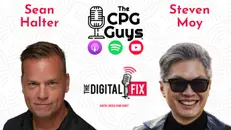
Sean Halter & Steven Moy - The Digital Fix Cross-Over


 Apple Podcasts Apple Podcasts
 Spotify Spotify
 YouTube YouTube
 Overcast Overcast
 Amazon Music Amazon Music
 Audible Audible
 iHeartRadio iHeartRadio
 Castro Castro
 TuneIn TuneIn
 RSS Feed RSS Feed
 Audacy Audacy
 Castbox Castbox
 Fountain Fountain
 Goodpods Goodpods
 PlayerFM PlayerFM
 PocketCasts PocketCasts
 Podcast Addict Podcast Addict
 Podchaser Podchaser
 Podurama Podurama
 Podverse Podverse
 Podyssey Podyssey
The CPG Guys are joined in this crossover with the Digital Fix Podcast by hosts Sean Halter CEO of MiOS Intelligence and Steven Moy, Founder & CEO of MoY.
Follow Sean on LinkedIn at: https://www.linkedin.com/in/seanhalter/
Follow MiOS Intelligence online at: http://miomarketplace.com
Follow Steven on LinkedIn at: https://www.linkedin.com/in/stevenmoy/
Follow MoY online at: https://www.stevenmoy.co/
Follow the Digital Fix podcast on Apple at:
This conversation was recorded in New York City at Advertising Week New York 2026.
CPG Guys Website: http://CPGguys.com
DISCLAIMER: The content in this podcast episode is provided for general informational purposes only. By listening to our episode, you understand that no information contained in this episode should be construed as advice from CPGGUYS, LLC or the individual author, hosts, or guests, nor is it intended to be a substitute for research on any subject matter. Reference to any specific product or entity does not constitute an endorsement or recommendation by CPGGUYS, LLC. The views expressed by guests are their own and their appearance on the program does not imply an endorsement of them or any entity they represent.
CPGGUYS LLC expressly disclaims any and all liability or responsibility for any direct, indirect, incidental, special, consequential or other damages arising out of any individual’s use of, reference to, or inability to use this podcast or the information we presented in this podcast.
Sean (00:00)
You are listening to season five of the Digital Fix. This is Sean Halter with my partner Steven Moy. We're here at Advertising Week and it's a full house. We're doing a double episode in essence. It's like this friends crossover because we're here with the CPG guys. Sri, introduce yourselves.
PVSB (00:15)
Welcome to the CPG Guys podcast. I am your co-host, the adorable PVSB, joined as always by my co-host. He is the father of pop stars, Lara Raj from Katseye and Rhea Raj. the fans, of course, call him Papa Raj. I call him the man known as Sri Sri,.
Sean (00:33)
we're here at advertising week. This whole podcast for us is presented in part by Moy & Halter, as well as Mios for the marketing intelligence operating system. Sri,, Peter, anybody you guys want to plug?
Sri (00:44)
The first thing I'm gonna plug is I want y'all to know we have a second podcast coming shortly. Watch out on LinkedIn for what it is and make sure to tune in because not only will it be just on business, it's gonna be about human adaptability as well. I'll tease and leave it at that.
Sean (00:59)
Steven, kick us off a little bit. What are you doing here at advertising week other than literally you're a couple blocks away and so it only makes sense for you to walk down?
Steven (01:06)
I
got invited to speak. I've been free from speaking and advertising week. always a great platform. this week I wanna hear more about, you know, we talk about it, right? Too many conversations, too many AI related conversation. I c I felt like there's a lot of noise out there and I wanna we wanna see more clarity in terms of people talking about like connected data, humanity talking about it. just too many things going on.
Sean (01:30)
Peter,
for our listeners, you know, our podcast is called Digital Fix. It's mostly about how you're fixing digital out there, what's happening, what adjustments you need to make to it. A lot of our guests are often talking about that. To your point, Steven, AI is constantly part of that. For our listeners who don't know what you guys do, talk a little bit about the the CPG guys podcast itself.
PVSB (01:48)
We we like to think that we are squarely ensconced at the intersection of commerce and technology.
And we're really exploring how brands and retailers engage consumers in a digitally driven world. So I know it's very encompassing, but what we're really trying to understand is all this tech that's available to us and all these new ways in an omnichannel world to execute media and then for consumers to buy products, how do we connect the dots there to help brands invest wisely?
Sri (02:20)
The only other thing Peter I'll add is every now and then we do have an episode on what most of our listeners will say boring, grocery merchandising. Yeah. The oldest form of
PVSB (02:28)
If I
would say retail it exists. And what percentage of traditional center store grocery products are still sold in physical? Yeah, that's
Sri (02:37)
Eighty percent approximately.
PVSB (02:38)
right.
Sri (02:39)
Here's the problem which let's ask you Sean that question because you're talking to brand marketers in not just this podcast but also on the CMO suite. Yeah. And you hidden CMOs. In a world where twenty percent of sales happens online, so accoutremo, eighty percent happens physical, yet the consumers a hundred percent digital, how should brands be dealing with that? What what do you want to see at AdWord?
Sean (03:03)
I I feel like the biggest thing they need to figure out is how to speak to the C suite because the C suite's head is sometimes off in a different direction. They think everybody can be replaced by AI. They think that all we need to do is just pull Claude or chat into, you know, the system. Suddenly the sales are just gonna go up and, you know, the pro the profit margins go up. So to me, I I I think that's where some of those CMOs are struggling right now. That's where a lot of the brand markers I feel like are struggling right now.
Steven (03:28)
Totally. I think you know, people this is kind of like mobile phone, we talk about it, right? Back in the day, right, not too long ago, mobile phone came out. If your brand not normal, a mobile app, you don't exist. Now everything AI. And I think it overly rom romanticize the the emotional connection side. I don't think AI is there. So that's that's why in person, to your point, in store is still very important. The brand needs to connect to you emotionally. A lot of time yourself associate your physical setup with
connect with them giving that brand experience, that digital sale, but mimicking the physical expenses.
Sri (04:04)
But then
Peter, isn't AI based product detail pages a risk then? For
PVSB (04:09)
Listen,
well, in general, what we're gonna see at A at Ad Week this week is a whole lot of talk about AI. Sure. And what we're not gonna see enough of, and I'm sorry, I am the son of two PhDs in economics. To me, it's about the performance and the measurement. I don't know that we're gonna see nearly enough about connecting the investment with the actual outcomes. We're really we're really overwhelmed with all the capabilities that AI can do from a creative perspective.
perspective from a programmatic perspective, but just a little too much grading of your own homework and not enough very understandable ways. Because at the end of the day, these investments against retail media, against creator economy, the decisions are moving up the up the food chain right beyond the CMO to the board level. And if they don't have if the CFO can't explain
What they got for their dollars, those investments aren't gonna get made.
Sri (05:10)
To
that point, Sean, don't brands have to be more experiential.
Sean (05:15)
Yeah, I think they've got to touch everything. It Peter, you also speaking of touching on something you just touched on the fact of what we you know, what we think we'll see at Advertising Week. We were lucky enough to have Ruth, the the head of Advertising Week, on our podcast this week. You can of course listen to the entire episode at digitalfix.com. The one thing she did mention, Peter, which I think was something we wanted to dig in, is just the mental aspect of of all this. The amount of pressure that everybody's feeling at all of these levels to ensure that AI is incorporated, that the to your point the CFO's got what he needs, everybody has what they need.
We're all sitting around these days banging on our computers, yelling at ourselves, because the box that we're talking to is trying to talk back to us. So I do think there are, if you can find them outside of the PR stuff, there are some moments at advertising this week that will speak to some of those itches that do need to be screwed.
PVSB (06:01)
You
know, y you've got leadership of that is, to your point, screaming and yelling about what are we going to do about all this transformation. Now you have w a a couple of different types of CEOs. You can have a CEO that really doesn't have a handle on what's going on and every time
They see something online, an email comes their way, they forward to their CMO, they forward to their CTO and say, what are we doing about this? What are we doing about this? And then what ends up happening is they're like putting out forest fires that are spurring up.
And on the other hand, you can also have a CMO, a CEO rather, who's an engineer who actually understands the nuances between what we use this model LM for and what we use that model LLM for. And that presents an entirely different kind of need from a CMO and a CTO in terms of how they engineer their companies to actually leverage all this transformation that's going on.
Sean (06:58)
What what
are you talking about at advertising week? Let's let's dig in. What are you gonna talk about?
Steven (07:02)
The topic still talk of talking about a debate between always on marketing versus big splash. I said, really? Okay. So that's also an AI component to it. But I do like what Peter is talking about. Too, you know, a lot of time, you know, we we are witnessing the fastest adoption or acceleration of AI innovation, right? Faster than anything I've seen every other week, you got a new model coming in. But two front is very interesting. A lot of people see looking at the marketing automation side of the house, not truly.
Witnessing a paradigm shift. The potential, there's no more click or screen base. You will be using a prom or voice finally in interact. Like ask Chief like 20 years ago, remember that the search engine back in the days. Probably too early about that time, right now for now. But you're witnessing a paradigm shift, like cross-generationally, they're using AI to do tests, daily tests, itinerary planning, the whole nine. To to to find something. But then the second component is a lot of people jumping, calling.
themselves AI company. I would argue they're on rented intelligence because all the RM doesn't belong to them. They should create their own enterprise RM.
PVSB (08:11)
Remember
in the year 2000, the greatest idea that came out of a CMO is let's add.com at the end of our name. Sounds like they're adding let's add
Sean (08:21)
That
one worked. I don't know. Sri,, you're gonna get the next question, but let me just say one thing. I do have to we have to always listen to what Steven is saying, only because when he says models, I never know if he's talking about the girls that he's going out with, if we're talking about AI. I I never know. Go go ahead, Sri,. The time is yours.
Sri (08:36)
My kids are super models now. Stay away from us
Sean (08:39)
The supermodels out there in this AI space? So
Sri (08:42)
One important thing I want to ask all three of you.
PVSB (08:44)
Is
that like speed intelligence? Supermodels or
Sean (08:46)
I don't think those two go together.
Sri (08:48)
Until
I am the supermodels.
PVSB (08:50)
Sorry.
Sri (08:50)
I'd like to go in order we'll let's do Peter first and Steven, then I'd like to get your opinion as you're talk again, you're talking to brands every day. I want to talk about live content creation as well as digital creators. What happens to those two in a world of AI? 'Cause Peter, those conversations are taking place at AdBeek. Not as much as AI. We recorded an episode this morning about digital creators. We're doing one this evening with Amazon on live studios.
Peter, Steven, John, let's just get from
PVSB (09:18)
Biggest
thing that needs to take place is th that democratizing the access
And the connection between brands and creators needs to take place for this to scale. And what that means is you need to work in a marketplace environment where people know how to buy programmatically essentially, but not so automated that the human aspect of creators is completely lost. But if you can bring creators to a marketplace, make it so that a brand can understand how to invest and find them and do so at scale, that is going to
Dramatically increase the share of budgets that brand advertisers are allocating against creators. Right now it's probably about two percent. It should be five times that or more.
Steven (10:08)
I truly agree, right? I we we still working with a lot of brands, so and I talked to they don't they cannot even keep up with the pace like you know, content velocity, right? That though we've been talking about everybody talking about it. Finally you got tools. And I think that's an opportunity creating a more because with the tools we have. Even even in house brand they can crank out content as long as with policy. Right support the governance
Sean (10:30)
To me, I think I feel like everything new is actually old again. This is all just DJ endorsements to to you know to my feeling. It's just DJ endorsements. You're you you're talking to somebody or you're seeing somebody we should call Diplo. It's just talking to somebody who you have a familiarity with that's you know that's talking about a specific product. I think the scale to all of our points, and Sri obviously you'll have a take on that as well. You have two daughters who are both influencers right now. Creators. They're creators, they really are. And so at the end of the day
I think where the technology can help is how do you create those touch points at scale, but also be able to dig into the data because the human element of that is still very involved. Sri,, of anybody, you should probably tell us your opinion on it.
Sri (11:10)
The part I think Adweek is gonna miss on the conversation. It's early. We're recording on Monday morning when Ad Week just launched, so we'll have to see three days later where we landed. I think Steven barely touched the surface of it. We're launching a second podcast where every other episode will be on this, which will be about the human element, the human adaptability. The world is changing eight hundred miles an hour. AI is gonna force change ten times, twenty times, a million times faster than change happened with the iPhone. Total and what does it mean for human beings?
What does it do to stress? You you kind of mentioned that. What does it do to the pace of working? What is it due to cortisol in your brain? What does it do to your job function? What do you have to learn as a result? Are you gonna lose your job? Are you gonna be in a better position? Why are we not having these conversations? I worry about that.
Sean (11:56)
It's monetization. You gotta figure who's gonna pay for the time of it. Steven, you get the next question.
Steven (12:00)
Yeah, next question. Well I I still want to talk about the enterprise L L is that do we have enough ranting
Sean (12:06)
Yes, I do.
Sri (12:07)
Yeah, you got a few more minutes.
Steven (12:09)
intelligence if I were any big brands?
Sri (12:12)
Steven, are you renting or are you giving it away to somebody else?
Steven (12:15)
I'm
still ranting, I wanna create my own other. But like
Sean (12:19)
We've got one in Mills.
Steven (12:20)
I think when you have investment R and D, right? You know, innovation R and D for a corporate brand, I do believe they should cover some dollars and create their own intelligence. You know your customer better than the RLM, like for example, but they they they're not connecting the internal data still.
PVSB (12:37)
The
amount of information that brands have on their consumers just from their help desk where people call in, there's a disconnect. They have a wealth of knowledge. They could turn that into a powerful product to help them invent and innovate to address concerns that consumers have voiced. It's it truly is mind blowing how
disconnected enterprise brands are to the data sets they have and their ability to really
And some of them here, the building we're in right now, Omnicom Build OAI, which is a giant private LLM that takes advantage of the ones that are out there, but it's created its own initiative. That is that's how successful companies will harness the assets they have, the data assets, to build their business.
Sean (13:33)
I'm
gonna self-plug for just a moment because again I own Meos Intelligence. Yeah. And I feel like we've built some elements of some of that, which thank you, which is you know, especially for those brands who who who are not omnicom, especially for those agencies who are not omnicom, who can't everybody necessarily afford to build all those parts. Steven, you and I had a big pitch with a massive global brand this past week for Q4 budgets, and the reality is
That pitch was formulated by taking some of that intelligence out of MIOS and dumping it into some of the LLM systems. So I think that's maybe to me one of those disconnects. Is you're using maybe your own L L or you're using a version of that, you're forgetting the extra fuel from either first party data or from outside party data like us really can can build on that and help you close that business.
Sri (14:16)
my words Peter you heard it here first on the CPG guys along with the digital fix. Someday he's gonna sell that LLM for multiple.
Sean (14:23)
We'll
make money.
PVSB (14:24)
I like it.
my big question for you all and I'll start with Steven is what's not being talked about here?
Steven (14:32)
still believe right people follow the shiny object, like talk about computing, we talk about like all the hardware innovation, CS already touch on it and guarantee everybody talk about like their own you know, all what kind of AI deployment they have. I think connected data. They they why is no one talking about investing connecting data, connect all the dots together. Because you
PVSB (14:51)
Is it because
it's not sexy? I think it's not sexy. But it's meaty. It's
Sri (14:55)
IT stuff.
Steven (14:56)
Yeah. Well but they but you need to run AI, you need data anyway. Yes. So you you don't borrow data, you should have your own data, p put it together.
Sean (15:04)
I'm gonna say what I think they don't talk about enough, which is failures. I think there are not nearly enough sessions at these events with people who are willing to stand up there and say, I failed. Like I failed miserably with this company or that company. And that's what that's where we learn. We don't learn as much from our success. Failures are way more valuable. But I I'd love to
PVSB (15:23)
Steps in our
Sean (15:24)
hear more about that.
Sri (15:31)
I want to go back to the LLM piece again and I think the conversation at the other minute that is missing. I was actually at Austin last week on Wednesday doing a live podcast for STEBO Systems, which is a master d unified master data management system. Yeah. Quite a bit of discussion about you need unified master data management equal to good LLM across multiple functions in a corporate infrastructure private, of course. Good LLM.
Equal to good AI, good outcomes. Bad L equal to bad AI. Remember
PVSB (16:06)
Garbage in, garbage out, is that
Sri (16:07)
what does a bad LM do? Annihilates humans by twenty thirty.
PVSB (16:12)
That's
Sean (16:12)
We don't want that.
PVSB (16:13)
what was said. Let's prevent that. I was gonna go with hallucinations, but you've gone full terminator.
Sri (16:19)
I didn't say it, it was said in the industry by somebody eight X more powerful than I am, million X, whatever. But
PVSB (16:24)
Yeah.
Sri (16:25)
guys we have a responsibility and that's why we're having the discussion. We wanna prevent the human annulation.
Steven (16:30)
No Skynet, please.
Sean (16:31)
Steven, you as always
you get the last word. What what's the word we need to know for this week at Advertising Week? We break.
Steven (16:36)
I think I'd be brave. Be
brace.
Sri (16:40)
Couldn't agree.
Sean (16:41)
Gotta be brave. Listen on behalf of the CPG guys, Shri and Peter. On behalf of, of course, us over here at the Digital Fix, Sean and Steven Moy. We wanna thank you guys for listening to this double episode. First time we've done it. We hope
PVSB (16:52)
Rosso.
Sean (16:52)
be more from there. Thank guys for listening. Enjoy the week.