
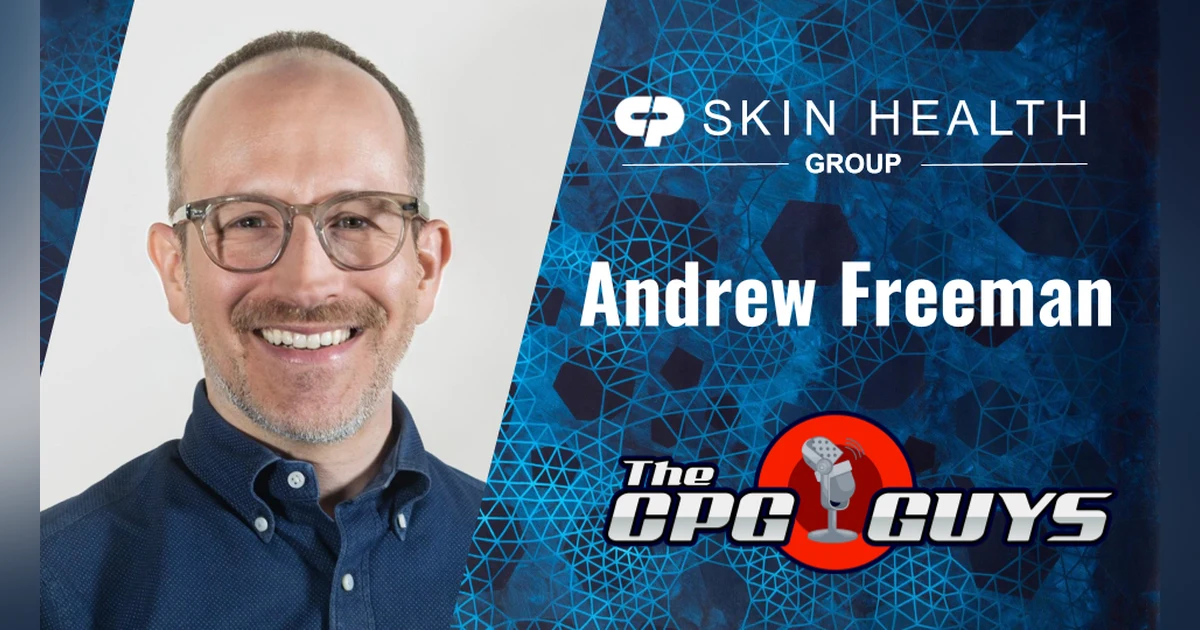
Prestige Skincare with CP Skin Health's Andrew Freeman


 Apple Podcasts Apple Podcasts
  Spotify Spotify
  YouTube YouTube
  Overcast Overcast
  Amazon Music Amazon Music
  Audible Audible
  iHeartRadio iHeartRadio
  Castro Castro
  TuneIn TuneIn
  RSS Feed RSS Feed
  Audacy Audacy
  Castbox Castbox
  Fountain Fountain
  Goodpods Goodpods
  PlayerFM PlayerFM
  PocketCasts PocketCasts
  Podcast Addict Podcast Addict
  Podchaser Podchaser
  Podurama Podurama
  Podverse Podverse
  Podyssey Podyssey
 The CPG Guys are joined in this episode by Andrew Freeman, VP North America eCommerce at CP Skin Health, a division of Colgate-Palmolive Company. Their mission is to be a caring, inclusive, innovative growth company that transforms and protects skin health through professionally endorsed skincare that improves people's lives. Portfolio brands include eltaMD, Filorga and PCA skin.
Follow Andrew Freeman on LinkedIn at: https://www.linkedin.com/in/andrewlfreeman/
Follow CP Skin Health Group on LinkedIn at: https://www.linkedin.com/company/cp-skin-health-group/
Follow CP Skin Health Group online at: https://www.colgatepalmolive.com/en-us/cpskinhealth
Andrew answers these questions:
1) Can you tell us about your role as Vice President of eCommerce at CP Skin Health ? What are your major responsibilities and priorities?
2) What are some of the biggest challenges you face in managing & growing the Skin Health portfolio of brands at CP?
3) Traditional scaled CPG brands have often been challenged by creating a DTC channel. Within your product portfolio, you are selling both through DTC and through retail channels including Amazon and Dermstore. What do you see as the value proposition of both methods?
4) What are some of the core capabilities that you need to master in being able to execute and deliver against a successful end-to-end eCommerce strategy in both DTC and Retail eCommerce?
5) Content is king on the digital shelf. What are some of the content imperatives that you find are driving the success of your brands and how does the content come to life in supporting all of the different digital store fronts where your brands may be found?
6) Retail Media is a major focus of most scaled omni channel brands. The demands from retailers to invest against their media platforms has been increasing significantly over the last 2 years. What is your involvement in ensuring that retail media is a productive channel to help grow your skin health brands? What are you looking for retailers to provide back to you in return for your investments?
7) How do insights play a role in your business activities? What types of data-driven insights drive the eCommerce priorities that you establish for skin health brands at CP?
CPG Guys Website: http://CPGguys.com
FMCG Guys Website: http://FMCGguys.com
CPG Scoop Website: http://CPGscoop.com
NextUp Website: http://NextUpisnow.org/cpgguys
RetailWit Website: http://retailwit.com
DISCLAIMER: The content in this podcast episode is provided for general informational purposes only. By listening to our episode, you understand that no information contained in this episode should be construed as advice from CPGGUYS, LLC or the individual author, hosts, or guests, nor is it intended to be a substitute for research on any subject matter. Reference to any specific product or entity does not constitute an endorsement or recommendation by CPGGUYS, LLC. The views expressed by guests are their own and their appearance on the program does not imply an endorsement of them or any entity they represent.
CPGGUYS LLC expressly disclaims any and all liability or responsibility for any direct, indirect, incidental, special, consequential or other damages arising out of any individual’s use of, reference to, or inability to use this podcast or the information we presented in this podcast.
PVSB:
Hello and welcome to the CPG Guys podcast where we explore the Omnichannel digital journey of brands and retailers. I'm your co-host, PVSB, and when I'm not podcasting, I serve as partnership acceleration lead at Flywheel Digital, the leading man services company that helps brands accelerate e-commerce growth. I'm joined for today's episode by my co-founder of this podcast. I call him the Wizard of Woodland Hills. He's a major influencer and thought leader in Omnichannel Digital World. But more importantly, he is my very best friend. Please join me in welcoming the man known as Sri. Sri, hey, how are you, brother? Welcome.
Sri:
I'm thrilled to have been promoted to Influencer status about that in the industry.
PVSB:
You are.
Sri:
Feels special.
PVSB:
You're like a little
Sri:
Judge
PVSB:
girl
Sri:
is back.
PVSB:
on TikTok, Sri.
Sri:
Judge is back and he's back with a bang.
PVSB:
I know, your boy is like hitting home runs left and right, swatting them out of the park, good stuff. You know, you guys get, you're pulling yourself out of the cellar in the American League East, good for you. Good to have you today, always love exploring the Omni Channel digital world, can't imagine anyone I want to do it with more than you, so thank you. Before we get to our guest, I want to remind our audience, please stop by CPGGuys.com, it's our brand website. You can go there to find links to our podcast on all the major and minor platforms. There's lots of great content. Uh, and you can learn more about the journey that we're undertaking together. And of course, to do that, you should also be on LinkedIn following our LinkedIn page. We publish new and interesting relevant content each and every day of the week, even on the weekend. So if you go there, search for CPG guys, and when you get to our page, click the follow button. You'll be joining over 22,000 other industry professionals that look to us for education and entertainment in the Omnichannel digital world. Also, you might want to subscribe to some of the other podcasts in our family. We've got our friends, Daniel and Efrain over in Europe doing the FMCG guys. We've got CPG Scoop with Risa and Jennifer. And of course, our dear third CPG guy friend. Brian Gildenburg, he's just launched CPG Guys Fast Forward. So all of those are available in the digital liner notes of this podcast episode. And of course, we're very proud to be sponsors of NextUp, formerly known as Network of Executive Women, whose mission it is to advance all women in business and to promote gender equality in the workplace. We're really excited to welcome Lisa Baird into the family as the new CEO. We just recorded an episode with her very recently. And of course, as sponsors, we have 50 memberships. We're giving them away to female entrepreneurs or women who work for companies that aren't already part of NextUp. It's part of what we think is important to advance the capabilities around networking and other educational resources. So drop us a line at contact at cpgguys.com if you'd like to avail yourself of one of these memberships. I think we've given away 15 so far. We've still got 35. We'd like to get them out the door as quickly as possible so people can leverage them. Of course, the digital liner notes of this episode contains the hyperlinks to our site, the other collective podcast sites, as I mentioned, and of course, our LinkedIn page and our landing page on NextUp. So you're on your mobile device, flip over the liner notes, lots of hyperlinks. You don't have to write anything down real easy. Sri, what's the time to do?
Sri:
Let's go CPG guys!
PVSB:
I like it. That's our catchphrase. I don't know. I think we have to work on that. I think we need something a little bit better than that. Something that also doesn't violate any copyright infringements, as has been the case. In any event, it's fairly obvious if you're in our space that no consumables category is more invested in the digital engagement of consumers than the beauty category, right? Digital commerce is a core pillar of growth for just about every manufacturer in the beauty and personal care category. Just last year at the annual CAGNY Conference, Brigitte King, who's the chief digital officer at Colgate Palmolive, shared with industry analysts the digital journey that her company was undertaking across their entire portfolio, setting themselves apart from the other 30 manufacturers that we saw presenting at that enormous industry event. by putting someone in her role, a Chief Digital Officer, in a very prominent presenting position. We're used to seeing the CEO and the CFO talking at this event from these companies. That really called out to us the organization's commitment to engage in consumers in a digital way. Our guest today is the Vice President of North America E-commerce for Colgate-Palmolive's Skin Health Group, overseeing the digital commerce imperatives of brands like PCA Skin, Elta MD, and Folorga. Previously to congregate at Palmolive, he established serious CPG credentials with work at Kimberly-Clark. Mondelez International and Kellogg's among other companies. He's here to share with us his expertise in e-commerce in this transformational omni-channel digital landscape. Please join Srim and me in welcoming to the podcast, Andrew Freeman. Andrew, how are you doing?
Andrew:
doing well. Thank you very much for having me.
PVSB:
Ah, we couldn't be happier to have you join us. I know we met back in March at Shop Talk, and I was very excited to invite you onto the podcast because we haven't had nearly enough conversations here around the beauty and personal care space, and that's one where digital omni-channel really excels. So we're excited to have that conversation. I should also make note of the fact that one company you did work at that I really didn't mention is actually one of my very favorites. I know you worked at Casemate. Now Casemate, for people who don't know, they make among other things custom and designer covers for your mobile phones. Now what I did is when I was at dunnhumby, my key client was Coca-Cola, I literally had custom iPhone covers made for every single brand in Coca-Cola's portfolio so that when I would go in and meet with a brand manager, I would just swap out my iPhone cover. Now I know that sounds like a little kitschy, but I personally estimate that that as a mechanism to connect with the person on the other and other side of the table probably generated an incremental three quarters to a million dollars of revenue a year just by learning that people love to connect with people who are passionate about their business. So Andrew, big fan of that brand, but that's not what we're here to talk about. We're here to talk about the beauty and personal care categories. You know, before we get to the questions Sri and I have prepared for us, why don't you share with our audience a brief overview of the CP Skin Health Group? We'd love to hear about that.
Andrew:
Great, I will absolutely do that. So first, I'm actually gonna read this so that I get it right. It's our mission statement. So CP Skin Health Group is a caring, inclusive, innovative growth company that transforms and protects skin health through professionally endorsed skincare that improves people's lives. So I think it's important to understand why we came up with that mission, what it's about, but to give you some brief background. Colgate-Palmolive entered the skin health space and category back in 2018 when they made several acquisitions. So the companies that make up CP Skin Health Group, as you mentioned prior, are Elta MD, PCA Skin, and Folorga. And the first acquisition, I believe, was Elta MD, followed very quickly by PCA Skin, and then Folorga. So Elta and PCA are professional brands that have been built. through the recommendation of professionals. So truly, LTMD is very much focused on dermatologists and plastic surgeons, whereas PCA Skin is very much an aesthetician focused brand. And then, Florida is a brand that's been built on science and as well as professional credentials, I would say, it's a French company. So it's a little less known in the US. But we really wanted to, you know, Colgate really wanted to make a move into this space because they knew there was a huge opportunity and they understand the professional space. You know, if you look at how Colgate's backgrounds on the Colgate professional and areas like that, as well as Hill's, right? With all the veterinary experience, they really do have depth and breadth of experience in different categories for professional brands. So that had a lot to do with why they went into that space. I can tell you all three brands are incredible brands in each of their own very specific areas. Elta MD is all about sun care. They have great skin care as well, but they're best known for sun care products. PCA Skin is really incredible daily use products, so a lot of, you name it, all sorts of serums, every kind of serum you can think of. We're really well known for our hyaluronic acid boosting serum, and there are a myriad of other serums that you can buy from them. but they're also really well known for their chemical peels, which are done in an esthetician space within a studio, like a medical spa or an actual esthetician studio space. So that's really where they became very well known. And then Folorga has always been more around prestige and anti-aging. And I can tell you from using a few of the products, it definitely helps.
PVSB:
I think Sri and I may need to avail ourselves of that as well. We're not getting any younger. So I know I'm speaking for you Sri, but I'm going to do that. Hey, thank you, Andrew. That was actually very helpful. We're going to include in the digital liner notes of this episode links to your LinkedIn profile, CP Skin Health's group LinkedIn page, and of course, your corporate micro site on Colgate-Palmolive. 90% plus of the people who listen to this episode do so on a mobile device. So no need to write this all down. Just toggle over to the liner notes and click the hyperlinks and you can, you can browse while you're listening to this podcast. People can multitask. It's really, really terrific. Okay. So let's get to the questions we've prepared. Sri and I are really excited, as I mentioned, to talk to you about all this. I'm going to just start off with your role there, right? Why don't you share with our audience a little bit more about your role as Vice President of E-Commerce at CP Skin Health. What are your major responsibilities and what do you see as being like the priorities that you are undertaking to help drive growth of these brands that have been acquired and put into this collective group?
Andrew:
Yeah, so from my perspective, my role is really around, I have sort of responsibility over our traditional e-commerce channels, right? So think about Amazon, Derm Store, different more traditional retail e-commerce channels. We also have a D2C channel, which as you have sort of alluded to within my channel, within my space category is a very big channel, right? So it's not a small channel. It's a legitimate business channel and it has to be well developed and fostered. We also own, basically we have B2B, which is internal. We have B2B2C that we're doing. We've got a lot of different platforms that we've launched and that we are in the process of continuing to launch. So basically anything that would be a digital commerce initiative winds up rolling through my organization.
Sri:
Awesome, thank you so much for that intro and what the organization actually does. So I'm going to jump right in to the world of beauty and especially in this digital omni-channel world that you deal with. What are challenges that you're taking head on that you have to manage through in growing this portfolio that you just described that's under you now online?
Andrew:
So it's interesting, right? What I will say is the challenges never stop and they're always different. So I think what I've learned having now been through multiple categories of consumer goods is that that's consistent, right? The challenges are never gonna stop. You know, can't go into all of them and what they are, but I know like a great example is last year, most categories were having challenges on Amazon around how much inventory Amazon was choosing to keep in stock. So that was a challenge for us, right? In addition to that, you know, we've got the challenges of right now, we're trying to launch a new direct to consumer website for PCA Skin and it's, you know, delayed and it's been delayed almost a month already and probably is gonna hit a two month delay until it gets live. They're just, it's constantly, you know, as I like to say to my team, I feel like we're always firefighting a bit on something. You know, and this year there's some new challenges with Amazon. You know, now they've gotten back to better inventory status, but what we've noticed as of late, which has been really interesting, and it'll be interesting to see if anyone has comments on this, you know, to the podcast, but we're seeing, you know, less, we're seeing 3P win a little bit more frequently than it used to be the case. And it's interesting though for us because we happen to live in the only gated category that Amazon has. Which means... It's unique, right? Most any other CPG, their 3P is someone they don't know, or it's a competitor, or it's someone who's basically trying to sell at a definite price and take, you know, siphon off customers to them. In our category, we actually own the 3P relationship. So it's very, very unique. We approve who becomes a 3P, and, you know, puts us in a really unique position. So even though we've been losing a little bit more... The three P's at least my team still sells to. So ultimately it all comes back to me and the e-commerce organization, which is I know very unusual, but it's still a challenge, right? Because ultimately we wanna help Amazon, we wanna support them in a one P way. So it's another challenge we're dealing with. And then I think, you know, on the B2B side, a lot of it is around adoption. So we have a really large field sales organization that sells to our professionals. And it's interesting, at Kimberly Clark and at Kellogg's when I was rolling out B2B in both of those companies as well. You always get this sort of pushback on the strategy and the idea because sales reps feel that they have to be there. They have to go in in order to actually drive that revenue and make sure they increase the sale amount. What's been really interesting is throughout my career when we've launched B2B, we have found that that is not necessary. And in fact, it has always been incremental on top of what they get. But it's another area of challenge because we're in the process of rolling out the B2B portals. And it's a lot of change management. It's a lot of strategy calls with our sales leadership and getting them to understand why this isn't going to take business away. It's going to be additive, how it helps people. So I would say it varies by the channel I deal with, but we have challenges in every area of our business today. But it's still all
PVSB:
Yeah,
Andrew:
growing.
PVSB:
I think...
Andrew:
That's the important part.
Sri:
The interesting thing Andrew, so I do have a small follow up for you here, the 3P stuff, right? It's the first time I've been around ecommerce for a while, a decade. It's the first time I've heard of somebody owning their own 3P. So how do you phrase this? You win when you lose or you lose when you win.
Andrew:
Yeah, I mean, pretty much. The way it becomes a little bit challenging in my org, right, is my org is sort of designed where there's one team that's Amazon, there's one team that's what we call e-tail, which is the rest of retail e-commerce. So our three P's are all retail e-commerce people. So think of, like, Lovely Skin. I'm trying to think of a few of the different term store, a few of these other companies that are our three P's. So they're e-tail customers. So the problem, it's twofold, right? One is Amazon's losing the 1P revenue. Yes, of course Amazon makes money 3P as well. And quite frankly, I don't think any of us truly understand which margin is better for them, but I'm gonna guess 1P is still a better margin for them altogether. But on my side of the business, you know, I've got two teams, one team loses while the other team gains. And usually it's, you know, we try to balance those things out. So it's an interesting. It's an interesting challenge that way. It's a challenge within my own team a little bit in keeping things stable. But to me, it definitely is we win either way, right? The reality is if a 3P wins, we win holistically as CP Skin Health. And that's the most important thing. And that's sort of how we look at it. And that's sort of how I sort of counsel my team is that there are gonna be some times that other channels are gonna win more than your channel will. And it just... You know, it doesn't say anything. It's not a negative. It doesn't say that they're not doing something right. It doesn't say anything like that because the strategy is very strong. If our strategy at Amazon wasn't as strong as it was, we wouldn't be driving the revenue that is unfortunately going to the three piece right now. So it's definitely interesting.
PVSB:
Thank you for that, Andrew. I think what I heard that was really interesting is I was unfamiliar that there were gated categories within Amazon where you could control that. But even in that case, what I hear you saying is that sometimes the 3P seller is winning the buy box. And you need to reconcile with why is that okay from a broader standpoint? And how do you want to let them do that to some degree? Yes?
Andrew:
Yes, yes. And that is something that we talk about, right? But we need them, right? There are times that we go out of stock on the 1P side, but our 3Ps have additional stock. And ultimately, when you think about the consumer's experience with the brand, we want them to be able to get our products, regardless of whether it's Amazon 1P or whether it's coming from Lovely Skin, Dermstore, et cetera, like we don't care. We just want the consumer to be happy and get the product where they want. And the
PVSB:
I
Andrew:
good
PVSB:
love
Andrew:
thing
PVSB:
that.
Andrew:
is pricing is consistent, right? So the pricing is always consistent. You don't see variations in our pricing model. So the Amazon is always the same price as all of our three P's and vice versa.
PVSB:
Okay, brilliant. All right, so you made mention earlier that unlike with other brands, your D2C offering is a viable and healthy and meaningful component of your entire business model. You know, traditional scaled CPG brands have often been challenged by creating a D2C channel. You know, you're selling through D2C, but you're also, as you mentioned, selling through the likes of Amazon and 3P mechanisms like Dermstore and what have you, can you just articulate what you see as being the value proposition of D2C versus working through other retailers and how you reconcile all of that in your go-to-market strategy?
Andrew:
Yeah, absolutely. So it's interesting. So I'm going to, Elta MD, I'm going to leverage that as the example. So there are two things to keep in mind. As professional brands with professional recommendation, there's an advantage, an inherent advantage to D2C because we can tie the professional to our direct consumer experience, which is what we've done. So if you look at the LTDM website and you go to purchase a product, you do have to set up an account. It's not an option. You cannot check out as a guest and you do need to register with a dermatologist or select a dermatologist in that process. Most people do select their actual dermatologist or plastic surgeon. Whoever is their professional that has made the prior recommendation. By doing that, we basically have rewards that we provide to the professionals based on the amount. you know, it's a dollar to point kind of thing, where it's based on how much people are purchasing on the site, they get a percentage in points, which then are redeemable or are redeemed for, you know, rewards essentially that we provide to them as a company. It was critically important when we decided to launch the direct to consumer business that we did this. We, you know, we call it the virtuous circle, right? Where Elta MD is in the center. and all of our touch points, whether it's the doctor's office, whether it's direct to consumer, whether it's Amazon, it's a virtual circle, a virtuous circle, and it allows us to sort of be in the middle connecting everything together with our professionals. So in that case, it works really well. And by the way, it's the same way with the site that's relaunching for PCA Skin, because that is also a professionally recommended business. Folorg is a little bit different as an example. because Folorga is truly a prestige direct brand, a retail brand. So that one does not require that you set up an account or that you nominate a professional. You can simply just go through the normal checkout process and purchase product. Now, what I will say is to me, it's category based, right? My category, I'm lucky, right? I'm in a category where it's profitable. It's a real business model. I obviously can't talk numbers on it as you would well know. but it is a real piece of our business, of our total digital business. And it's growing rapidly. What's really interesting to me, and I found this to be, it's really interesting. It just is, I wasn't expecting this, but we have not seen any reductions in growth or anything from any of our other channels. This was truly additive to our business, which was really interesting. It shows that there are consumers that would rather buy from the brand, right? They don't trust Amazon. We see it all the time in the ratings and reviews on Amazon where people go, is this real Elta MD product? Is this real PCA skin product? People to this day still question that when it's a premium product on Amazon. And so that's one of those areas where it's been really eye-opening, I would say, because we definitely thought we would be pulling some business away and it has truly been additive to our business overall. When I look at other CPG categories I've been in, so for example, food, when I was at Kellogg's, we actually did do D2C. We had a few different D2C businesses we were running, but it was a very different concept there. It wasn't about making it a business that made money, right? It needed to break even and cover its expenses, but it wasn't about it actually turning a profit. The whole goal there was data. It was all about data. How much data can you get? 1P data on consumers. data about consumer preference, data on flavor preference. It was so much
PVSB:
Yep.
Andrew:
different components that we were gathering and then we were feeding it back into the innovation side of the business. And they used information from it to actually create new products that actually then became full products that went into all of our retail partners, Target, Walmart, Amazon, et cetera. So it was a really different point of view and perspective on what D2C does for a business. I loved that when we were building out the strategy because I thought it was the right strategy is that this is like an innovation pipeline and that's how you can look at it. So I really do believe it is very much channel-based but there are opportunities. You just have to go into it with the right point of reference. Like, what are you trying to do? Is this profit? Is this data? Is this innovation? What is it?
PVSB:
So before I hand it over to Sri, I'm really intrigued by, on the sites where you mentioned that you connect the consumer to their physician or professional associated with that. Todd, can you just quickly share with us, like what is the, you see as the benefit of that and how do the professionals play a role in ultimately driving the sales through your DTC site as well?
Andrew:
So the benefit from our perspective was that the professionals really want to feel like they are maintaining the relationship with their patient,
PVSB:
Okay.
Andrew:
right? And that they're not losing that component. Long term, we have not done this yet, but long term, the goal is to be able to share certain data with our professionals, right? So that they can get like, when you go through the registration process, we actually ask you to check to select, there's a checkbox. Is this a new professional? So long-term, we're gathering all that data and we have it in all of our terms and conditions that we are allowed to hold that data and that we can share that data with our partners. Well, our partners are all of our professionals. So long-term, we could actually leverage that data and give it to them and say, hey, these are all new customers that have been coming, that have not seen you before. You guys should pull this into your CRM and email them so that you can start... speaking with them directly and have a direct relationship. Like I said, it's a lot more complicated to do that part of it. So we have not gotten there yet. That is more long-term strategy and we set it up so that we would be able to do that. And it also comes back to, you know, you think about, I talked about B2B portals and that's sort of this holistic 360 degree view of a patient all the way from the doctor to us back that they start to build this true view. We're not there yet. What we're launching initially is for them to be able to order, for them to manage their invoicing, easy things that we don't have today. That's what we're building first, but we have a full strategy and roadmap that's around how do we make this fully inclusive? How do we turn this into something that's meaningful for our professionals and makes them want to work with us and to look at us as their preferred vendor?
Sri:
So Andrew, the one thing I did want to go back to was you mentioned pricing 1P3P being similar. Are D2C pricing also similar with 1P3P?
Andrew:
Yes, so we have for our brands, for CP Skin Health, we have map policies in place. So everyone stays within the minimum advertised, pricing policy that we have for our products.
Sri:
So now let's jump into making these channels successful. So the first thing that comes to mind typically Peter and I would ask is it search, is it content? But let's turn the table over to you. What is the series of core capabilities that one needs to be really good at in being able to execute and deliver against this sort of end to end, especially being consistent with pricing is one of the just one such outcome you're seeking in both DTC as well as retail now that Amazon is a big partner of yours 1p and 3p. Is 1p and 3p any different?
Andrew:
So I'll start with what the capabilities are, right? And I think this goes back really well and what I've dealt with in my career. And Sri, I know you've known me for a while, so you know some of what I've done. I built out what Digital Shelf was globally at Kellogg's, right? I had a lot to do with that also at Mondelies. And even before that, I had a lot to do with it at Kimberly Clark. So to me, it's all content, content, content, especially in my category. Like that is... the golden ticket is your content. And it has to be good, it has to be compelling. It has to be robust enough that a consumer cannot need to be at a beauty counter or with their dermatologist to make a decision on a product, right? And that's what's really important to us. So honestly, whether it's my DTC channel, whether it's my Amazon channel, whether it's an etail channel, in all those, and even in our professional channels, right? For our B2B, it's all about developing really robust content for both above the fold and below the fold, and making sure that it helps educate the consumer. Because we are a premium product. Our price points are premium, right? We are far more expensive than other people in our category for our products. And you have to have a legitimate reason to be able to be more expensive. And that's what we're doing, right? We're explaining the efficacies of the product. We're explaining why our, for example, hyaluronic acid is better than other. companies hyaluronic acids and why we're known for it. All of that is really, really important. With ELTA-MD, we are not only just the dermatologist's number one recommended, but most used brand by actual dermatologists and plastic surgeons. So I would actually challenge you, more than likely, especially Sri, I'm gonna guess in your household, they will know what ELTA-MD is. They have heard of it, they have seen it, they have probably heard of it from dermatologists, right? And you know. things like that. But it's definitely a really well-known brand in that regard. For men, it's a lot lesser known, right? Because we don't tend to do as much with our skin as women do. It is growing exponentially in that area as well, but yeah, I mean, so ultimately, first and foremost, it's content. So I always will harp back to that as basically the number one capability that you have to be best in class for. You know, outside of content, you know, of course, it's pricing and consistency. You want to have the right brand experience and make sure the brands are being represented in the right way, because brand is really very important in premium beauty. So you can't have the brand incorrectly represented. We do a lot of work on imagery. We do a lot of work. I mean, we just, we're launching a whole new look and feel to all of our products. We're just starting to roll it out. So we're just literally Amazon just started being updated this week with the new look and feel of some of our major products because we're changing our packaging. We're changing the way things look for L to MD. So that requires a full sort of rebrand experience and how it looks. We'll be doing the same with below the fold. We actually get a lot of traffic through our brand store, which I know is kind of unusual because in CPG, a lot of times the brand store is kind of ignored or it's just done because Amazon tells us to do it, right? but it's different in our category. We actually just launched, Amazon is in beta right now for it. We just launched a product finder that is on our brand store, which is really, really cool. It allows people to walk through a series of questions, which limits down their products and helps them come up with a regimen. So we already did that in direct to consumer. It has been wildly successful for us there. We use a company called SalesFloor. They have a product that we leverage and it is an artificial intelligence driven bot that communicates with the consumer. On each site is a different name. We've got Elise, we've got Margo. Okay, we have a third one and I can't remember her name right now. But the point is we use a separate one in each one of our brands and the lift in all the major KPIs is significant by using that. Because again, it goes down to the education piece. Everything boils down to education in our space and in our category. And if you can educate the consumer on what the right regimen is, why it's the right regimen for them, and make them feel comfortable in buying it, you're gonna sell it, right? So basically all orders that flow through those bots flow through at a higher average order value, more products per order, higher level of customer satisfaction overall with the products they've purchased, et cetera. because they really have gotten what is more of a custom tailored product for themselves. Or a regimen, excuse me, for themselves. But we just launched, Amazon has it as a beta. So we just launched it on EltaMD. We only got it on one brand so far, but we launched it yesterday, so we're waiting to see how it's going to perform.
Sri:
Peter,
PVSB:
A reminder.
Sri:
I do have one quick thing before we move on. And that is, most people who come here on the CPG guys do say content is still, after a whole decade of doing this, I still hear content is one of the most important facets of being successful. You literally called it number one, right? So I'm curious to see in the content world, are y'all starting to use tech like AI to generate it, to get, especially for scale, or are you still doing content the old way, things of that nature and this is not good or bad. I'm just curious to see if AI has arrived yet in the industry.
Andrew:
And I'm glad you asked that, because this was my favorite thing to discuss after Shop Talk, right? I was on a podcast there with Don Brett and I discussed this concept. And generative AI, right? It is the future. I 100% believe it's the future. I 100% believe when we go back to Shop Talk next year, everything's gonna be about generative AI in some form or fashion. All the technology companies were gonna see the new ones. the big ones and everyone that already existed will be about how generative AI is going into their platform. But today, are we using it? No. Are we absolutely evaluating it? Yes, 100%. We're already doing testing with it just to see what it can produce. And it's really compelling what it's able to do. It's really interesting to see it. I will give you an example. We're not leveraging it, but it is available to try out, like in Shopify, for example, because that's the platform we're leveraging. they just rolled out generative AI, right? For helping you produce, like you were mentioning, Sri, content at scale and to make it easier. Ultimately, right now, we are very much still, I will say, hands on keyboards, right? I mean, we do leverage partners for it. So we work with OneSpace, we've worked with a number of different companies, right? Colgate has a bunch of different relationships and that definitely helps us in creating the optimized content and making sure that we reoptimize. at least twice a year. Our business is very seasonal, so we have reasons to re-optimize our copy and content. And also it's just search intent changes. Every year what people are searching for changes, especially in beauty. So you have to make sure you understand what are people looking for this year so that we can update content accordingly and continue to drive search on Amazon, search in Google, search on every major.
PVSB:
A reminder audience that today Sri and I have the pleasure to speak with Andrew Freeman, Vice President of North America E-commerce in the CP Skin Health Group, a division of Colgate Palmolive. Okay, so let's double click down into content because it was the top of your list for priorities. You know, I want to understand in more detail some of the content imperatives that you're finding that are particularly driving the success of your brands and how do you make that come to life? What works on Amazon doesn't necessarily work on DermStore and how you structured your own DTC with Shopify. I'm like, how do you manage all of that? It's really kind of an interesting need because, like I said, not everything works the same way at each retailer.
Andrew:
Correct. And it's a bit complicated still. I'm not gonna lie and say that I have some easy, streamlined way to make it all work. Cause we've all been looking for that, by the way, anyone who's had anything to do with digital shelf in their career, we've all been on that same path of how can we simplify, how can we get this automated? How do we automate? How do we automate? Everything is always talking about automation. So today, what I would say is, yes, on our brand.com websites, That is a little bit more brand centric content. We also put a lot more content that's more medical professional there because the consumers we have found that shop on our direct to consumer sites tend to be brand loyalists, right? And these are people who are really picky about skincare. They wanna know every active ingredient that's in every product that we have, right? Because they know what those do to their skin. They know whether they're good or bad for them. They want all of that data and information. Amazon, they don't want that. And quite frankly, it wouldn't help on Amazon because you're dealing with a very different consumer on Amazon. A lot of consumers that come to our Amazon, it's people that have seen the product on TikTok, people that have seen the product on Instagram. And of course, Instagram and TikTok link back to our direct to consumer sites. But there are a lot of people, especially younger people, who would prefer just to buy on Amazon because they can get multiple products at one time. and they feel much more comfortable that our products are authentic. We state that they're authentic on our websites. So they just feel more comfortable going there and getting what they need or going to DermStore and getting what they need, going to Lovely Skin and getting what they need. We've got a bunch of, like I said, third parties that we work with, or I should say, etail partners that we work with that sell the product for us. So from that perspective, I think it's just, it's a little bit different. Like literally it is different by... buy etail partner, but that should be no, like it's different on Walmart, right? I remember this from Kellogg's, what you put on Walmart is not what you put on Amazon. What you put on Target is not what you put on Walmart. So it kind of becomes that whole thing of management. Now I will say this, we give content to our partners and some of our partners are owned by very brilliant physicians. So they have a very specific point of view on how they want their product represented, and they want that voice in their product descriptions. So they will rewrite what we provide to them. Ultimately, we are not giving them necessarily what winds up getting posted on their sites. They will make changes to it. The one piece that you'll see that's very consistent is our imagery, because we do prefer that our products are shown in a very specific way, and we don't really... want people to deviate from that. We have one partner that does all their own imagery. We're okay with that because we've worked with them on how we want things to look from their standpoint. But generally speaking, the images are the same. You will see that being very consistent. And again, to us, that's important because it's visual consistency of our brands. And we don't want to see that not be portrayed accurately on someone's website.
Sri:
Makes sense. Now I'm going to go Peter where no one has dared to go before and that is our favorite
PVSB:
Oh,
Sri:
word,
PVSB:
please.
Sri:
retail media. Retail media. So obviously Andrew, I'm not going to repeat the obvious here, retail media, hardest thing since sliced bread in 2023 in our entire industry. Demands that are coming through in terms of what to invest against all these media platforms has changed significantly, increased significantly as well over the last two years. How are you looking at the retail media making sure that you're doing the right thing by every platform you choose to do business in and Overall, what ROI you're expecting
Andrew:
So it's interesting for us. It's a little different, which is good. The majority of our retail media is gonna be in Amazon, of course, as you would expect. Our other partners are all smaller, right? And they have not gotten into it yet. So it's interesting. I don't wanna say too much about that because I don't want them to suddenly decide maybe they should. Because for me, that's much more financially savvy, right? It's better for me that they're not. I mean, Sri, what I wanna always ask is, Like retail media has become this huge thing, but that's because everyone has decided because Amazon made so much money in it that they all need to do it too, right? That's why Walmart has to have a media group. That's why Target has to have a media group. That's why, I mean, you name it. Kroger has to have a media group. They all do because they see it as another revenue stream. It legitimately is a new pillar to their business model because they make so little in the products they actually sell. So they have to have this other way to generate revenue and profitability for their shareholders. So that's sort of why they've gone down that path. I don't think it's necessarily bad. I just am, I think lucky that I don't have to deal with it quite as much as people in other categories have to deal with it. Because trust me, I know the pain, right? I have friends who are on the hillside, the Colgate side. They have to do a lot more retail media because they have a lot more partners that require investment in retail media. We still have to be really smart, right, about our investments with Amazon. I will say it's really interesting being again in this category in Amazon. There are a lot more betas that come to us, right? Like I just described the product finder that came through Amazon advertising to us. We get a lot of different opportunities through Amazon advertising that other categories don't necessarily get access to, or that they don't do yet in those categories because they feel, I think because profitability is so much higher in our category, it makes sense to start there. see if it works, see if it drives revenue, and then roll it into other categories. So they've tested a lot of different video formats with us and things like that for video search results, et cetera, that they aren't necessarily doing at this point in time in other categories. So that's been really interesting and very different for me, obviously, having worked in more traditional CPG companies in the past. But overall for me, It's a little bit one sided, right? The conversation that I have today and then leveraging the right tools and capabilities, you know, to help us optimize in those areas. And that's what I would say. I mean, a lot of it is around optimization and around, you know, making sure you have the right provider and partner that you're working with that works well for you. I do think by the way, that that won't be consistent for everybody for each category. I think some... providers are better than others, depending on the category you're in. And when I'm talking about that, you know, it's like Commerce IQ, people like that, right? That it varies by how they work in category. I know they would tell you they work across every category, right? But I think some categories there, each of these different companies are better at, like PacView, et cetera. I think they have niche areas they're better in.
PVSB:
All right, so let's shift from retail media to insights. I'd love to understand how they play a role in your business activities. Like what kind of data-driven insights are really driving your e-commerce priorities and activations that you've established within the Skin Health Group?
Andrew:
I think the interesting area that we have that we can talk about, I mean, obviously we're going to look at all areas, right? But D to C, because you really own all the data. You really have very unlimited data sources. When you think about it, you're able to stitch so much more together, right? You're able to stitch together your CRM and see all the way through from the email that's sent to the revenue that's driven, right? So it's, it's a different, the insights that you can pull are definitely. And we leverage those insights within the organization for different reasons. I will routinely tell my Amazon team, right, talk with my D2C lead for this brand and find out how this is working right now, a specific KPI, because they're trying to understand oftentimes, I'll give this as the example, oftentimes we launch our D2C in advance of Amazon, for example, because the D2C is tied to pro, right? It's tied to the professional. So we'll launch a new product there first. So we can glean learnings from that, from the data and the insights that we have available to us from our direct to consumer business, to help us understand how we might want to launch something on Amazon. It gives us more detail, right? We understand when we're talking to Commerce IQ, these are the groups we want to go against. These are the searches we're seeing come up on our direct to consumer business, right? It gives us a lot more data points than I think most people have. when they're going into it. A lot of times, you know, when you think, when I would think about prior companies, you were working with, hey, we're gonna look in Stackline and try to build what this would look like, right? We wanna try to figure out how this new type of product will perform based on competitors who've launched similar types of products, right? And also your insights teams. And, you know, also in most other categories, you have more data from Nielsen, for example, and I, you know, companies like that where we definitely have a deficit in my category because we're professional. And, you know, think about it. All the data is sitting with all these doctors offices, all these estheticians. It's not sitting with Walmart that's been scanned. So it's like, we don't have that visibility that other categories have. But we, I mean, there are other groups that get data, but it's all self-reported. Everything in our category is self-reported data. So the insights, when you think about professional insights are a little bit more difficult. They're a little bit more nuanced. And I would definitely say, you know, different than when we look at our direct consumer insights and the data that we can pull there. But it's a big part of our business. We are really data-driven. My CEO, she is very big on data. She understands the data. I mean, I'll be honest, like I still learn things from her every day. Like we had a conversation this week on something. and she explained how to look at something in a certain way. And I'm like, why didn't I think of that? I mean, and I told her, I said, that's incredible. That's easy. I should have thought about that myself. So our organization overall is very data-driven. We're a small company overall. Like CP Skin Health Group is two to 300 people overall globally. So it's not a huge company or business when you think about the size of Colgate-Palmolive. But we do have two data scientists that are full-time in our business. And they, you know, so like I said, we're leveraging what we have access to. I even use it with our partners. Some of our small partners truly do not have forecasting or any of that in their businesses today. So my team has to go in and look at sell in, sell out, and sort of figure out how to drive those businesses and forecast for the businesses and help, because they're literally forecasting for those businesses. They're talking to the partner. and saying you really need to order this much because right now your inventory's here, your sell through is this much, so your weeks of cover are here. If you don't order now, you won't have it in time. You're gonna go out of stock. So it's interesting. We're a little different, I think, than most consumer goods businesses today.
Sri:
one easy question for you literally 30 seconds before we wrap up on this episode and that is I should have asked you earlier but does one need a prescription from a professional to buy on Amazon or is this a straightforward buy?
Andrew:
Nope, straightforward buy. So Amazon is, the reason we went into Amazon
Sri:
Thank you.
Andrew:
was twofold, one, gated, so we can control the three P's and control the price. Well, really that's one and two, right? One, gated. Two, we can control the three P's and the pricing because prior to going into Amazon, which by the way, for all these brands was prior to acquisition by Colgate, it was the wild west on Amazon. The three P's were driving prices down more than 50%. So they... The germs and the plastics at the time literally said, please own it. We want you guys to own it so that we don't have to worry about all these pricing discrepancies and have our customers come in and say, we wanna return this because we can buy it on Amazon for half the price. So a lot of it was that. It really did have a lot to do with that. And in the end, it did very frankly, not have a professional tied to it, which is a little bit more unusual, but our professionals... asked us to do it. So it was a very unique situation.
PVSB:
All right. Well, I wanna remind our audience that you should visit cpgguys.com where you can find all of our content. And if you think you or your company has some thought leadership to contribute, if you think you or your company has some thought leadership to contribute to this ongoing community discussion, drop us an email at contact at cpgguys.com and maybe you can join us on the podcast for a future conversation. And of course, Please, when you're on our site, go to the rating and review section, leave us some feedback. We really appreciate it. And of course, we're very grateful for the 22,000 plus followers we have on LinkedIn. Industry professionals are looking to get educated and entertained at the same time. Hey, Andrew, Srin, I really want to thank you for taking the time to come on the podcast and break down how the CP Skin Health Group is tackling e-commerce. both from a D to C and a 1P and 3P perspective. This is really exciting. Thank you for joining us today.
Andrew:
Yeah, thank you very much for having me. I enjoyed it.